

Weather: Cloudy mornings, sunny afternoons and increasingly cold winds. Temperatures ranging from 10°C to 13°C.
From Prague to Vienna – A New Capital Awaits
I set off for Vienna on a FlixBus, leaving Prague behind after several days of exploring the Czech capital. The tram took me most of the way to the central bus station, where I boarded the bus for the journey south into Austria.
Prague had been overcast and rather dull, but as we crossed the border, the clouds began to clear, and sunshine spread across the countryside. It was still chilly, with temperatures reaching only 13°C, but the change in weather was welcome.
Vienna was another important stop on my journey through Europe’s capital cities, and I was looking forward to exploring somewhere so rich in history, architecture, music and imperial grandeur.
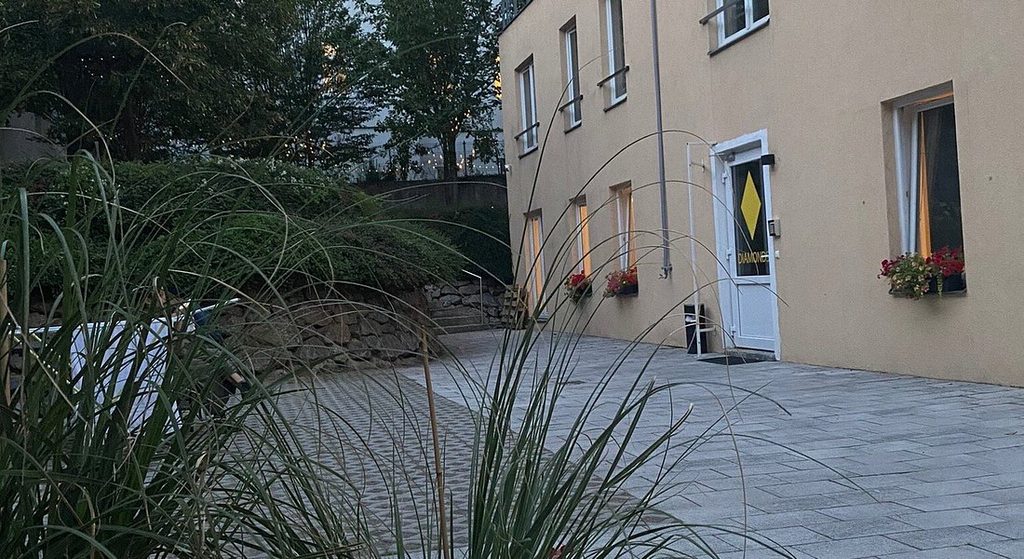
Finding my hostel was straightforward enough, but getting inside was another matter.
I had been given an entrance code, but no matter what I did, the door refused to open. After some confusion and communication with the receptionist, I discovered that I needed to press the tick symbol after entering the code. Such a simple thing, but not particularly obvious when you’ve just arrived in an unfamiliar city.
Once settled, I went looking for something to eat and found a nearby shop selling Döner kebabs. Unfortunately, mine was rather dry, and I ended up leaving some of the bread behind. European kebabs can be quite substantial, and perhaps next time I’ll choose something a little different.
The remainder of the evening was spent catching up on my travel blog and planning the next day’s adventures.
Before I knew it, midnight had come and gone.
One thing I’ve discovered during this journey is just how demanding maintaining a travel blog can become. After spending an entire day walking around a city, the prospect of sitting down for several more hours to write, research and organise photographs isn’t always appealing.
Sometimes you simply want to put your feet up and relax.
There have been moments when I’ve questioned whether I should continue writing, but then I remind myself why I started. I want to share these experiences, particularly with older people who might be considering stepping outside their comfort zone and discovering the world for themselves.
So, onwards we go!
Vienna City Hall – A Gothic Masterpiece
My first major destination was Vienna City Hall, or Rathaus, one of the city’s most impressive architectural landmarks.
I had hoped to explore the interior, particularly the grand halls and staircases, but unfortunately, the building was closed to casual visitors when I arrived.
Nevertheless, even from the outside, the building is extraordinary.
Standing proudly along Vienna’s famous Ringstrasse, this magnificent neo-Gothic structure dominates the surrounding square.
Its five towers rise above the intricate stonework, with the tallest crowned by the famous Rathausmann, the armoured figure that has watched over the city since 1882.
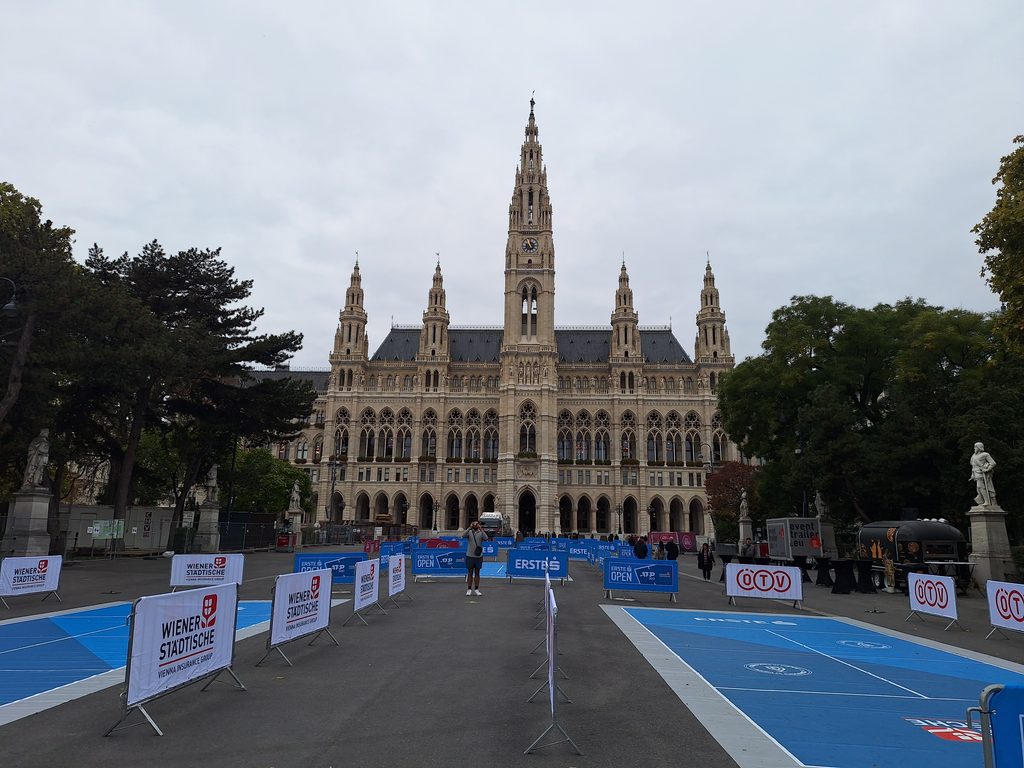
The façade is covered in beautifully carved figures representing emperors, historical personalities and virtues such as Power and Justice.
Among them is Vindobona, representing Vienna’s ancient Roman beginnings.
I spent time walking slowly around the building, studying the architecture and imagining the generations of people who have passed through its doors.
Vienna is one of those cities where almost every building seems to have a story waiting to be discovered.
I learned that free guided tours of City Hall were available in German on Mondays, Wednesdays and Fridays at 1 pm, so I made plans to return.
Senior Travel Tip: If you want to join a free City Hall tour, check the latest arrangements before visiting. When I was there, tickets had to be collected from 9 am on the day, and they disappeared quickly. Audio guides were available in several languages, with a passport required as a deposit.
Burgtheater – Vienna’s Legendary Stage
From City Hall, I crossed the square to the Burgtheater, another magnificent building that had caught my attention.
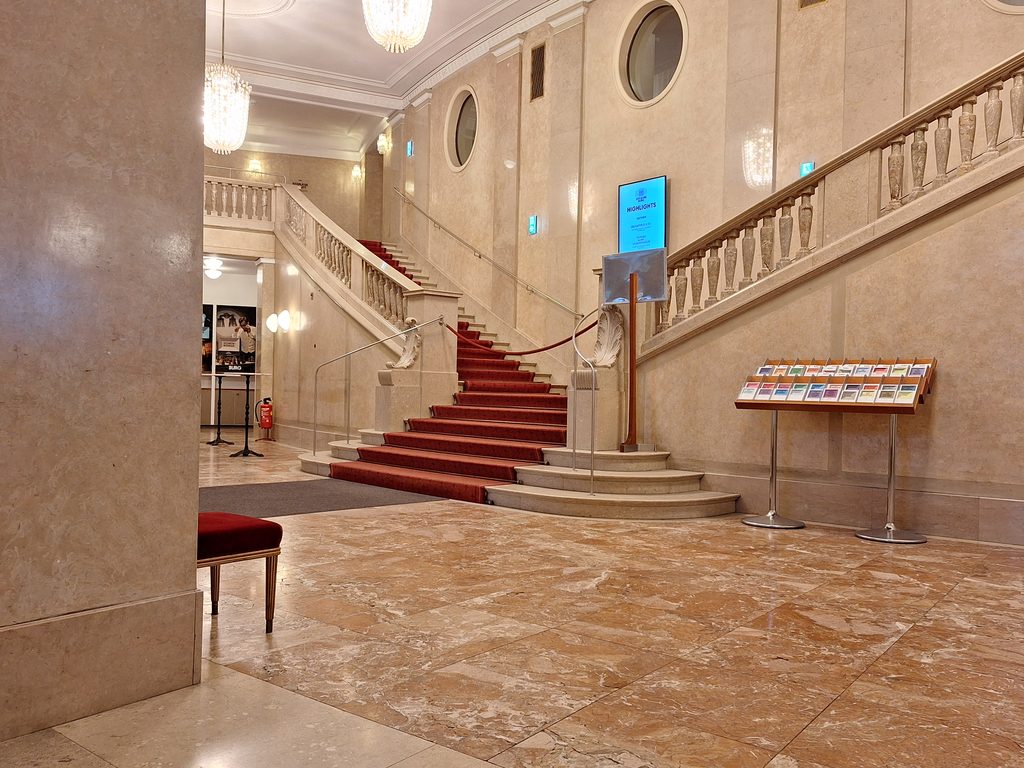
I had hoped to explore more of the interior, but once inside, I discovered that visitors were restricted to the lobby, with much of the theatre roped off.
A little disappointing, but it was still worth stopping.
The Burgtheater traces its beginnings to 1741, when Empress Maria Theresa established a court theatre.
The present building opened in 1888 and was designed by architects Gottfried Semper and Karl von Hasenauer.
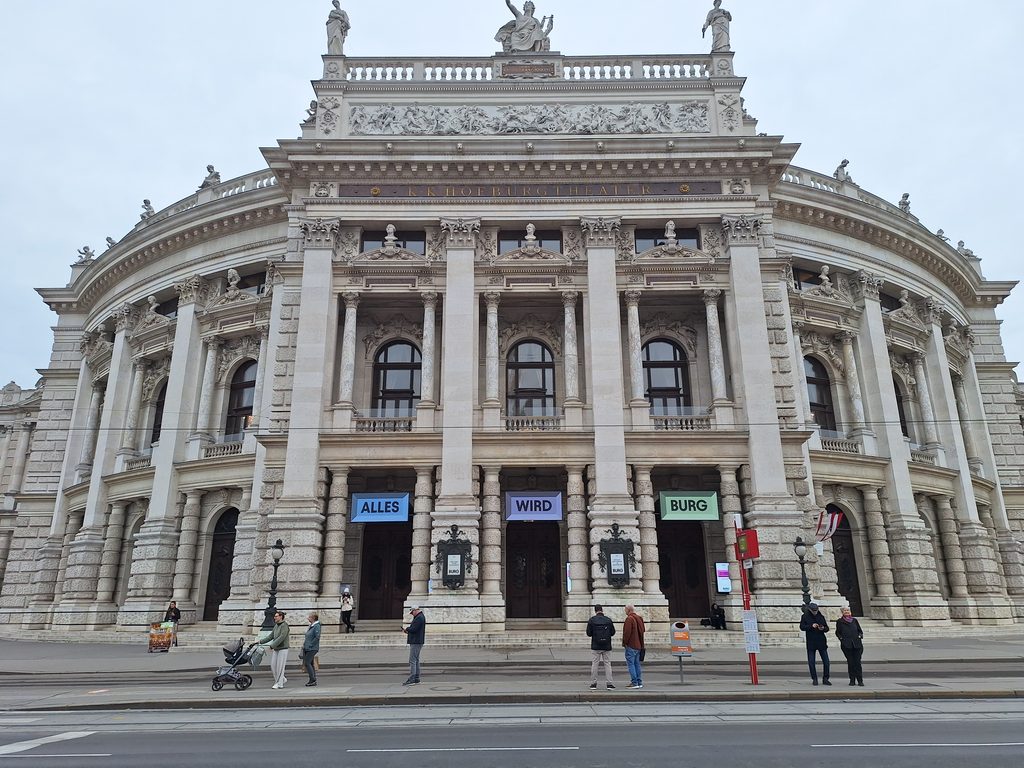
Its architecture reflects the elegance and extravagance of Vienna’s imperial period.
The theatre is famous for its sweeping staircases and magnificent frescoes created by Gustav Klimt, his brother Ernst Klimt and Franz Matsch.
Among the artwork is Gustav Klimt’s only known painted self-portrait.
The theatre also has an extraordinary musical and dramatic history. Mozart’s The Marriage of Figaro was first performed in Vienna at the original Burgtheater, and Beethoven’s First Symphony premiered there in 1800.
Standing inside, I tried to imagine the excitement of those performances and the audiences who witnessed them.
The Burgtheater once possessed one of Europe’s largest revolving stages, another reminder of Vienna’s enormous contribution to the performing arts.
Even without exploring the entire building, I enjoyed learning about its history.
Senior Travel Tip: Theatre performances and guided tours are worth investigating if you have the time and budget. When I visited, some performances started around €25, and discounted tickets were sometimes available. Guided tours also offered access to areas normally closed to casual visitors.
Votive Church – A Neo-Gothic Treasure
Continuing through central Vienna, I came across the Votive Church.
The closer I approached, the more impressive it became.
Its towering spires and elaborate Gothic design make it one of Vienna’s most striking churches.
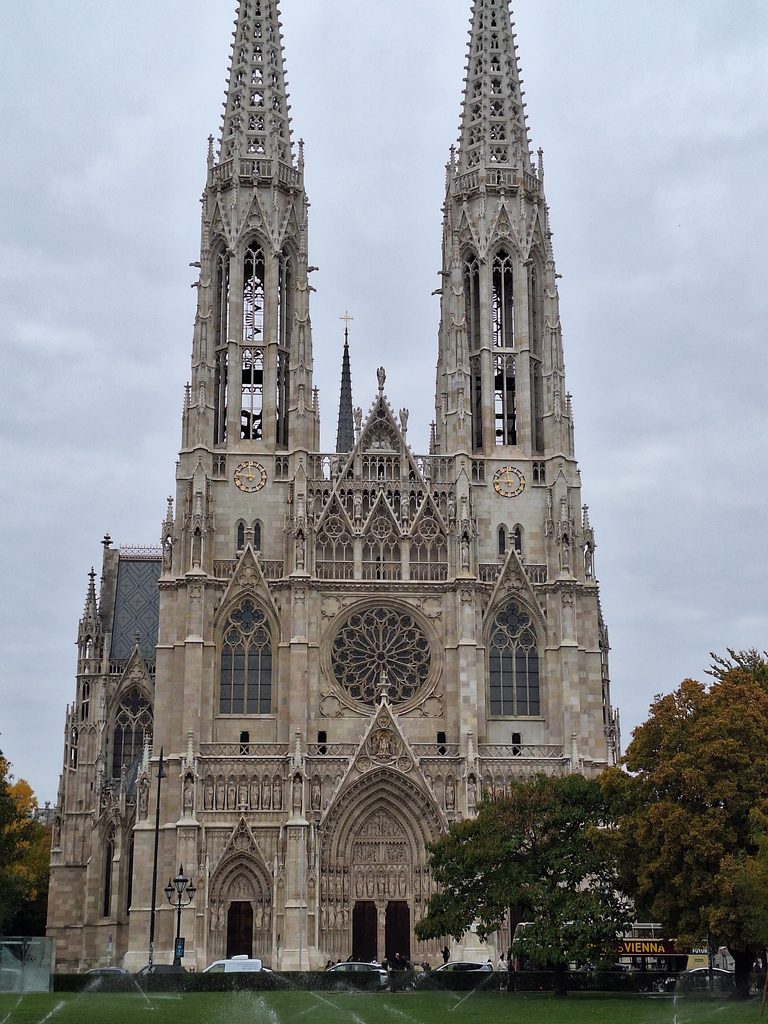
The exterior was beautiful, but once inside, I found a rather different atmosphere.
The interior was dark, with areas that appeared blackened by age and the passage of time. It lacked some of the brightness and grandeur I had expected.
Nevertheless, I wandered through the areas accessible to visitors, taking photographs whenever I could find a reasonable angle.
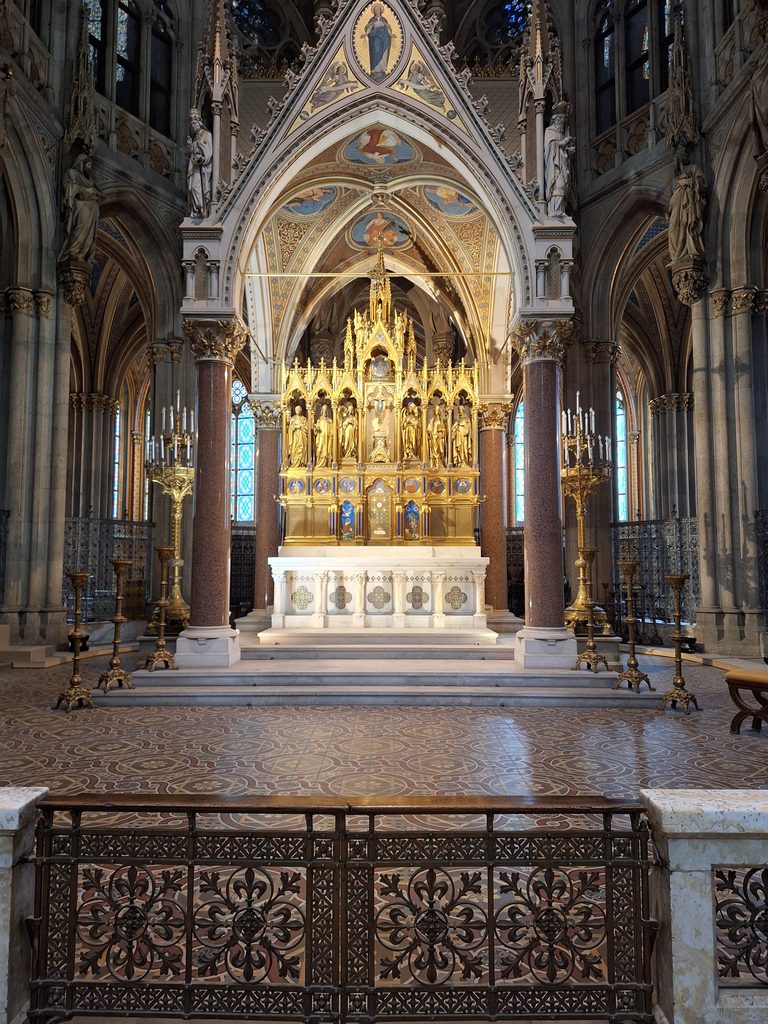
There were additional areas and experiences requiring payment, and I considered whether they would be worthwhile.
One option was priced at €27, but with my daily budget firmly in mind, I decided against spending the extra money.
You have to make these decisions constantly when travelling for an extended period.
The church itself has a fascinating history.
Its construction followed an unsuccessful assassination attempt against Emperor Franz Joseph in 1853.
His brother, Archduke Ferdinand Maximilian, promoted the building of the church as an expression of gratitude for the emperor’s survival.
Completed and dedicated in 1879, the year of Franz Joseph and Empress Elisabeth’s silver wedding anniversary, it became one of the great monuments of Vienna’s Ringstrasse.
Originally used as a garrison church, the building was constructed from white sandstone, a material that requires continual maintenance.
It also suffered damage during the Second World War and has undergone extensive restoration.
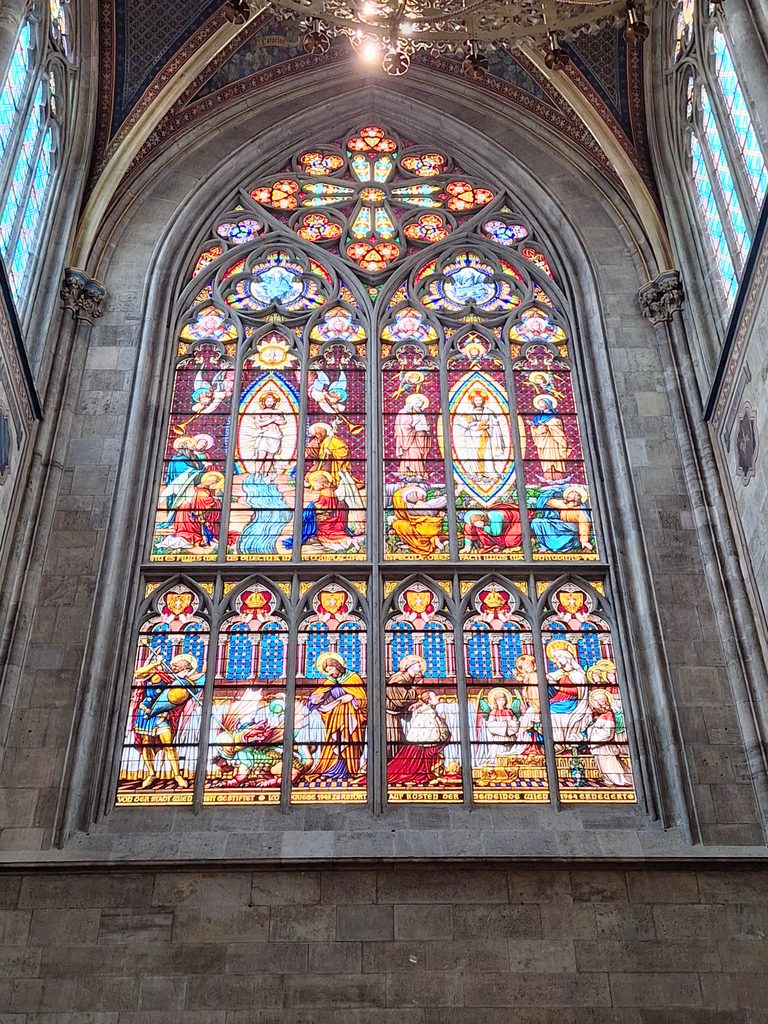
Although I didn’t explore every corner, I appreciated the opportunity to experience another part of Vienna’s religious and imperial history.
There is also a light presentation called Creation of Light, which reveals the church’s beauty in a completely different way.
For anyone interested, here’s a video:
Sigmund Freud Museum – The Birthplace of Psychoanalysis
My next stop was the Sigmund Freud Museum.
Freud is one of the most influential figures in the history of psychology, and his former home and workplace provides a fascinating glimpse into his life.
He lived and worked at this address from 1891 until 1938, when he was forced to leave Austria to escape Nazi persecution.
For more than five decades, Vienna was central to his life and intellectual development.
The museum contains hundreds of historical objects, including personal correspondence, original editions of his books, photographs and furniture associated with his consulting rooms.
I spent time looking through the displays and reflecting on how Freud’s theories changed the way people understood the human mind.
One particularly interesting section included rare film footage of the Freud family during the 1930s.
Seeing the people behind the historical names gave the museum a more personal atmosphere.
It is sometimes easy to forget that the famous figures we read about in history books were ordinary people living through extraordinary circumstances.
Hundertwasser House – Vienna’s Psychedelic Rebel
After spending so much time admiring Vienna’s grand imperial buildings, I wanted to see something completely different.
Hundertwasser House certainly provided that.
Getting there proved slightly complicated.
I took the U2 underground line towards Rathaus, changed to the U4 towards Landstraße and then walked through the surrounding back streets.
Fortunately, the sun was shining, making the walk rather pleasant.
And then, suddenly, there it was.
A building unlike almost anything else I had seen in Europe.
Hundertwasser House is an explosion of colour, curves, irregular windows, decorative columns and greenery.
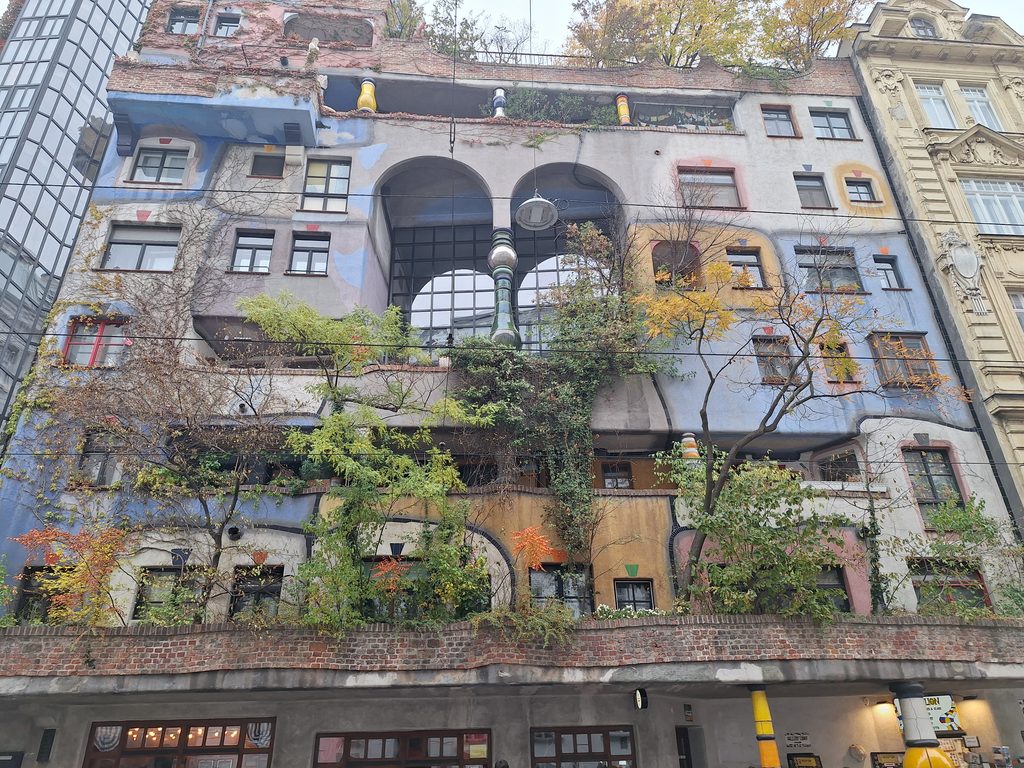
Designed by the Austrian artist Friedensreich Hundertwasser and completed in 1985, it deliberately challenges traditional architectural conventions.
There are uneven lines, colourful ceramic details, roof gardens, onion-shaped domes and trees appearing where you might least expect them.
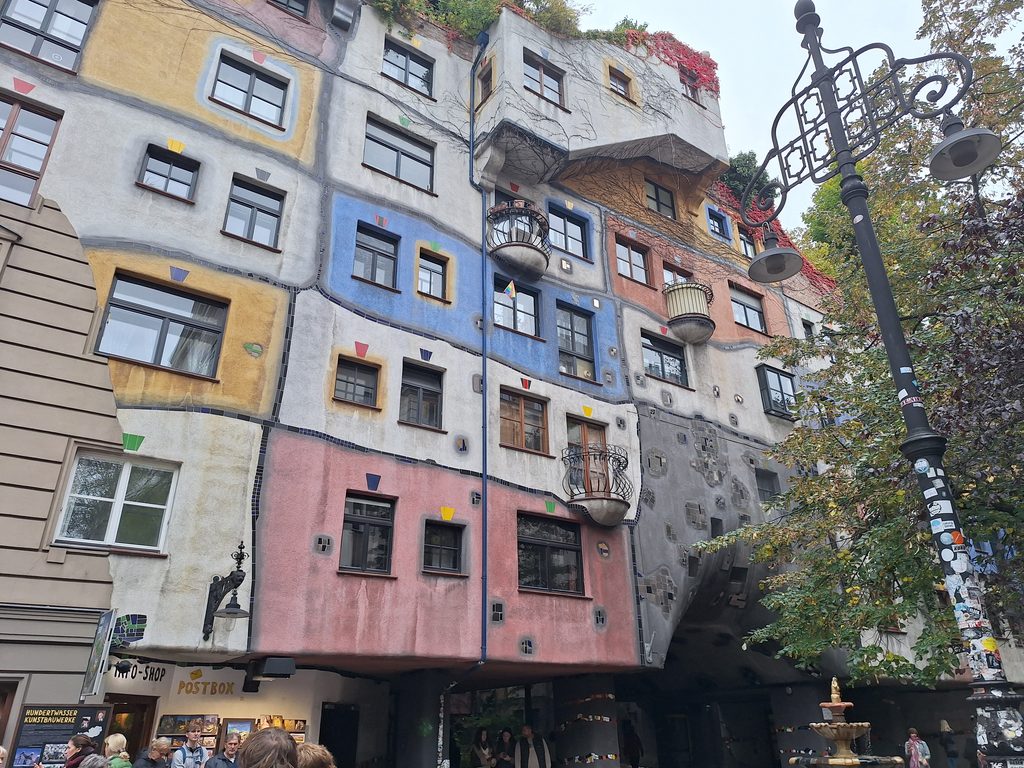
It almost looks as though a child has been given an enormous box of coloured pencils and told to design a building without following any rules.
And somehow, it works beautifully.
Hundertwasser reportedly refused payment for his contribution, believing that preventing an ugly building from occupying the site was reward enough.
Mission accomplished, I would say!
Standing outside, I couldn’t help wondering what it must be like to live there.
Imagine opening your curtains every morning to find tourists photographing your home.
Across the street is Hundertwasser Village, a quirky collection of shops, cafés and unusual architectural features.
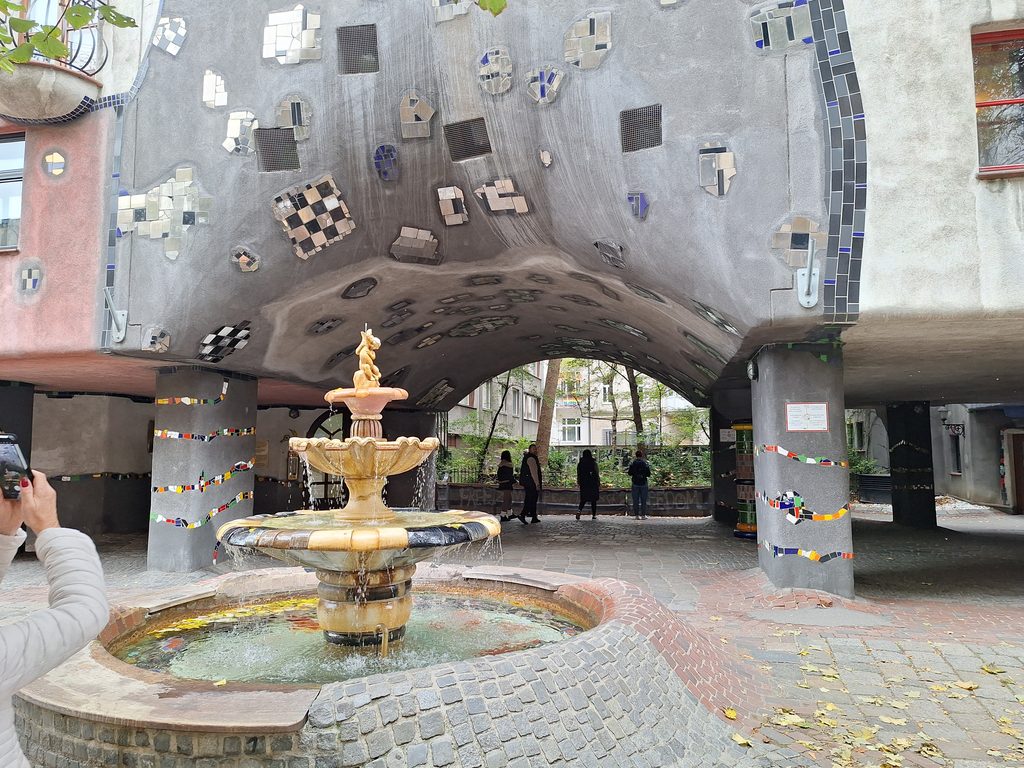
I spent some time exploring and taking photographs before settling down with a beer.
Sometimes the best part of travelling is simply sitting somewhere unusual and watching the world go by.
Anker Clock – Vienna’s Musical Timepiece
After about half an hour at Hundertwasser Village, I set off towards the Anker Clock, roughly two kilometres away.
I caught a tram for part of the journey and walked the remainder.
My timing was excellent because I arrived for the midday display.
The Ankeruhr is one of Vienna’s most unusual public clocks.
Rather than relying solely on hands and numbers, it features historical figures who move slowly across the clock face.
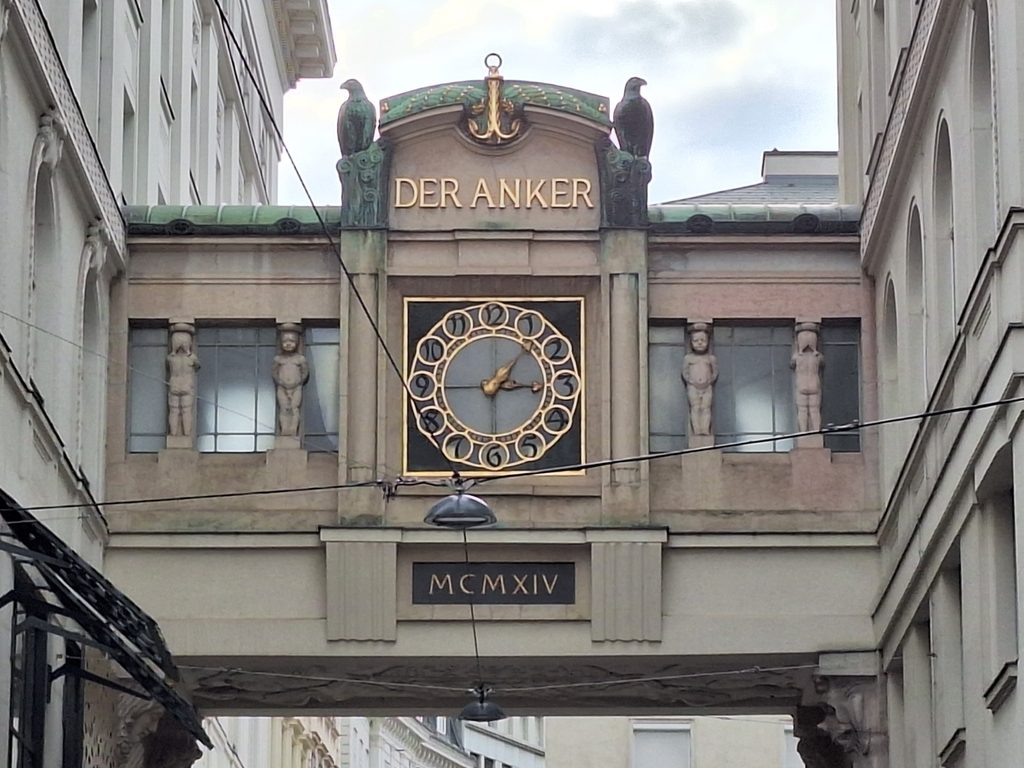
At noon, twelve figures representing different periods of Austrian history appear in a procession accompanied by music.
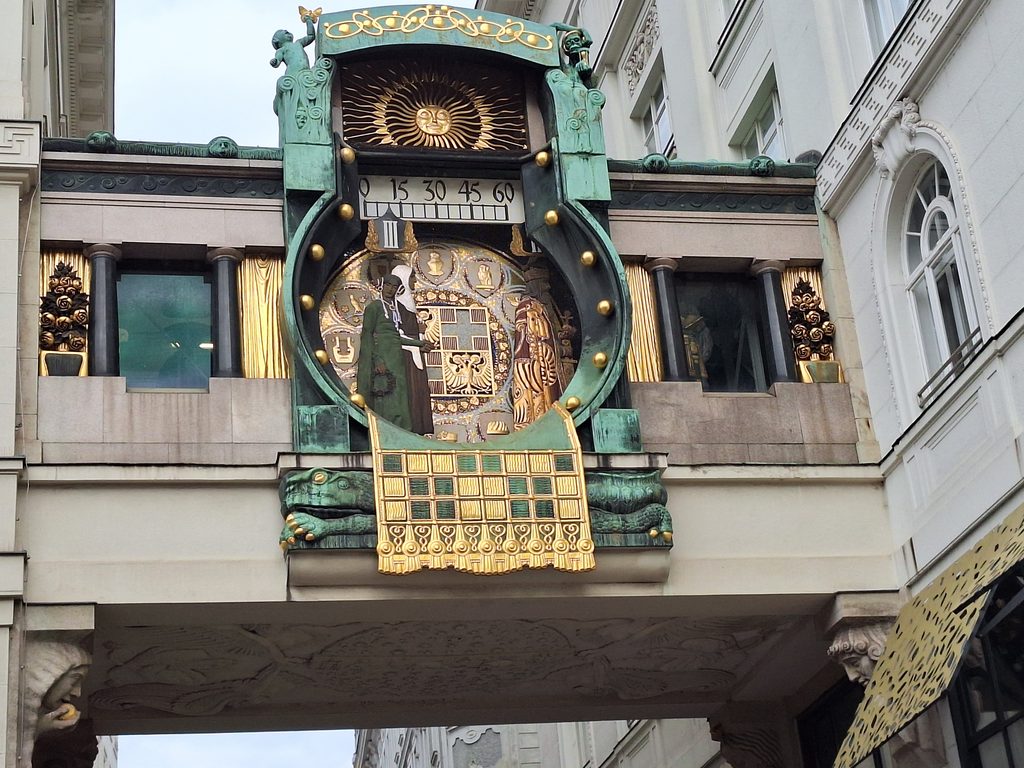
I stood watching the figures glide past, appreciating the craftsmanship and imagination behind the display.
It isn’t as grand as the astronomical clocks I had seen in Prague or Gdańsk, but it has a wonderful charm of its own.
And there wasn’t the same enormous crowd.
Nearby stands the Marriage Fountain, depicting the marriage of the Virgin Mary and Saint Joseph.
Unfortunately, protective netting had been installed to discourage pigeons, which made photographing the monument rather difficult.
Nevertheless, it was another fascinating glimpse into Vienna’s extraordinary collection of historic landmarks.
St. Stephen’s Cathedral – The Heart of Vienna
Eventually, I arrived at St. Stephen’s Cathedral, known locally as Stephansdom.
What an extraordinary building.
Its towering Gothic spire dominates the surrounding streets, and I found myself craning my neck to appreciate its full height.
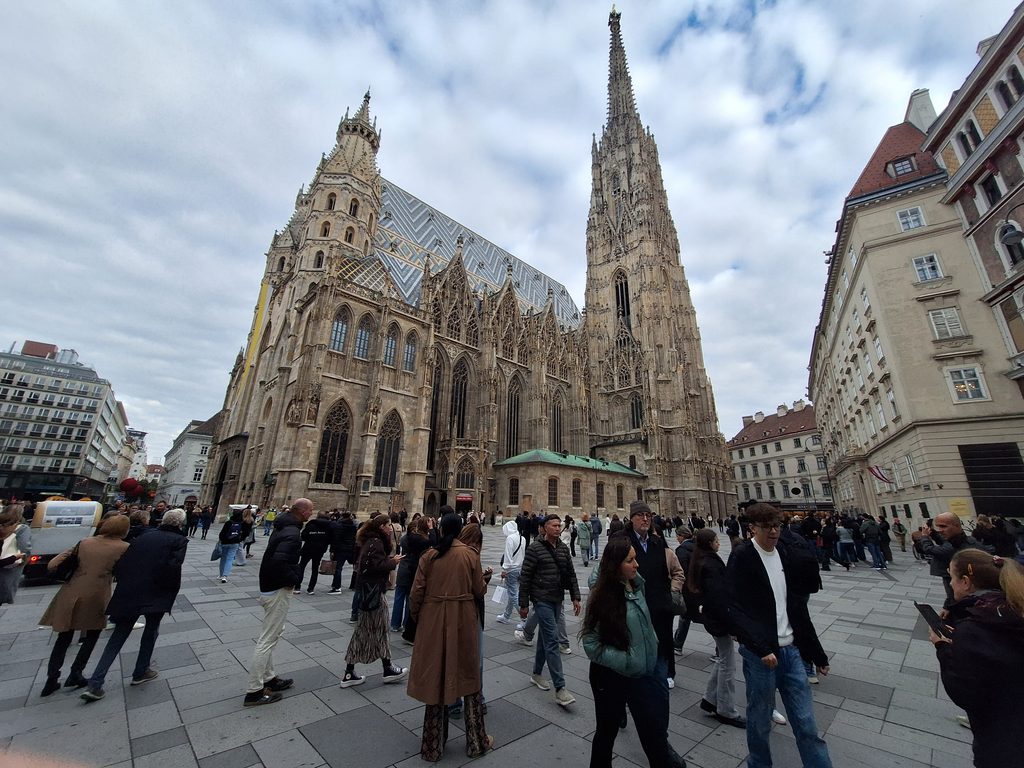
The cathedral’s history stretches back to the twelfth century, with the earliest church on the site dating to 1147.
Over the centuries, it has been expanded and transformed into one of Austria’s most recognisable landmarks.
The combination of Gothic and Romanesque architectural features gives the cathedral an imposing presence.
Inside, the history is just as remarkable.
The cathedral is home to the famous Pummerin bell, one of Europe’s largest swinging church bells.
Music is woven deeply into the building’s story.
Joseph Haydn sang here as a young choirboy, Mozart married Constanze Weber here, and his funeral service was held at the cathedral following his death.
Beethoven and the Strauss family also form part of the wider musical history associated with Vienna and its great churches.
I wandered through the cathedral admiring its altars, religious artwork, monuments and architectural details.

Beneath the building are extensive crypts and burial chambers containing the remains of thousands of people, including members of the Habsburg dynasty.
The cathedral’s catacombs hold an estimated 11,000 remains.
Outside, I spent more time studying the gargoyles, carvings, inscriptions and weathered stonework.
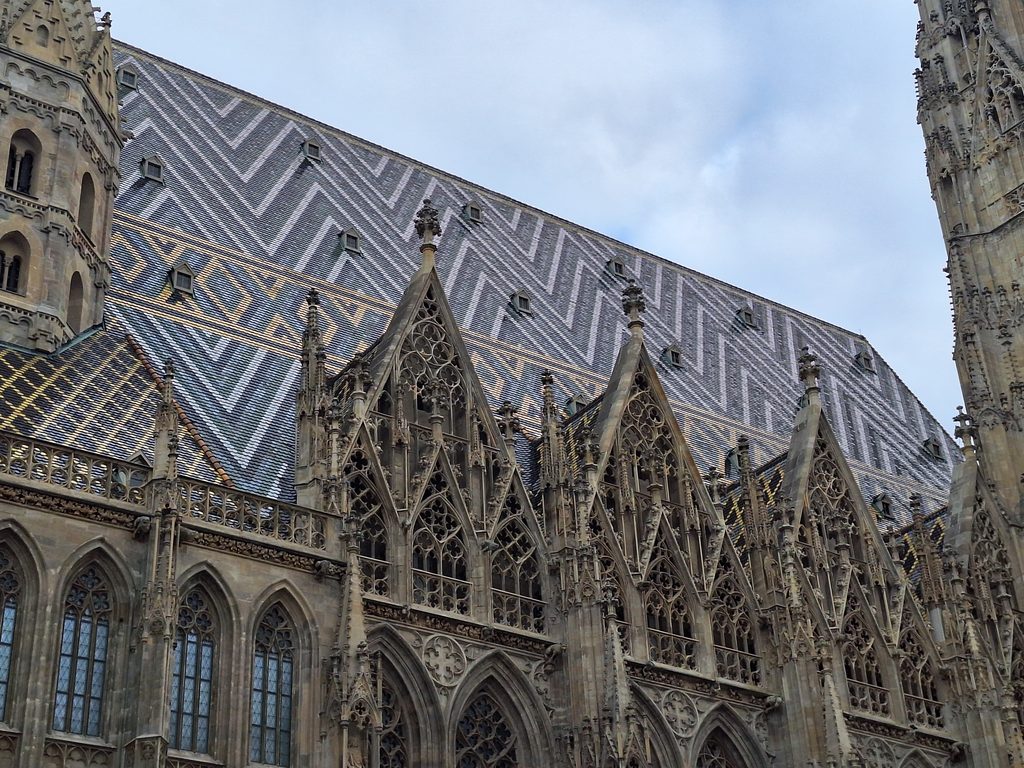
Some of the details are so old that it is difficult to imagine how many generations have passed since they were created.
I often find myself wondering what these buildings would tell us if their stones could speak.
The celebrations, tragedies, wars, marriages and funerals they have witnessed must be almost unimaginable.
For anyone wanting a closer look at the cathedral and its restoration, this video is worth watching:
St. Peter’s Church – A Hidden Baroque Gem
Not far from St. Stephen’s Cathedral, tucked between surrounding buildings, I discovered St. Peter’s Church.
It would be surprisingly easy to walk past without realising just how magnificent it is.
The best view is from directly in front of the entrance, where its curved façade and twin towers reveal their beautiful Baroque design.

Tradition associates the site with an early church dating back many centuries, although the present building dates from the early eighteenth century.
Construction began in 1701, inspired partly by St. Peter’s Basilica in Rome, and the church was completed in 1733.
Its twin towers curve inwards, and their design has sometimes been associated with the shapes of Turkish tents during the Ottoman siege of Vienna in 1683.
But the real surprise comes when you step inside.
What an astonishing interior!
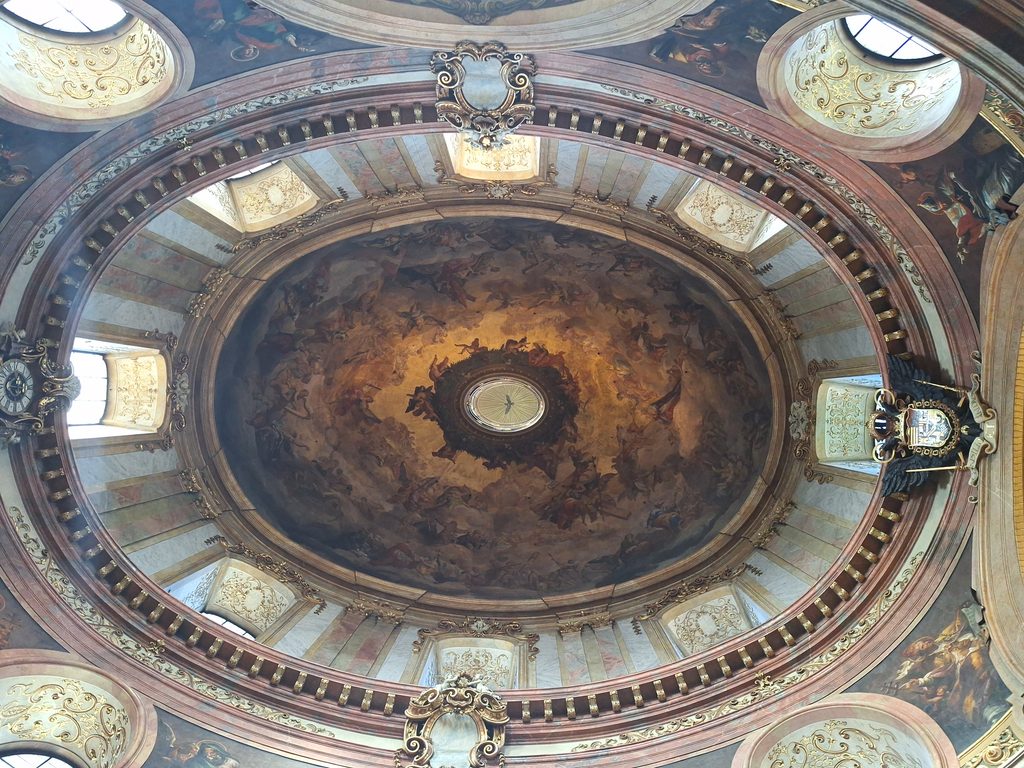
Gold decoration, magnificent frescoes, intricate carvings and a beautifully painted dome surround you.
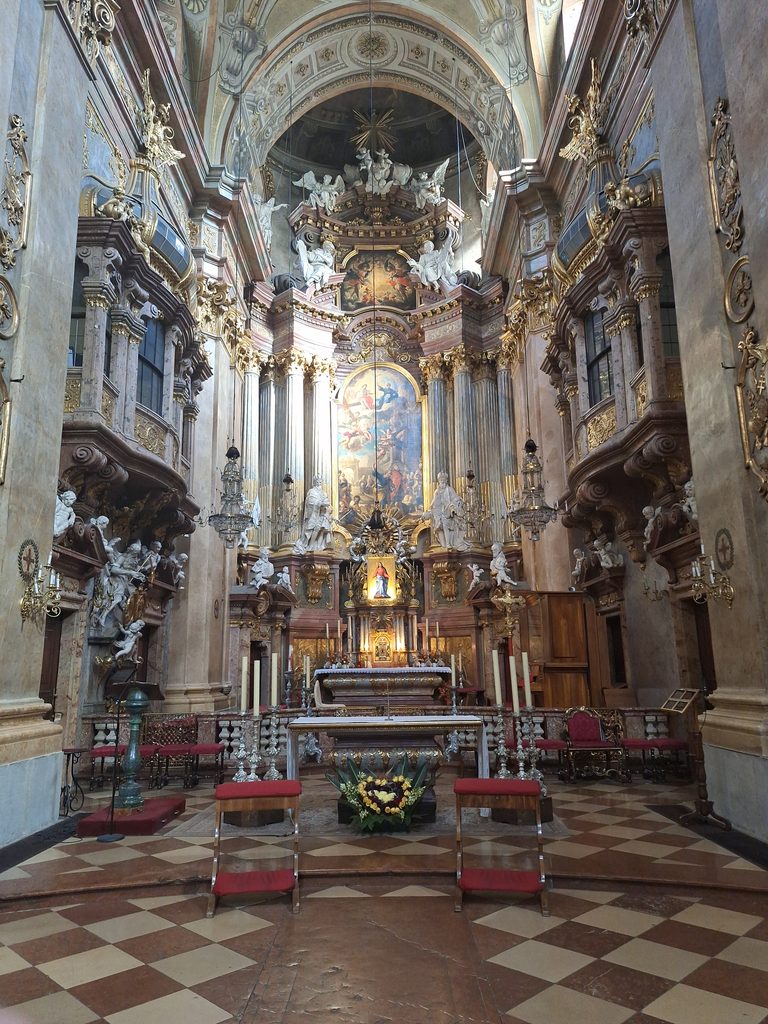
The ceiling artwork by Johann Michael Rottmayr is especially impressive.
The high altar depicts Saint Peter and Saint John healing a beggar, while crystal coffins around the church contain relics associated with early Christian martyrs.
The church underwent major restoration between 1998 and 2004, bringing many of its decorative features back to life.
I could have remained inside for hours simply absorbing the artistry and atmosphere.
Senior Travel Tip: St. Peter’s Church is a wonderful place to enjoy Vienna’s religious architecture without necessarily spending a fortune. Free organ concerts and occasional choir performances are held here, although schedules should be checked beforehand.
Another Cold Morning in Vienna
After several days of exploring, I woke to another chilly Viennese morning.
I was out of bed by around 7:30 am, although I hadn’t enjoyed the most peaceful night’s sleep.
Builders had been working away nearby, and the noise was travelling through an open window.
Eventually, someone got up and closed it, which made an enormous difference.
Outside, winter was clearly approaching.
The temperature had dropped to around 10°C, and although the sun was shining, the wind was bitterly cold.
I couldn’t help thinking that if I hadn’t experienced delays connected with my problems in Poland, I would probably have been somewhere around the Mediterranean enjoying much warmer weather.
But that’s travel.
Things don’t always work out as planned, and you have to accept what life throws at you and make the best of the situation.
Getting to the kitchen was enough to make me shiver, even though it was only a short distance away.
I settled down with a bowl of chilli noodles, hoping the warmth and spice would prepare me for another day outside.
My first destination was Karlskirche, about two or three kilometres away.
I caught a tram for part of the journey because the cold wind was cutting straight into my face.
Even in sunshine, Vienna was beginning to feel decidedly wintry.
Karlskirche – Vienna’s Magnificent Baroque Church
Karlskirche, or St. Charles Church, stands beside Karlsplatz and is one of Vienna’s grandest Baroque buildings.
Approaching the church, I was immediately impressed by its enormous green dome and two monumental columns.
The design combines classical Roman influences with the rich decoration associated with Viennese Baroque architecture.
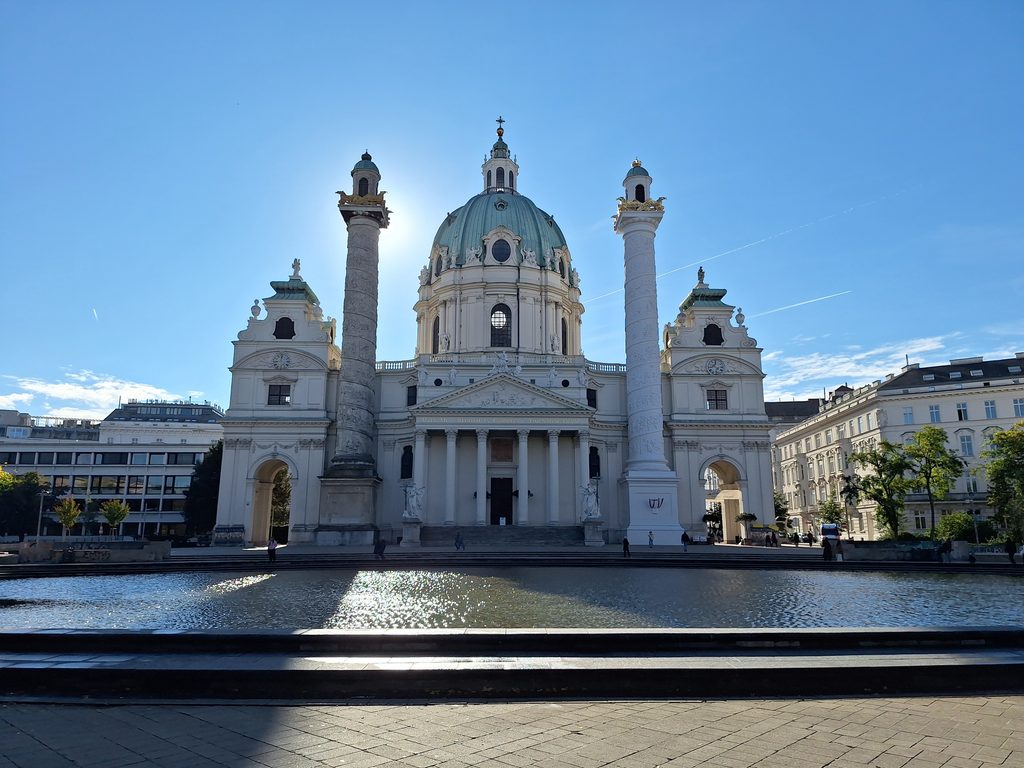
Commissioned by Emperor Charles VI in 1713, the church was completed in 1737.
It was dedicated to Saint Charles Borromeo following a devastating plague epidemic.
Standing outside, I debated whether to pay the €9.50 admission fee, equivalent at the time to approximately NZ$19.26.
Several visitors approached, looked at the entrance prices and turned away.
I considered doing the same.
Travelling on a pension means watching expenses very carefully, particularly in a city where so many attractions charge admission.
But something told me this one might be worth the money.
And was it ever!
The moment I stepped inside, I was absolutely amazed.
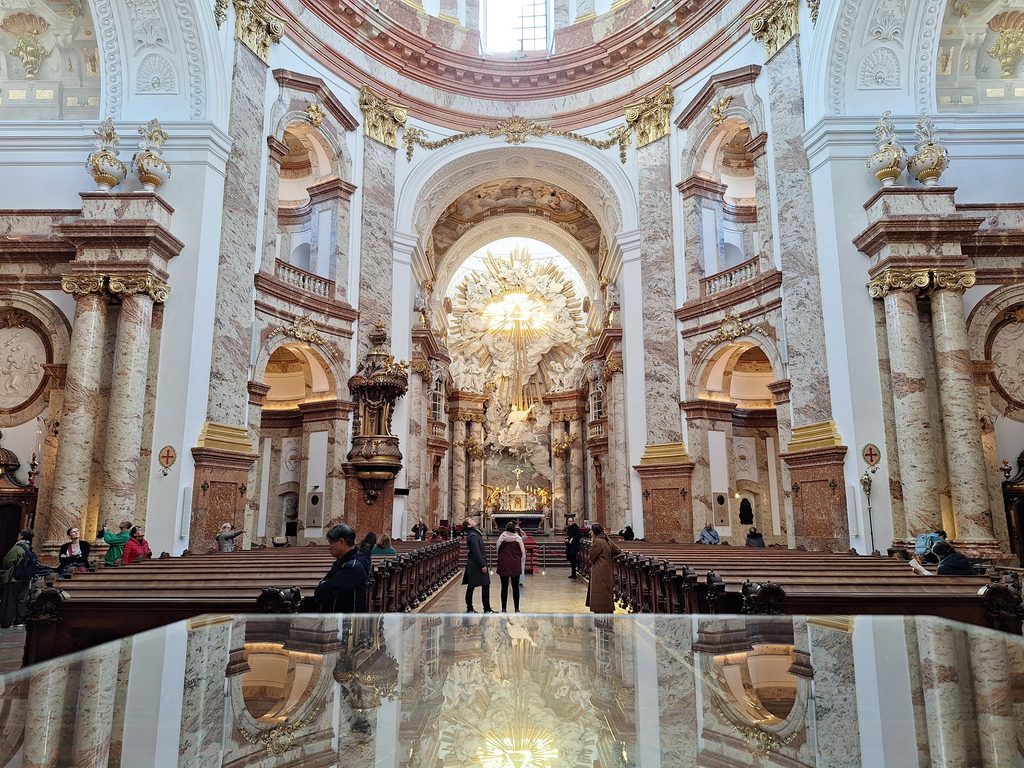
Your eyes are drawn upwards towards the magnificent dome, richly decorated with frescoes and towering high above the nave.
The interior rises to approximately 70 metres beneath the dome, while the overall church structure reaches even higher.
It is one of those places where photographs can never quite capture the overwhelming sense of space and beauty.
The magnificent frescoes depict the glorification of Saint Charles Borromeo, surrounded by angels and religious imagery.

Everywhere I looked, there was something new to discover.
The beautifully carved walnut pulpit was another highlight, with its intricate woodwork and elaborate decorative details.

The church also has important connections with Vienna’s musical and cultural history.
Antonio Vivaldi died in Vienna in 1741 and is remembered through performances of his music.
Johann Strauss married here, although that particular marriage did not last.
Years later, Austrian-born Hollywood actress Hedy Lamarr was also married in Karlskirche.
Imagine the generations of people who have gathered beneath this extraordinary dome.
I climbed the staircase to the small museum on the second floor.
Nearby was the organ, overlooking the nave.

The old floorboards creaked beneath my feet, adding another sense of history to the experience.
From this level, the views across the church were magnificent, and I could appreciate the dome and decorative details from an entirely different angle.
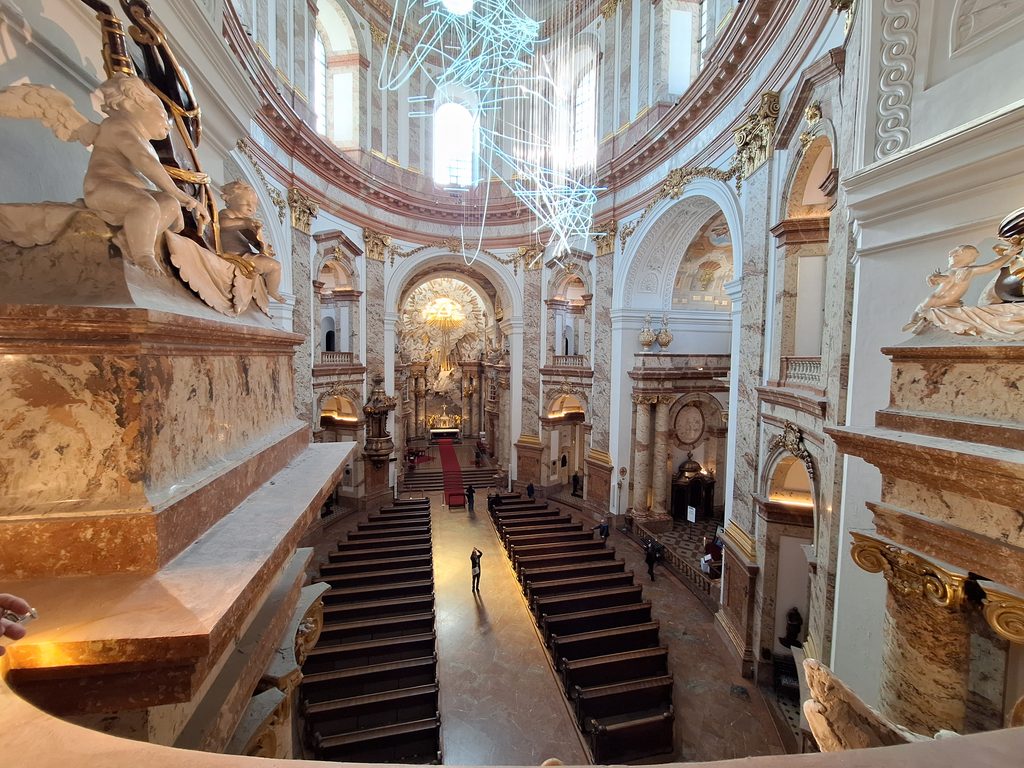
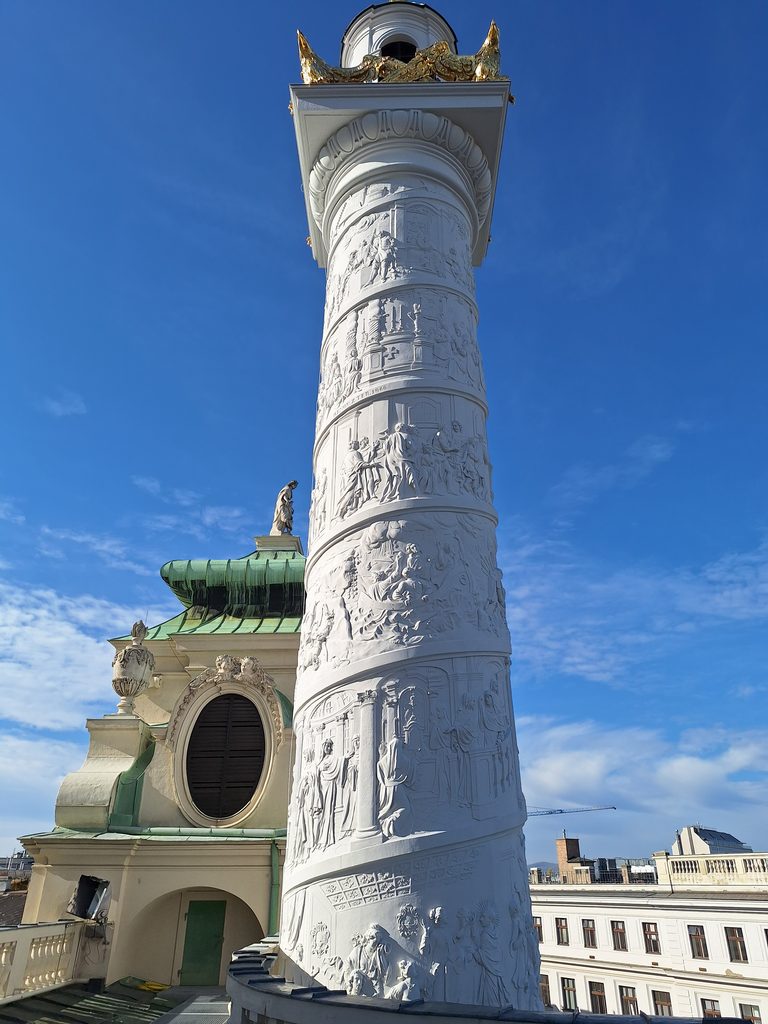
Continuing upwards, I followed another staircase towards the viewing platform, approximately 32.5 metres above ground level.
The two enormous exterior columns almost resemble minarets, although their design is inspired by ancient Roman triumphal columns.
I had hoped to take the lift that once carried visitors closer to the magnificent ceiling frescoes.
Unfortunately, I discovered that it had been removed several years earlier following changes to the dome’s interior.
A little disappointing, but the visit had already been worth every cent.
As I was leaving, I noticed a couple debating whether they should pay to go inside.
They appeared ready to walk away.
I couldn’t resist offering my opinion.
“It’s worth it. You’ll be disappointed if you don’t go in!”
They looked at each other, reconsidered and headed towards the entrance.
I smiled to myself.
Hopefully, they enjoyed it as much as I did.
Augustinerkirche – A Church of Royal Weddings and Imperial Secrets
Leaving Karlskirche, I made my way back towards the heart of the city.
I wanted to visit the Imperial Crypt, but along the way, I passed Augustinerkirche, the Church of St. Augustine, and decided to have a look inside.
The atmosphere was very different from Karlskirche.

It was dark and rather dank, and I didn’t feel particularly inclined to remain there for long.
Nevertheless, the history was fascinating.
The church was founded in 1339 and eventually became incorporated into the expanding Hofburg Palace complex.
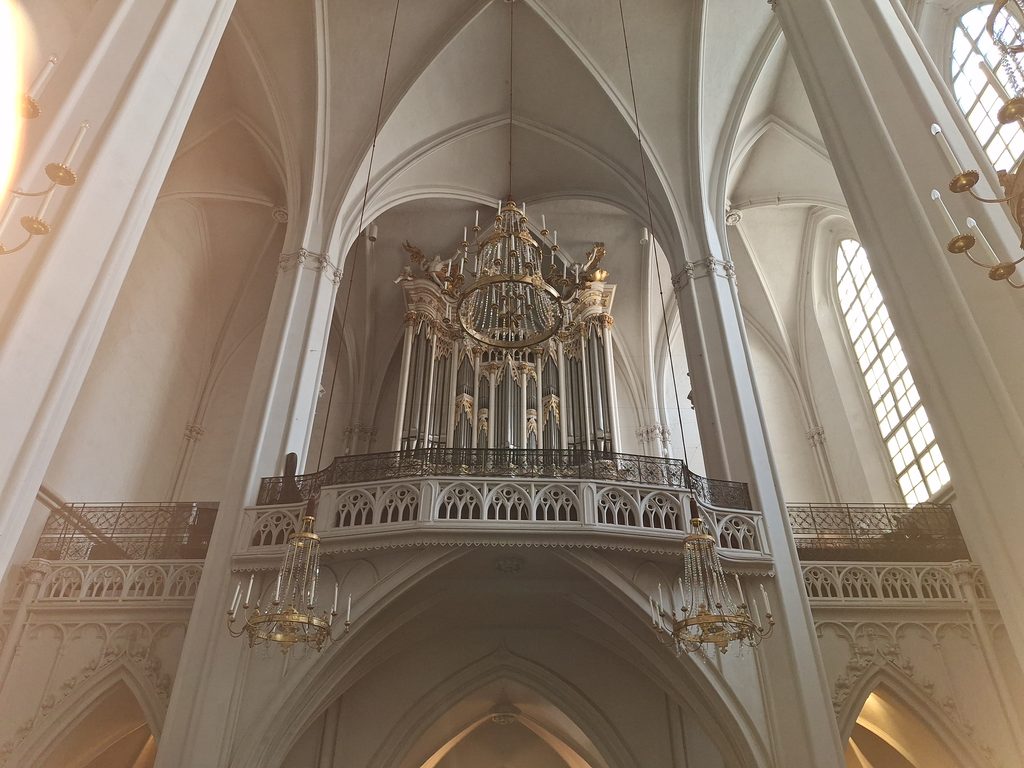
Over the centuries, it witnessed numerous royal weddings and ceremonies.
One of the most remarkable was the marriage of Archduchess Marie-Louise of Austria to Napoleon Bonaparte in 1810.
Napoleon himself wasn’t present.
Instead, the marriage was conducted by proxy, with another person standing in for the emperor.
An unusual arrangement by today’s standards, but not uncommon among Europe’s royal families.
The church also contains several chapels, including the Loreto Chapel.
Inside are 54 silver urns containing the hearts of members of the Habsburg dynasty.
Yes, their actual hearts!
The Habsburgs had some rather unusual burial traditions.
While many of their bodies were buried elsewhere, their hearts were preserved separately.
It certainly gives a different meaning to the expression “leaving your heart behind.”
Their main burial place was my next destination.
The Imperial Crypt – Beneath Vienna’s Streets
A short walk from the Hofburg Palace brought me to the Imperial Crypt, also known as the Capuchin Crypt or Kaisergruft.
Hidden beneath the Capuchin Church near Neuer Markt, this extraordinary burial chamber contains the remains of generations of Austria’s imperial rulers.
Admission cost €11.50, approximately NZ$23.20 at the time.
That meant I had already spent €21 on just two attractions, before buying food or paying for transport.
Vienna was proving to be an expensive city.
There are plenty of beautiful buildings to admire for free, but once you start entering churches, museums, palaces and underground attractions, the costs quickly mount up.
Nevertheless, I decided this was another experience I didn’t want to miss.
Descending the staircase into the crypt, the atmosphere changed almost immediately.

The noise of the streets disappeared.
People spoke quietly, almost in whispers, as though afraid of disturbing the centuries of royal history surrounding them.
The air felt cool and heavy.
The crypt has served as the burial place of the Habsburg dynasty since the seventeenth century.
Its origins go back to Anna of Tyrol, the wife of Emperor Matthias, who arranged for its establishment in 1617.
She died the following year, and her husband died not long afterwards.
The crypt was consecrated in 1632, and the first burials took place the following year.
Over the centuries, it became the final resting place for approximately 150 members of the Habsburg family, including numerous emperors and empresses.
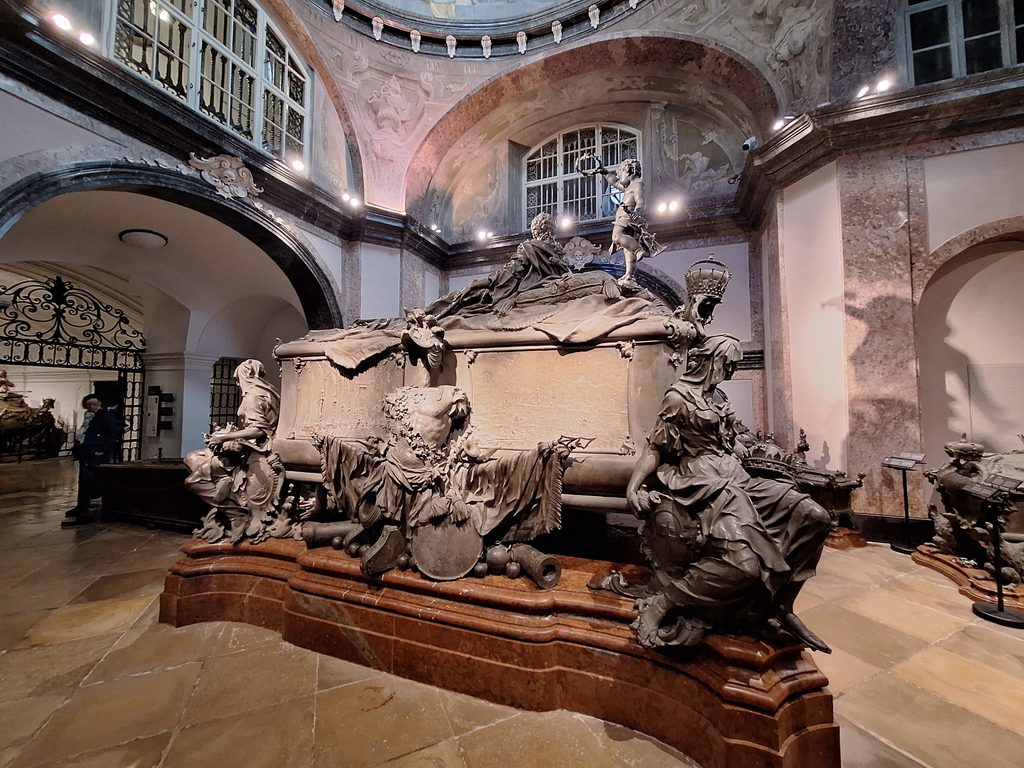
Walking through the chambers, I was astonished by the elaborate metal coffins.
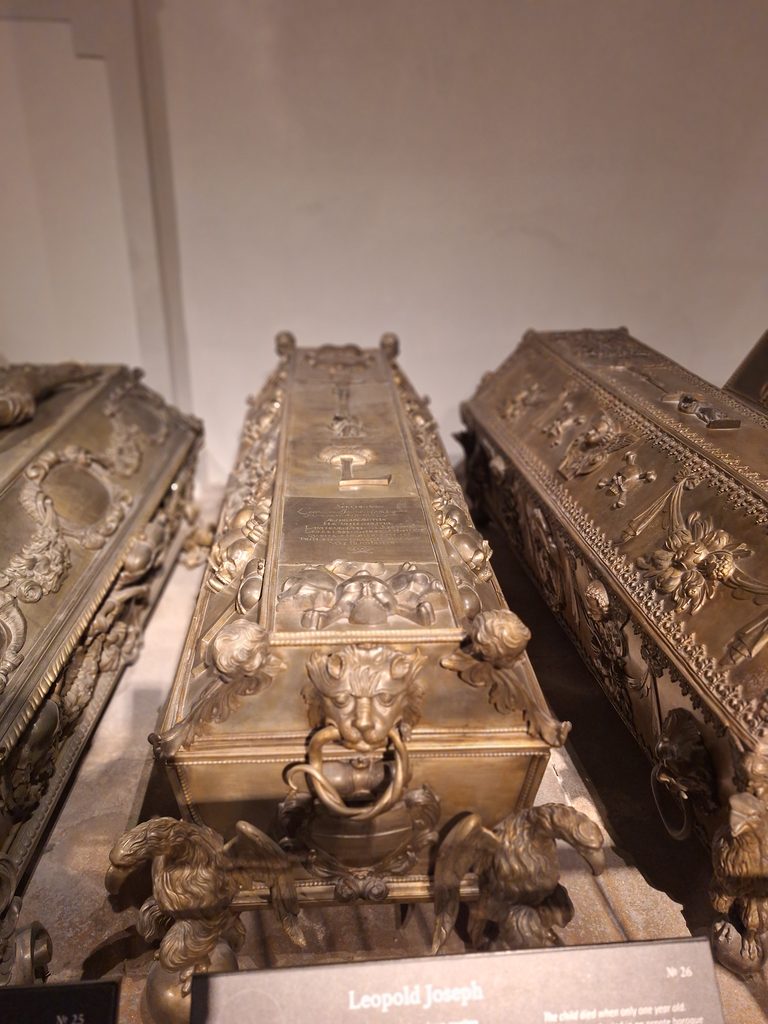
Some were relatively modest, while others were covered in extraordinary Baroque decorations.
Angels, crowns, skulls, religious symbols and imperial emblems appeared everywhere.
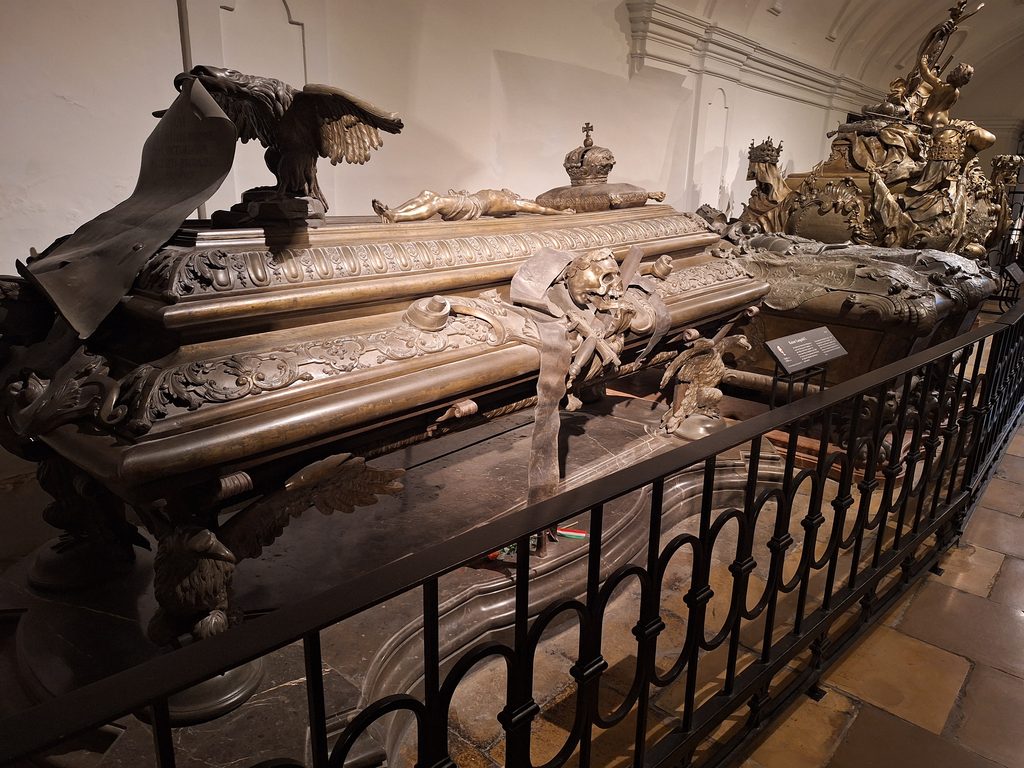
Each coffin seemed to represent an entire chapter of European history.
The craftsmanship alone was worth the entrance fee.

Some of these enormous sarcophagi were almost works of art, created to demonstrate the wealth, power and importance of the people buried inside.
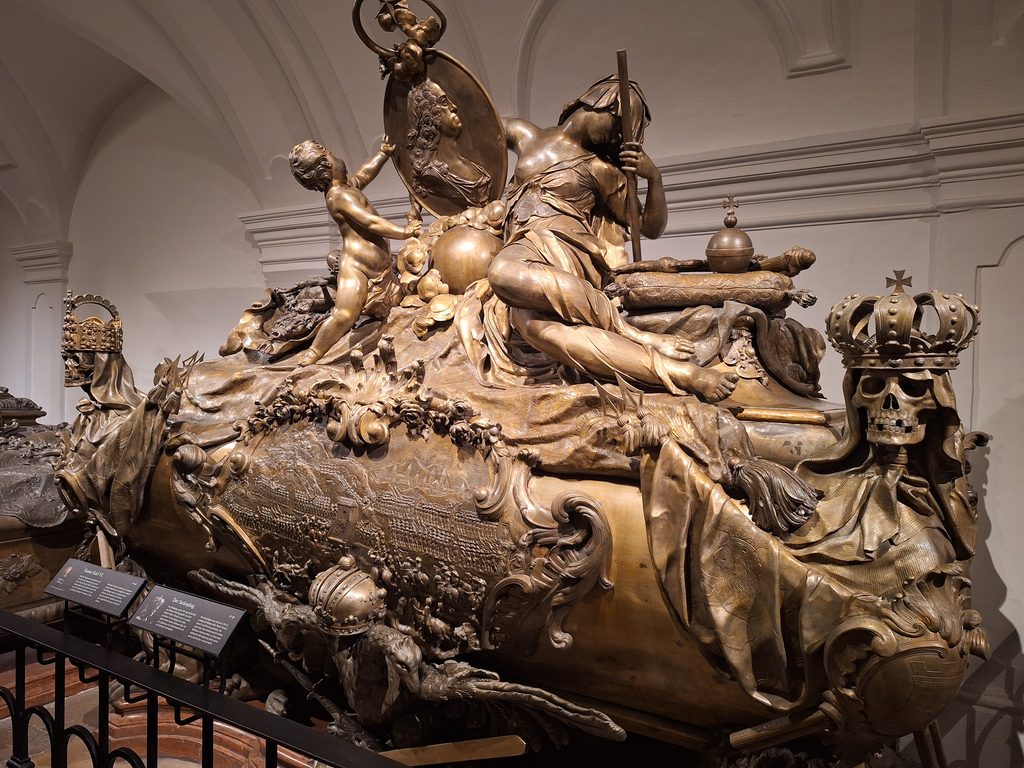
I found myself thinking about the enormous contrast between the lives these rulers had enjoyed and the silence surrounding them now.
Emperors and empresses who once controlled vast territories had ultimately ended up in these underground chambers.
Their titles, fortunes and political power had disappeared, leaving behind their monuments and memories.
There is something deeply thought-provoking about walking through such a place.
For all their grandeur, royalty eventually faced the same inevitable ending as everyone else.
The crypt felt like a museum, a chapel and a time capsule combined.
And who would have thought that so much imperial drama could be found beneath an ordinary Vienna street?
A Second Attempt at Vienna City Hall
After leaving the Imperial Crypt, I made my way back towards City Hall.
I was determined to take the free guided tour that I’d discovered earlier in my visit.
The tour was scheduled for 1 pm, and I arrived expecting to join the other visitors.
Unfortunately, I had misunderstood how the ticket system worked.
Tickets had been available from 9 am that morning, and they had disappeared within minutes.
By the time I arrived, there was no chance of getting inside.
Another disappointment!
Had I understood the arrangements properly, City Hall would have been my first destination that morning.
But this is one of the lessons you learn when travelling independently.
It’s important to investigate opening times, tour arrangements and ticket availability before heading off, particularly when places offer free admission.
Sometimes the most popular attractions are booked out long before the actual tour begins.
There was nothing I could do about it now.
Rather than spend the afternoon feeling disappointed, I headed for an Irish pub, found somewhere comfortable to sit and caught up with more of my travel writing.
Not every travel day goes according to plan, but there is usually a way to make something worthwhile out of it.
Vienna on a Pension – Beauty Comes at a Price
Vienna is undoubtedly one of Europe’s most beautiful cities.
Everywhere you turn, magnificent buildings line the streets.
Grand palaces, historic churches, theatres, museums and monuments reflect centuries of Austrian history.
It is a city that demands your attention.
But it is also a city that can demand quite a lot from your wallet.
For someone travelling on a pension, deciding which attractions to enter becomes an important part of daily planning.
I could easily have spent considerably more than my budget allowed.
Sometimes I paid because I felt the experience would be worth it, as with Karlskirche and the Imperial Crypt.
Other times, I admired the exterior, read about the history and continued walking.
And there is absolutely nothing wrong with that.
You don’t have to enter every building to enjoy a city.
Some of my most memorable moments have come simply from wandering through unfamiliar streets, watching people going about their daily lives and discovering unexpected places.
Vienna also reminded me that free attractions often require just as much planning as paid ones.
Missing the City Hall tour twice was frustrating, but it was another lesson learned.
Senior Travel Tips for Vienna
- Allow plenty of time. Vienna has so much to offer that even five days barely scratches the surface.
- Check admission prices. Churches, museums, crypts and palaces can quickly consume a modest daily budget.
- Book popular free tours early. Free doesn’t necessarily mean you can simply turn up.
- Make use of public transport. Vienna’s trams and underground railway are useful when distances become tiring.
- Dress for the weather. Even sunny autumn days can bring bitterly cold winds.
- Take regular breaks. A café, park bench or quiet church can provide a welcome rest between attractions.
- Choose what interests you most. Travelling on a budget means making decisions, but it doesn’t mean missing out on the pleasure of exploring.
Final Reflections – Five Days in Vienna
My five days in Vienna were filled with remarkable architecture, fascinating history, beautiful churches and unexpected discoveries.
From the colourful eccentricity of Hundertwasser House to the grandeur of St. Stephen’s Cathedral, from the magnificent interior of Karlskirche to the silent burial chambers of the Habsburg emperors, the city seemed determined to reveal another chapter of its history around every corner.
There were disappointments too.
I missed the City Hall tour despite two attempts, found some attractions more expensive than expected and struggled occasionally with the cold weather.
And I must admit that writing this blog has been something of a challenge.
My thoughts have wandered, I’ve been distracted, and there have been evenings when I simply haven’t felt inspired to sit down and write.
Travelling continuously for so long can be exhausting.
The excitement of discovering somewhere new is still there, but occasionally your mind and body remind you that you need time to recharge.
Perhaps that’s something particularly important to recognise as an older traveller.
There is no need to prove anything to anyone.
Sometimes it’s enough simply to enjoy where you are, without feeling obliged to see everything or fill every hour with activity.
Vienna is a city where you could spend weeks exploring and still have plenty left to discover.
I have only scratched the surface.
But the places I visited, the history I learned and the people I encountered have given me another collection of memories to carry forward.
Tomorrow, I’ll be leaving Austria and heading south towards Ljubljana, the capital of Slovenia.
I’m especially looking forward to returning to that part of Europe.
I first visited Slovenia in the early 1970s, when it was still part of Yugoslavia, a socialist country that felt quite different from much of Western Europe.
I remember being so taken with the country that I even considered staying.
Now, more than fifty years later, I’m returning as a 72-year-old traveller, still following the same curiosity that first drew me out into the world.
It will be fascinating to see how much has changed and how much remains familiar.
And that, for me, is what travelling is all about.
Stepping out of fear, one step at a time, into the unknown.
Next stop: Slovenia – returning to a country that captured my imagination more than half a century ago.
Follow my continuing journey at Inspire Seniors Travel.