

Day 385–387: From Da Lat to Buon Ma Thuot – Adventures, Discoveries and Unexpected Challenges
November 22, 2026 | by Andrew Matthews

Day 385: Da Lat to Buon Ma Thuot
Height above sea level: 1580 Ft
Weather Update: 26 °C, cloudy, Sunny Intervals
Air Quality: Average from 13am – 64pm
I was up early at 6.15, finished off yesterday’s blog, and posted it to the travel map and website. This morning I chatted with a guy who originally lived in Papamoa and a girl from Christchurch, and it’s amazing who you meet while travelling; I met two girls in Cairns whose parents live in Tauranga.
This morning I chatted with Annette from RNZ Checkpoint Radio to make sure we could communicate via WhatsApp, and we spent a quarter of an hour going through the details of how the interview will go. It is sometimes hard to leave hostels because they become your home for a short while, but that is what travellers do: come and go, and then the excitement of reaching a new destination, finding new places to visit, and meeting new flatmates, even if only for a short while.
At the bus station ticket office, I asked where I needed to go to catch the bus; she said it was outside, by the purple bus. So I dragged myself outside and talked to several bus drivers, who waved their arms around, indicating it wasn’t their bus; I went back inside and spoke to the lady who could communicate in English, but she said it wasn’t their company and didn’t want to help. I said I needed to know which platform the bus would arrive at, but no luck, so I was left outside wandering, looking lost and out of control. Panic slowly set in; it was only a few minutes before 10 am, and I still had no idea where or when the bus would arrive.
I thought young people generally learned English, but the several I spoke to couldn’t, so I used my translator and sat next to a young girl, who told me the bus was late and that she was getting on the same bus. My anxiety levels went down, and I relaxed knowing I was in the right place.

The bus arrived 5 minutes later, and it was a 34-person sleeper bus. I managed to get a lower bed, and these things aren’t that comfortable because the back doesn’t sit upright; if it did, you’d hit your head on the top bunk. It’s a weird position to be in, but only 5 hours to go. Next time I get one of these sleeper buses, I will download a movie to watch.

The trip was uneventful, and we made a pit stop in the mountains for a short break, so I thought, I asked the driver how long, and he put three fingers up, and I said 3 minutes, and he nodded yes, but if it was 30 minutes, had I known, I may have bought lunch.

It was a relatively smooth ride, but at times we had to drive on the other side of the road to avoid all the potholes—some very large.

What was disappointing was how much trash was on the roads. I’ll sum it up like this: when you get on a bus, you take your shoes off and put them into a plastic bag; when the mother got off, she dropped her plastic bag on the side of the road. This is a testament to the attitude in Vietnam; when we arrived, you notice there is a lot of rubbish piled up in various places along the route. I can never understand how, at an altitude of 4500 ft, there was so much waste in the mountains with the occasional house; why is it so bad?

Booked into what’s called The Easy Dorm for 3 nights: $475000 (NZD 33.37 or NZD 10.32), and it’s relatively easy to find; so far, it looks nice, but it will be hard to mingle with other guests because there is no lounge area to sit together.

Went out for tea; had a couple of Heinekens and a beef dish with potatoes, green and yellow peppers, and onion, for a total of 185000 Dong (NZD 13.00, Euro 6.53, GBP 5.46, USD 7.19, AUD 10.71).

Headed back to the dorm with the fans on; although we have an air conditioning unit, we don’t have a remote. Hopefully I can sleep with the heat.
Day 386: Muon Ma Phuot
Height above sea level: 1580 Ft
Weather Update: 29 °C, cloudy, Sunny Intervals
Air Quality: Good 15 – 23
This doesn’t have many photos because the city doesn’t have photogenic features; most photos were taken on tours outside the city and up into the mountains, so this is more of a read.
I slept reasonably well, except the lady above me was coughing for ages, so I got up and said, “Can I help you?” because I had an inhaler she could use, but she chose not to and went out the door to sleep on the couch. Spent a couple of hours editing the video of the crazy house—it’s ok but not very professional—but I will improve as I upload one a week to YouTube.
I had my interview on the radio this morning with RNZ Checkpoint, then went to find some food. I passed a couple of local stalls when I looked across the road—a place with many locals in it— so where the locals go, you know it’s going to be good.

I was ushered to my seat and in my translate app I was asking for a menu but lady came with 6 things and put them on the table, I didn’t order anything but here they only serve the one dish which was 6 sheets of rice paper so much salad it was like trying eat a whole lettuce but the salad consisted of at least 6 different ones, a crunchy stick, a sliced pork sausages, sliced length ways cucumber and something else that had a texture of a melon but not much taste, a small bowl of dipping broth, small bowls of sweet sauce and some small potatoes all for 55000 Dong (NDZ 3.88. Euro 1.94, GBP 1.63, USD 2.13, 3.20) I will link a photo here so you can see what you get “Bang for your buck” in New Zealand the lettuce would be double that price alone.

I’m not doing anything today—just chilling and relaxing, having a beer outside at a coffee place, typing away. I hope you liked the Crazy House video. I’m trying to do one at least once a week, and as I get more proficient, I might get to two a week. I’m not sure of my plans at the moment; going to Hanoi will make it difficult to get to Siem Reap from there, travelling in the region of 900 kms in a straight line but, in reality, 1220 kms by bus, and that’s a long trip on a sleeper bus that is very uncomfortable, and that would put me very tight on my visa of 45 days, of which I’ve used up 18 days already. At the moment, I’m 1271 km away from Hanoi, so in terms of purpose I’m around 2500 km from Siem Reap, which is 9 trips of 3 days—27 days. Doing 3-day trips is tight—right on my limit—so I might do a couple more jumps, then branch off and head to either Phnom Penh for a week and then Siem Reap for a week. When I get back to the hostel, I will have to check my travel map.
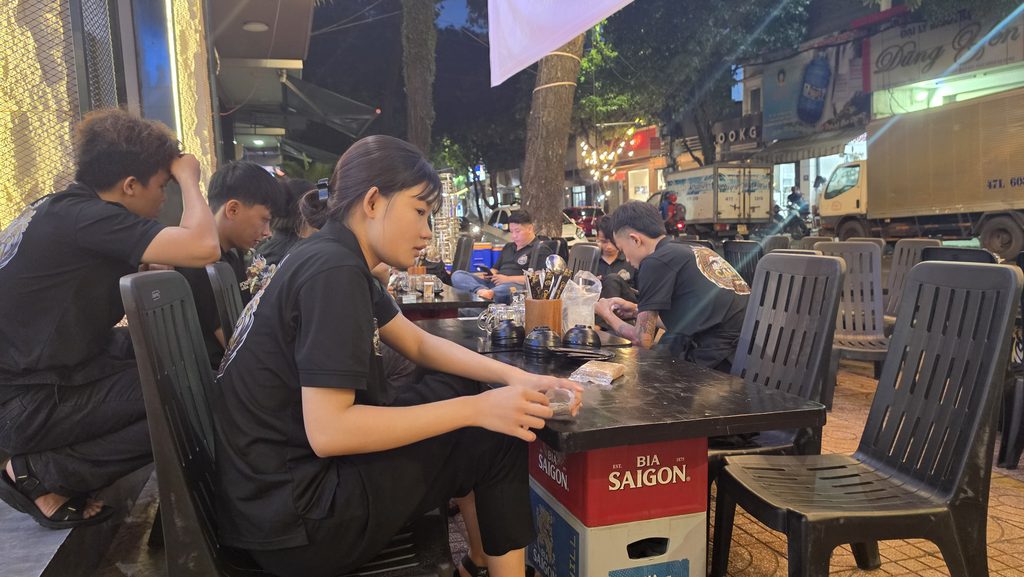
Something I have noticed here in Vietnam is how young everyone looks, and I wonder if it is because in the past there was a lot of malnutrition; you go out to a restaurant, and everyone looks 14-16 years of age, just like when I was in East Timor in Dili, where girls looked 12 but in fact, they were 30. Another thing is that these young people’s mobile phones control everything they do. Last night at a restaurant, I took a photo of the staff where you can see how young they were, and they were all playing games, and customers take a back seat, considering I was the only one there at that time, 4.30 pm, because life evolves at night; people sleep during the day because of the heat and open the bars and restaurants at 6 pm in the evening when all the bright lights are switched on, and they are open until late into the evening.
Here in Buon Ma Phuot, tours are expensive; the cheapest is NZD 55, which is a huge dent in my daily budget, with most tour prices over NZD 90 to NZD 250, so I’m perplexed about how I’ll spend my day tomorrow. Looking at a budget around NZD 50 for travelling, accommodation, food and finding free things to do, it’s expensive for a 3.5 hr walking tour where in most countries walking tours are free and you pay at the end with a donation, even considering you will have a chance to taste local cuisine on the tour at NZD 69 is very expensive when local street food costs less that NZD 4, so if you are budgeting keep away if you are on holiday you are here to spend, spend and spend because you are a tourist who has money to burn.
It looks like I will spend my evening watching a couple of movies instead of heading out into the bright lights of this city, which is not that appealing. My first view of the city hasn’t changed my outlook; at the end of the day, your feet are very dirty because it’s quite dusty here. The city isn’t as busy as other cities, and crossing the road isn’t that dangerous if you follow the flow of traffic.

Across from me, 5 young children still at school approached me and wanted me to dance with them, but I had to decline because, one, I cannot dance, and my hips might not agree, so photos were a good option. We took a lot of photos, and they were a wonderful addition to my day—strangers interacting and sharing a common goal across language barriers, with a shared interest in communicating through different cultures.

So, another day ends, and tomorrow another begins. I hope you enjoyed the read up to now, but I plan to go to a Buddhist Temple tomorrow that is quite close by, and the museum, which is not one of my favourite pastimes, but the building might have some history attached to it because, in this area, a lot of the Vietnam war was in this area.
The Battle of Ban Me Thuot in March 1975 was one of the most decisive battles of the Vietnam War, marking the beginning of the rapid collapse of South Vietnam. The battle formed part of a major North Vietnamese military offensive known as Campaign 275, launched to capture the Central Highlands, a strategically important region of Vietnam. The North Vietnamese People’s Army of Vietnam (PAVN) launched a massive assault against the South Vietnamese Army (ARVN), and within just ten days, much of South Vietnam’s II Corps military strength had been destroyed.
The operation was enormous in scale. South Vietnamese forces numbered approximately 78,300 soldiers, supported by 488 tanks, 374 artillery pieces, 134 fighter-bombers, 250 helicopters and 101 reconnaissance aircraft. Facing them were around 65,141 North Vietnamese troops, equipped with 57 tanks, 679 military vehicles, 88 heavy artillery pieces, 343 anti-aircraft guns and 1,561 anti-tank or recoilless guns. Despite South Vietnam’s considerable military resources, the North Vietnamese offensive overwhelmed its defences, exposing serious weaknesses in its military leadership and organisation.
Two major mistakes contributed to the disaster. In the days leading up to the battle, South Vietnamese commander Major General Phạm Văn Phú repeatedly ignored intelligence reports warning that several North Vietnamese divisions were gathering around Ban Me Thuot. The situation deteriorated further when South Vietnamese President Nguyễn Văn Thiệu ordered a withdrawal from the Central Highlands. The evacuation was poorly planned and descended into chaos, leaving soldiers and thousands of civilians desperately trying to escape.
The human cost was devastating. Approximately three-quarters of the South Vietnamese forces involved were killed, wounded, missing or captured, while enormous quantities of military equipment were abandoned or destroyed. North Vietnamese losses were reported at 800 killed and 2,416 wounded. Perhaps the most tragic chapter unfolded along Route 7, where retreating South Vietnamese military convoys, accompanied by soldiers’ families and fleeing civilians, came under heavy North Vietnamese artillery fire. Vehicles were destroyed, escape routes became blocked, and countless people lost their lives in the confusion.
The defeat at Ban Me Thuot proved to be a turning point from which South Vietnam never recovered. What began as a military campaign to capture the Central Highlands quickly developed into a nationwide offensive. Just weeks later, on 30 April 1975, Saigon fell to North Vietnamese forces, bringing the Vietnam War to an end and forever changing the course of the country’s history.
I headed back to the dorm to watch a movie. The hostel has no communal space to talk and share experiences; it feels cold and empty, and I feel alone—especially after my last experience in Da Lat at a lively hostel full of life.
Day 387: Sac Tu Khan Doan Pagoda
Height above sea level: 1580 Ft
Weather Update: 28 °C, cloudy, Windy with Sunny Intervals
Air Quality: Good 28 Rising to 63 Overnight
I included air quality in the blog because it shows what it is like where you are. The rise from 28 to 63 is because nighttime brings everyone out, increasing traffic and pollution as temperatures slowly decrease and the sun goes below the horizon. It looks like tomorrow the air quality will stay at 63, which isn’t great, but standards say it’s bad when it reaches 100. I was wondering because the lady in the bunk above me may have been suffering because of the pollution.
Slept reasonably well, but my back was sore during the night because the bed was uncomfortable; that’s hostel life. I feel quite lonely here with two Asian ladies who do not speak or try to communicate, so I’m trying to keep myself occupied. Out on the street, it’s not so busy; being a Saturday, I thought it might be, but the roads are easy to navigate. I left around 9 am for breakfast, and the best places are busy with locals. I found a little place along the road, but their seating is almost to the floor, and when you’re elderly and your muscles aren’t as strong as they were when you were younger, it is a mission to sit down and get up.

I sat down and used my Translate App, and if you are travelling overseas, this is a vital communication tool. I asked for a meat dish with rice and was told that it was noodles with sliced bacon or pork, and that rice dishes were in afternoon and evening meals. I paid 35000 dong (NZD 2.48, EUR 1.24, GBP 1.04, USD 1.36, AUD 2.05). If you are heading out to Vietnam, don’t be afraid to sit down and sample street food; restaurants cost more, but given how cheap local food is, you cannot go wrong. By the way, most restaurants and bars don’t open before 4-6, so grabbing a beer or sitting down with a nice glass of wine (which you might get at the hotel) will be expensive.
I left and made my way to the Pagoda, a short walk away.

There are two entrances: the Main Gate and the Back Gate, which I used because that’s how I came.

The workmanship that has gone into making this Pagoda is astonishing; the wood is hand-carved, and the columns are solid pieces of timber that look like mahogany, though that’s only a guess.
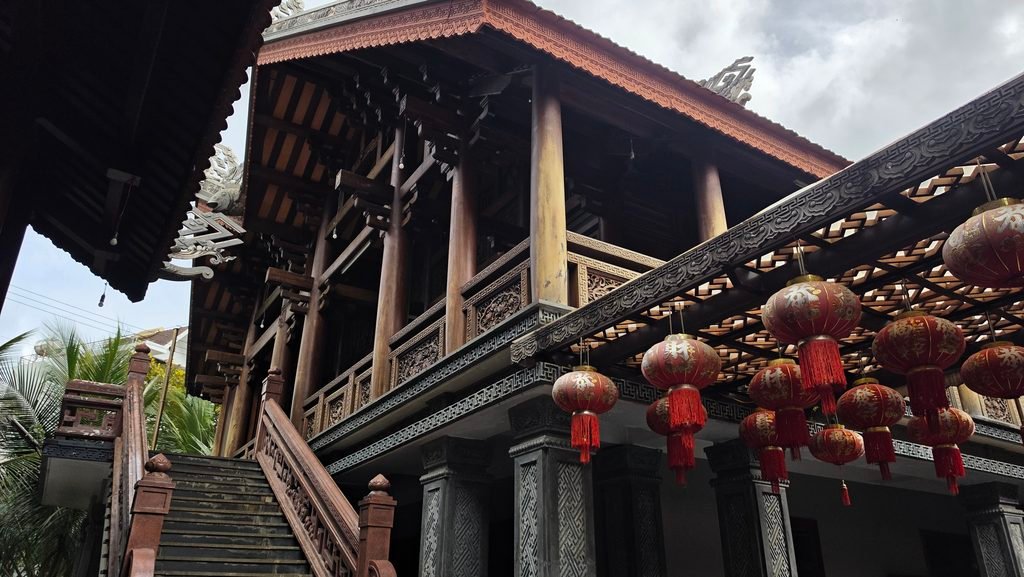

Here, there are several temples in the compound with very tall symbolic statues depicting Buddhism.

One thing I noticed was two 5-metre-tall statues that seemed to depict what Buddha described as evil and how it affects you; they looked like demons, but they are Dharma Protectors.
Tieu Dien Dại Sii – The Demon-Subduing Bodhisattva
Often positioned on the left, this statue is one of the temple’s most frightening figures. With its dark blue or fiery red face, bulging eyes, sharp horns, fearsome fangs, and long protruding tongue, it looks more like a terrifying demon than a Buddhist guardian.
However, behind this fearsome appearance lies a surprising story. Tiêu Diện Đại Sĩ is believed to be a powerful manifestation of Quan Âm, the Bodhisattva of Compassion. According to Buddhist tradition, Quan Âm took on this frightening form to enter the world of hungry ghosts and evil spirits, protecting people from harm while guiding lost souls away from darkness and towards enlightenment.
It is a fascinating reminder that, in Buddhism, even the most terrifying appearance can represent compassion, protection, and kindness.

Vi Da Ho Pháp (Skanda) – The Guardian of Buddhist Teachings
Standing opposite the fearsome Tieu Dien Dại Si, on the right side of the temple, is another towering and imposing figure known as Vi Đa Ho Pháp, or Skanda. Dressed in traditional military armour and carrying a ceremonial weapon, he resembles a powerful warrior guarding the sacred grounds.
Unlike his companion’s frightening appearance, Vi Đa represents strength, courage, discipline, and constant vigilance. His purpose is to protect the teachings of Buddha, known as the Dharma, and defend the temple against evil spirits and negative influences.

Together, these two remarkable statues create a powerful contrast between fear and protection, darkness and enlightenment. Although their imposing appearances may seem intimidating, both are regarded as guardians of the sacred temple and those who enter it.
In Buddhist art, fierce or “dark” imagery is rarely about evil—it represents the strength required to overcome ignorance, greed, and negativity. Rather than inviting darkness into the temple, these two statues act as spiritual bouncers: they confront and transform dark forces at the door so that the space inside remains peaceful and pure.
Every morning, chanting and the banging of drums wake me; the chanting lasts 30 minutes, and here, two matching wooden pavilions above them house the pagoda’s sacred instruments: the Drum Tower (Lau Trong) – the Voice of Buddha’s Teachings. Inside the Drum Tower stands a large ceremonial drum known as the Prajna Drum, or Trong Bat Nha. In Buddhist tradition, this drum is much more than a musical instrument. Its deep, powerful sound is believed to represent the Buddha’s teachings, echoing like thunder across the temple grounds.

Each beat symbolises a spiritual awakening, encouraging people to look beyond ignorance, confusion, and the distractions of everyday life. The sound reminds us to seek wisdom, compassion, and enlightenment. It is fascinating to think that something as simple as the beating of a drum can carry such a powerful spiritual message, calling people to awaken their minds and find greater understanding in their l
Standing within the temple grounds is the Bell Tower, home to an impressive 380-kilogram bronze bell known as the Dai Hong Chung. Cast in the historic city of Hue in 1954, this magnificent bell carries a deep spiritual significance in Buddhist tradition.

Although the symbols represent light, awakening, and compassion, Sac Tu Khai Doan has a distinctly solemn, heavy atmosphere compared to brighter, gold-painted temples.
Built in 1951 in the imperial Hue style mixed with Central Highlands longhouse architecture, it uses massive pillars of dark ironwood (Go Lim), weathered stone, and deep earth tones. Combined with the deep, low-frequency resonance of the drum and bell, the space is intentionally designed to feel grounded, serious, and awe-inspiring rather than bright or playful.
So, I end a peaceful day that had some troubles of my making, which I question.

I booked my onward trip, checked the dates of travel, and everything was above board: the date was correct, the time was correct, the payment was correct, but when you click, the algorithm sometimes takes over and changes what you are after and if you are not careful, you book the wrong day, which I did; I ended up booking Monday when I was leaving Sunday, a 400000 Dong mistake, but you have to take it in stride and move on and take note to be more careful, but when everything looks right, it can become wrong.
I remember booking flights to Australia in the past: I entered the dates I wanted to fly to Brisbane, Australia, paid, and everything seemed above board, with no issues. But, unbeknownst to me, the algorithm took my booking without issuing the dates I entered on the website; I didn’t fly on those dates and was put on the flight the day before. It wasn’t until I was packing and checking everything that I realised the plane took off the day before. I was frantic; my wife was expecting a month’s holiday in Noosa, and we had no flight, but Air New Zealand were very good and got us on flights that day to Coolangatta, 10 hrs away from our destination, Noosa, but it was an adventure that a mistake proved to be a good experience.
So just another day thinking everything is ok, but then something brings you back down to earth.
Glad you are here following my journey; I’d like to reach out to friends and neighbours and get them to follow my journey at inspireseniorstravel.com, inspiring seniors that this type of travel is not just for young people but for anyone who has the courage to make that first step; the difficult bit is accepting you can do it and, just like me, exploring the beauty this world has to offer. If you need help taking that first step, let me know; I want seniors to explore, step out of the fear that holds you back from challenging yourself, and believe you can do this.
Andrew: Inspire Seniors Travel
RELATED POSTS
View all


Day 383–384: The Hidden Wonders of Da Lat — Part 2
November 19, 2026 | by Andrew Matthews

Day 372 — Ho Chi Minh City to Can Tho
November 7, 2026 | by Andrew Matthews