

From Berlin to Prague — Another Adventure Begins
After a rather disappointing few days in Germany, I was looking forward to arriving in Prague, the historic capital of the Czech Republic.
The morning began with another race against the clock.
I’d booked a FlixBus leaving Berlin at 10 am, but managed to miss my tram at 8 am by just a few seconds. The next tram was running eleven minutes late, which immediately put my connecting train at risk.
If I missed the S-Bahn connection at 8.36 am, I wouldn’t reach the bus station until approximately 9.45 am. That would leave just fifteen minutes before departure.
Not exactly how I wanted to start the day!
Fortunately, I made the connection, caught my bus and finally settled into my seat.
Outside, the skies were grey and rain was falling steadily. Berlin gradually disappeared behind us as we travelled south towards the Czech border.
After the frustrations of Hamburg and Berlin, I was hoping Prague would offer a different experience.
An Unexpected Detour Through Tisá
Several hours into the journey, our bus suddenly slowed down.
Traffic was being diverted off the motorway and onto narrow country roads. Cars were being directed one way, while heavy vehicles followed another route.
Most passengers probably regarded it as an inconvenience.
I saw it as an opportunity to discover somewhere I might otherwise have missed.
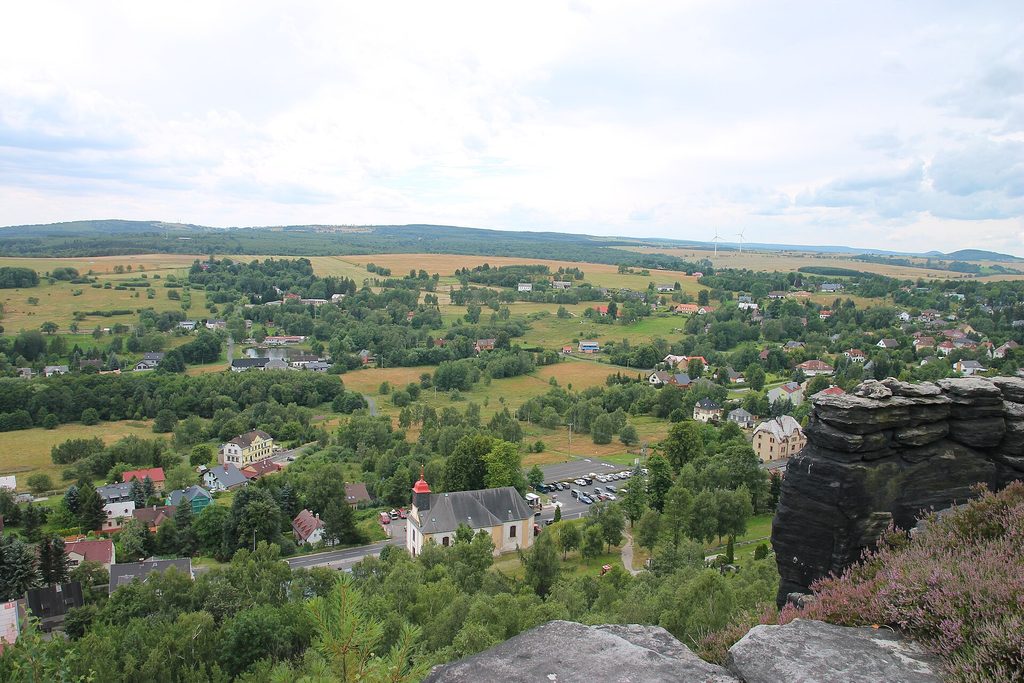
With only around a thousand inhabitants, it seemed a world away from the busy cities I’d been visiting.
Autumn was beginning to transform the countryside. The trees displayed beautiful shades of orange, brown and red, while mist drifted across the surrounding hills.
Nearby stood the remarkable Tisá Rocks, enormous sandstone formations rising dramatically above the landscape.
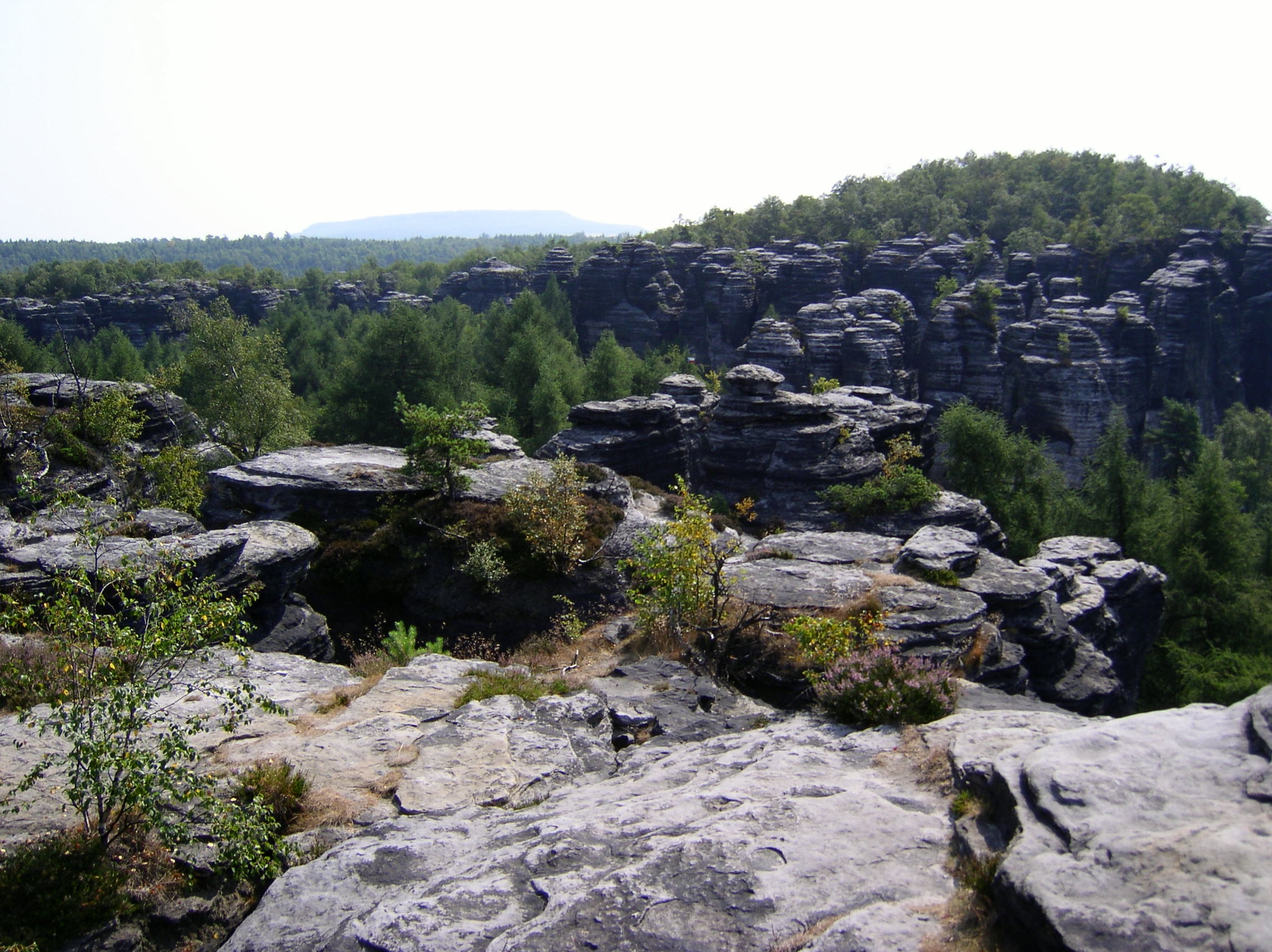
Looking through the bus window, I imagined what the countryside might look like in winter, with snow covering the rooftops and the sandstone formations rising above a white landscape.
It made me think about the freedom of travelling without a strict timetable.
Wouldn’t it be wonderful to have the time and money to wander through countries, stopping in small towns and villages that rarely feature on the main tourist routes?
There must be thousands of beautiful places that people never discover because they’re rushing between famous attractions.
Unfortunately, our bus had a destination to reach.
We eventually returned to the main road and continued towards Prague.
But Tisá stayed in my thoughts.
Sometimes the most memorable places are those you never intended to visit.
Arriving in Prague — Too Old for the Hostel!
I thought the difficulties of the day were behind me when we arrived in Prague.
I was wrong.
I’d booked a hostel that looked perfectly suitable online, but when I arrived, I discovered an age restriction buried in the booking conditions.
Guests had to be between eighteen and thirty-nine years old.
At seventy-two, I was apparently a little outside their preferred age group!
I’ve travelled through dozens of countries, staying in hostels and sharing accommodation with people of all ages. Rarely has my age been a problem.
Fortunately, the hostel refunded my payment.
I found another hostel that looked promising, only to discover that it belonged to the same company and imposed exactly the same restriction.
So there I was, in a new city, with rain falling and nowhere to stay.
Not the welcome I’d been hoping for.
Eventually, I found One Arbes Hostel, across the river from Prague’s Old Town.
The reviews were encouraging, and when I arrived, I immediately felt more comfortable.
The hostel required a cash deposit for the room key, which was unusual, but after everything that had happened, I was simply grateful to have somewhere to sleep.
The dormitory was on an upper level, with comfortable beds, privacy curtains, individual lights and power sockets.
There wasn’t a shelf for smaller belongings, but after months of hostel living, I’ve learned to appreciate privacy and a good night’s sleep.
My German SIM card was also causing difficulties, so finding reliable mobile internet would be another task.
Then came a pleasant surprise.
Free sangria in the hostel kitchen!
After missing transport connections, taking an unexpected detour and being turned away by two hostels because of my age, that glass of sangria tasted particularly good.
Another difficult travel day had finally come to a happy ending.
Petřín Hill — One Way, Then Another
My first proper morning in Prague didn’t begin particularly early.
I’d been woken by people leaving the dormitory, with the usual rustling of bags and opening and closing of lockers.
I almost said something about the noise, but fortunately kept quiet.
When I looked at my phone, it was already 9.05 am!
After finishing some work on my travel photographs and blog, I headed out to find some local currency.
My digital travel card, which normally worked without problems, refused to allow a cash withdrawal.
In New Zealand, my credit card doesn’t usually permit cash advances, but I decided to try it anyway.
To my surprise, it worked.
One problem solved!
The weather was cloudy, and Prague’s Old Town was approximately 2.7 kilometres away.
I asked the hostel receptionist whether there was somewhere nearby where I could enjoy a beer.
He recommended Strahov Monastery, which has its own brewery.
A monastery with a brewery?
That sounded like an excellent idea.
Unfortunately, he didn’t mention the hill.
What began as a relatively gentle walk soon became a demanding climb up Petřín Hill.
And to make matters worse, I’d decided to wear sandals rather than proper walking shoes.
Not one of my better decisions!
Petřín Hill rises to approximately 327 metres above sea level and is one of Prague’s most attractive green spaces.
Its gardens, orchards and winding pathways provide an escape from the crowded streets below.
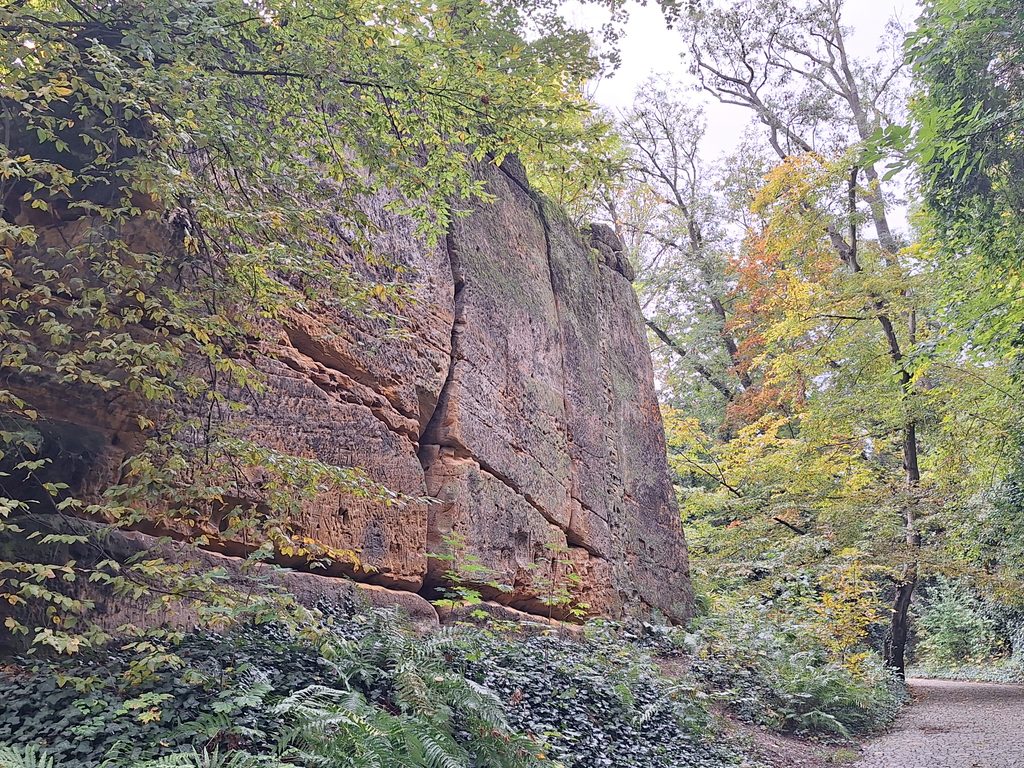
Historically, parts of the hillside were used for quarrying stone, while other areas were cultivated as vineyards and gardens.
Today, it is a beautiful place to walk, with wooded paths, landscaped gardens and magnificent views across the city.
Choosing the correct path wasn’t always easy.
I took several wrong turns, stopped occasionally to catch my breath and wondered whether the monastery was getting any closer.
But every turn brought something interesting.
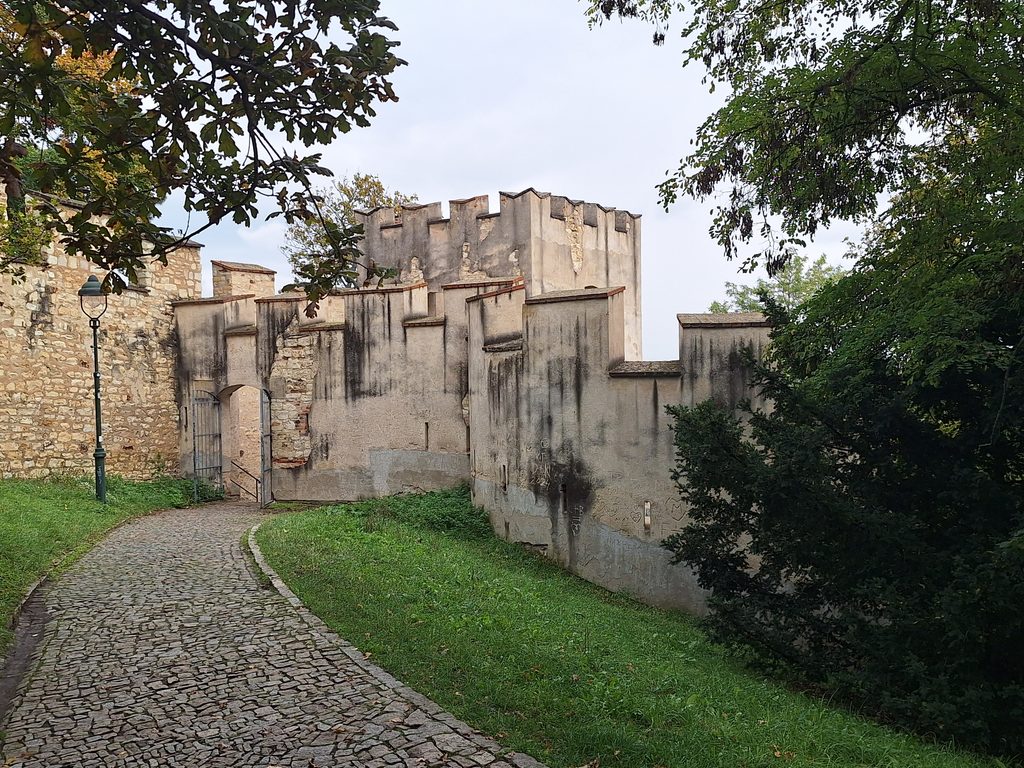
And that’s one of the reasons I enjoy walking rather than rushing everywhere on public transport.
The Hunger Wall — A Medieval Reminder
Partway up Petřín Hill, I came across the remarkable Hunger Wall.
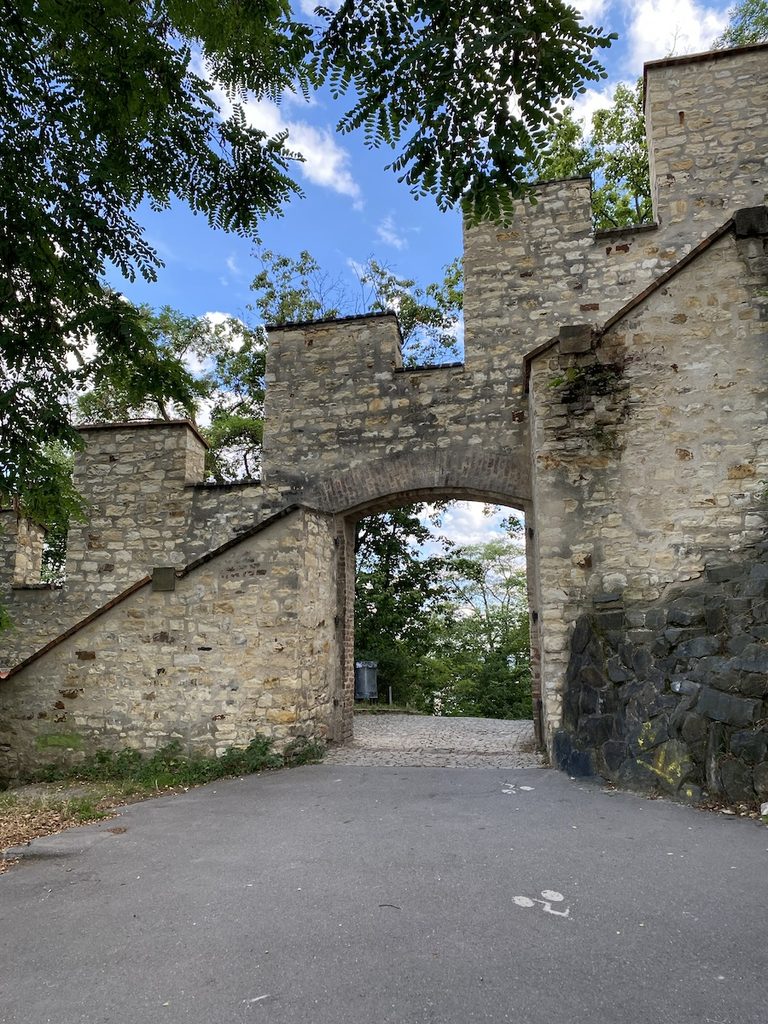
Originally, sections stood more than four metres high and almost two metres thick, complete with battlements and defensive bastions.
Its purpose was to help protect Malá Strana and the approaches to Prague Castle.
But its name tells another story.
According to local tradition, Charles IV commissioned the work partly to provide employment for poor people during a period of famine.
Rather than simply giving out charity, the construction project supposedly allowed workers to earn money and support their families.
The precise historical circumstances are debated, but the story has remained part of Prague’s folklore for centuries.
The wall has undergone numerous repairs and alterations over the years, yet substantial sections remain.
Standing beside those old stones, I found myself imagining the people who had worked here more than six hundred years ago.
For them, it wasn’t a tourist attraction.
It was hard physical labour, possibly undertaken simply to put food on the table.
History has a way of becoming more meaningful when you’re standing right in front of it.
Štefánik Observatory — Looking Towards the Heavens
Continuing uphill, I reached the Štefánik Observatory.
Founded in 1928, it is named after Milan Rastislav Štefánik, a Slovak astronomer, military officer and politician.
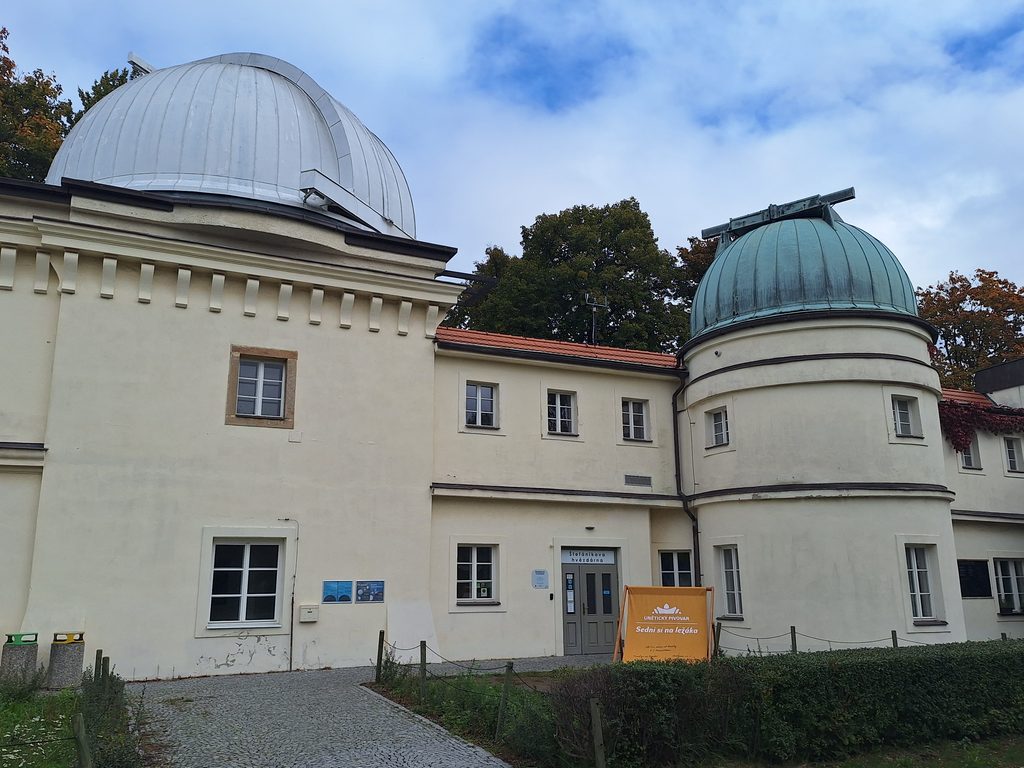
The observatory’s distinctive domes house telescopes used for astronomical observations and public education.
Visitors can learn about the planets, stars and other celestial objects, and when conditions permit, look through the telescopes themselves.
Unfortunately, the cloudy weather wasn’t especially promising for astronomy.
Still, it was an interesting discovery.
I’d left the hostel intending to have a beer and found myself exploring medieval defences and an astronomical observatory instead.
That’s the beauty of travelling without making every hour fit a fixed schedule.
Petřín Tower — Prague’s Little Eiffel Tower
Nearby stands one of Prague’s most recognisable landmarks, Petřín Tower.
Built in 1891 for the Jubilee Exhibition, it was inspired by the Eiffel Tower in Paris.
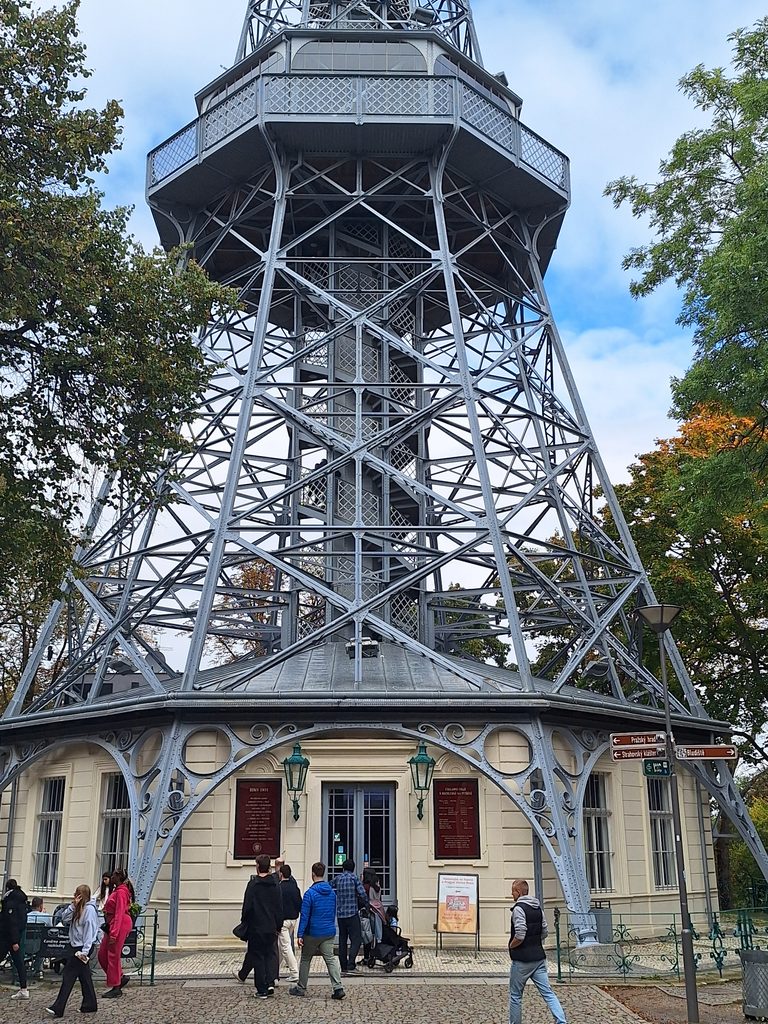
At approximately 63.5 metres high, it is considerably smaller than the French original, but its position on the hillside gives visitors wonderful panoramic views.
Construction took only a few months, an impressive achievement for its time.
Visitors can climb 299 steps to reach the observation platform or use the small lift.
Having already walked uphill in sandals, another 299 steps didn’t sound particularly attractive!
Unfortunately, the funicular railway that normally carries visitors up Petřín Hill was undergoing reconstruction during my visit.
That meant walking or using road transport.
If I return, I might investigate an easier way up.
For now, I’d already had quite enough climbing.
And I still hadn’t reached the brewery!
Strahov Monastery — History, Beer and Czech Hospitality
Eventually, I made my way towards Strahov Monastery.
The monastery was established in the twelfth century and has long been associated with the Premonstratensian religious order.
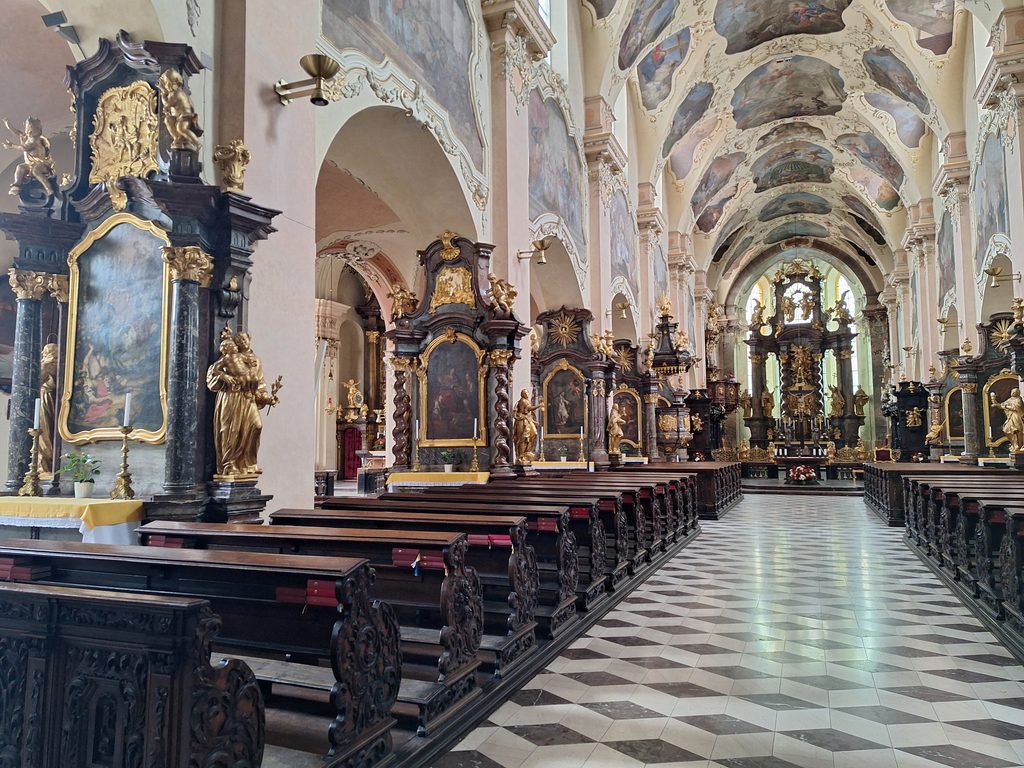
Over the centuries, it became an important centre of worship, scholarship and learning.
Its historic library is particularly famous, containing magnificent halls decorated with frescoes, woodwork and thousands of books.
But on this occasion, I was interested in something rather less scholarly.
The brewery!
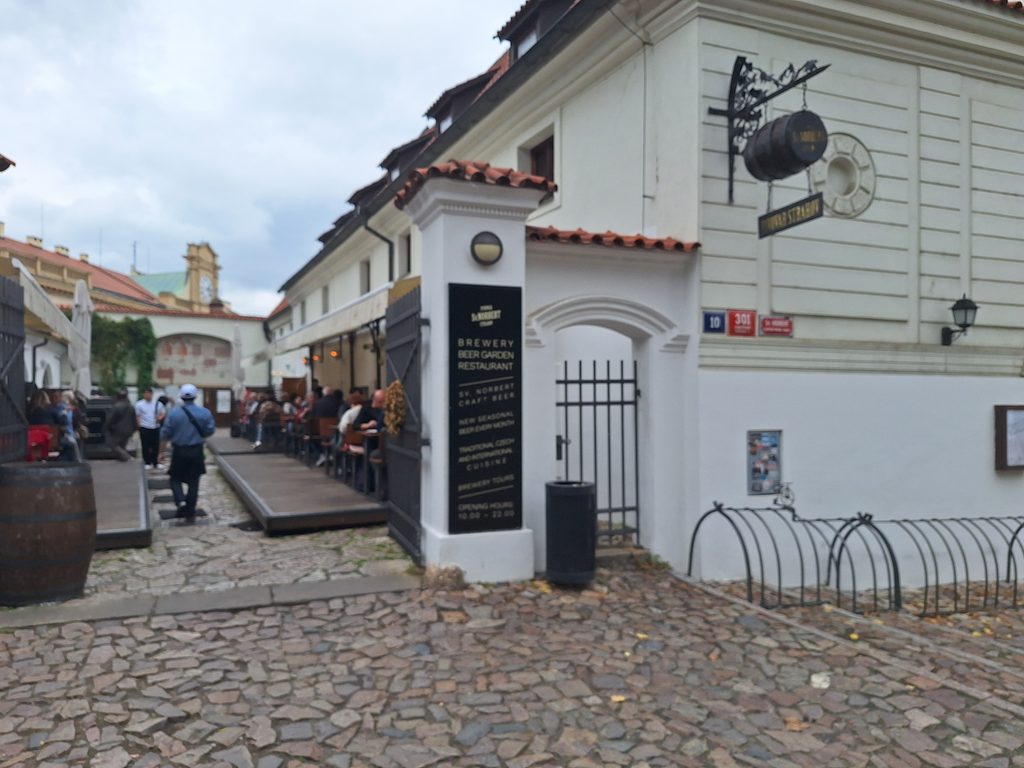
Strahov has a centuries-old brewing tradition, and its restaurant serves traditional Czech food alongside locally brewed beer.
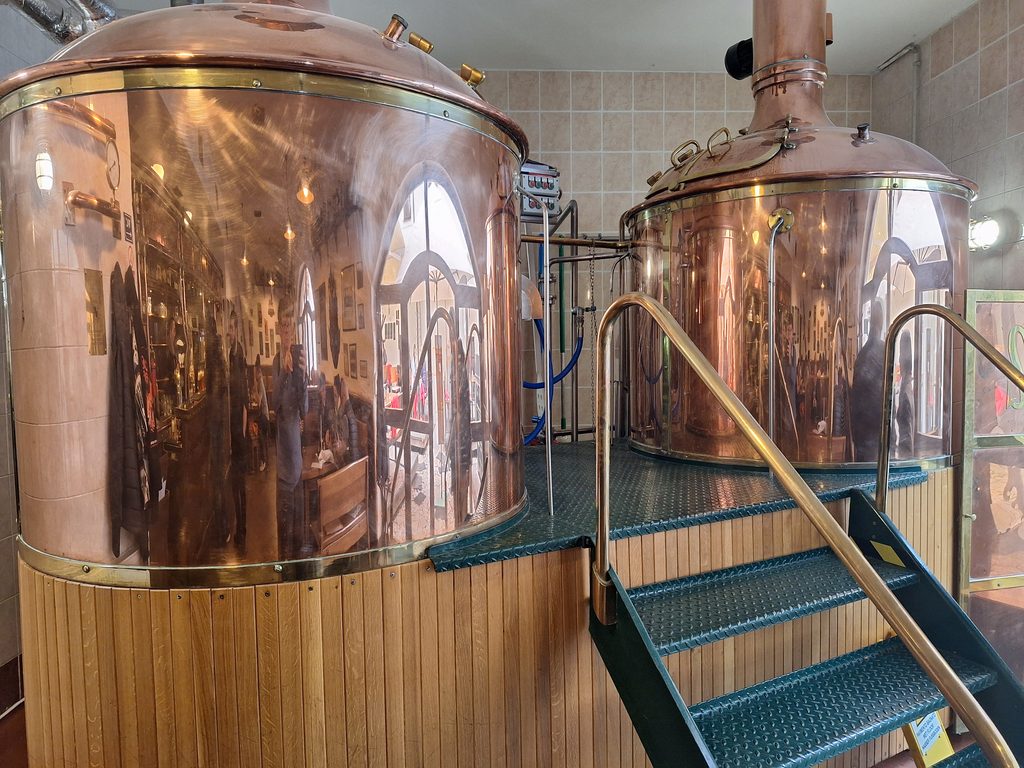
The courtyard restaurant was busy, but I managed to find a seat at the end of a table shared by a friendly group of Spanish travellers.
I’d originally intended to have just a couple of beers.
Then I noticed the food being carried past.
Plates of steaming goulash, dumplings and other hearty Bohemian dishes looked far too tempting to ignore.
My plans quickly changed.
I ordered Dark Lager Beef Goulash with dumplings and a pint of the brewery’s Antidepressant Dark Lager.
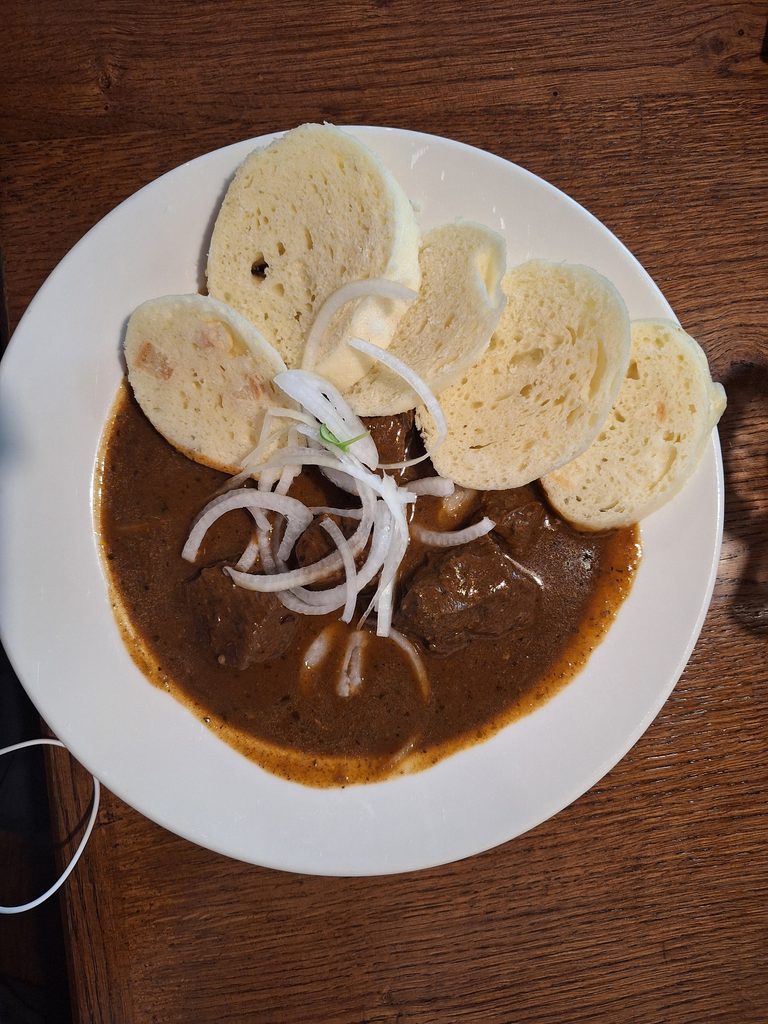
What a wonderful name for a beer!
The dark lager was rich and malty, exactly what I needed after climbing Petřín Hill.
The goulash was equally impressive, with tender beef, a rich sauce and traditional Czech dumplings.
A proper meal after a long morning walking.
Two beers and the goulash cost 459 Czech crowns, approximately €18.84 or NZ$38.23 at the time.
Worth every crown.
I’d set out to find somewhere for a beer and ended up discovering beautiful gardens, medieval history, an observatory, an Eiffel Tower-inspired landmark and a wonderful monastery brewery.
Not a bad day’s work!
An Evening with Fellow Travellers
Afterwards, I walked back downhill towards One Arbes Hostel.
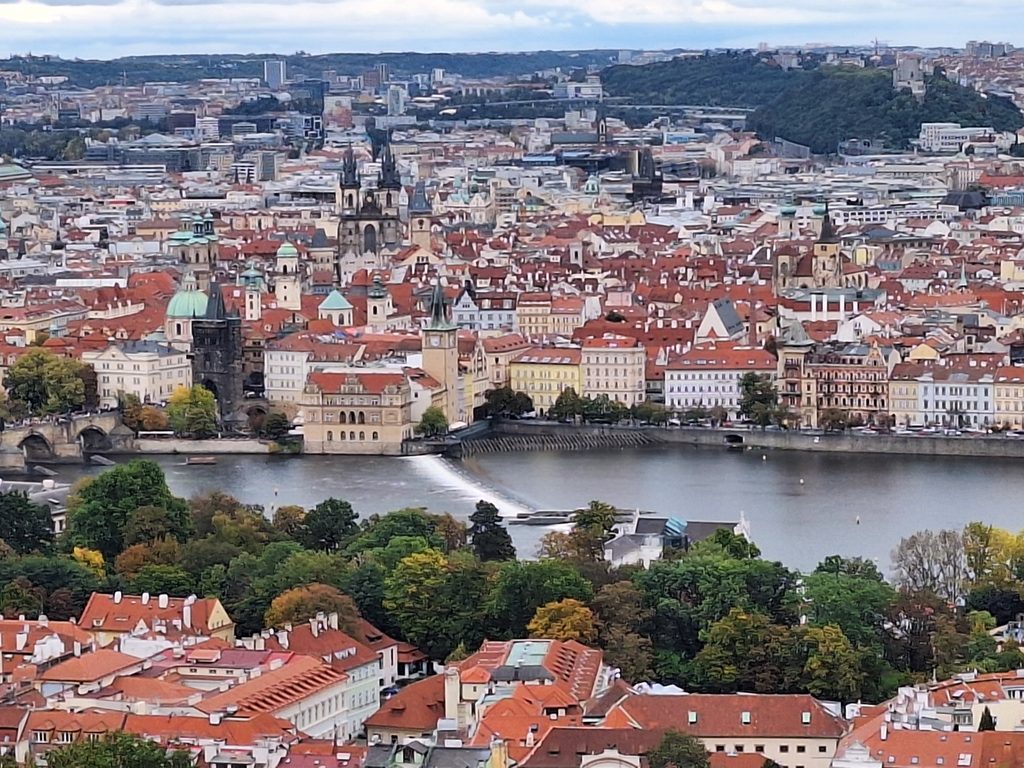
Thankfully, the return journey was much easier.
That evening, several of us shared a meal in the hostel kitchen, with two different pasta dishes on offer.
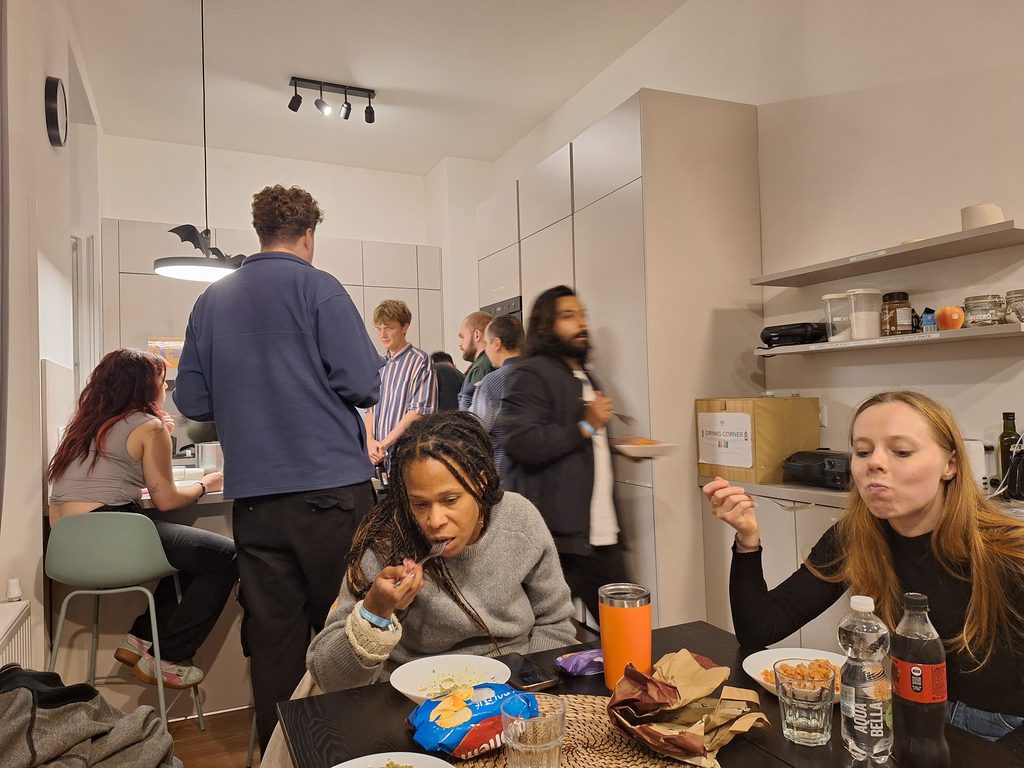
We spent the evening playing cards, talking and enjoying each other’s company.
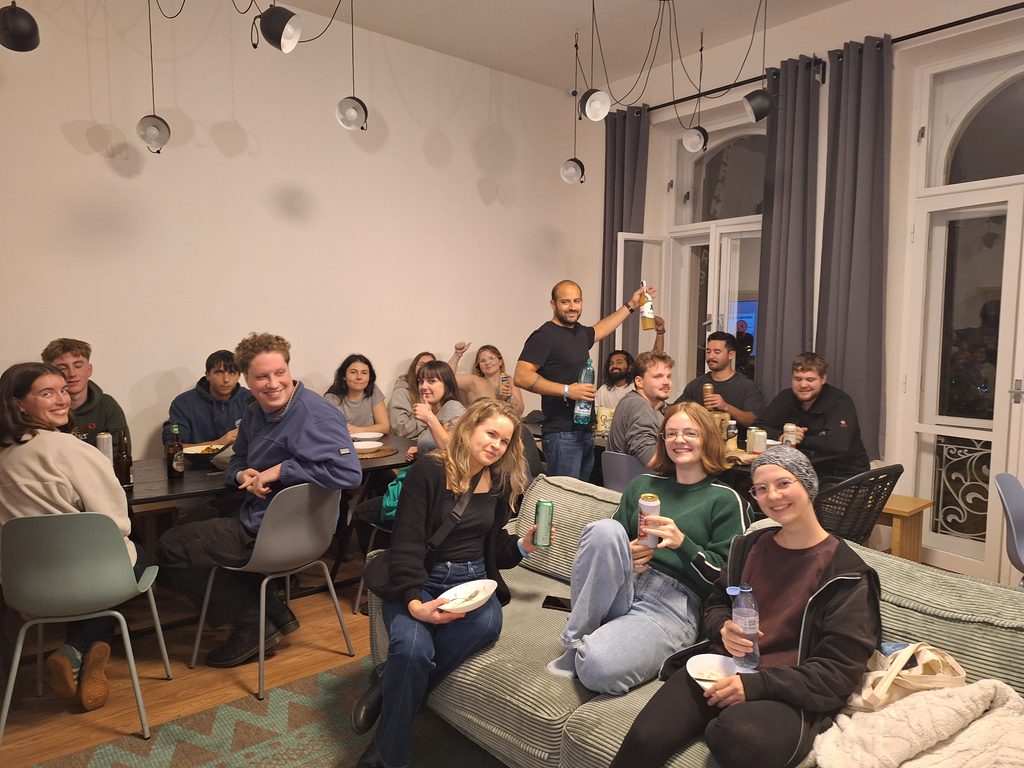
A few younger travellers headed out on a pub crawl and didn’t return until around four in the morning.
I was perfectly happy to stay behind.
One of the great pleasures of hostel travel is meeting people from different countries, backgrounds and generations.
Age becomes far less important when everyone is sharing experiences and enjoying a conversation.
I’d walked 10.84 kilometres during my first proper day exploring Prague.
Not bad for a seventy-two-year-old wearing sandals!
And tomorrow, it would be time to explore the historic Old Town.
Prague’s Old Town — Walking Through Centuries of History
The weather remained cool, with light cloud and temperatures around 15°C.
I set off towards Prague’s Old Town Square, a little over two kilometres from the hostel.
My route followed the Vltava River, where boats were moored along the waterfront, some offering meals and drinks with views across the water.
Prague is one of those cities where history seems to appear around every corner.
The closer I came to Old Town Square, the larger the crowds became.
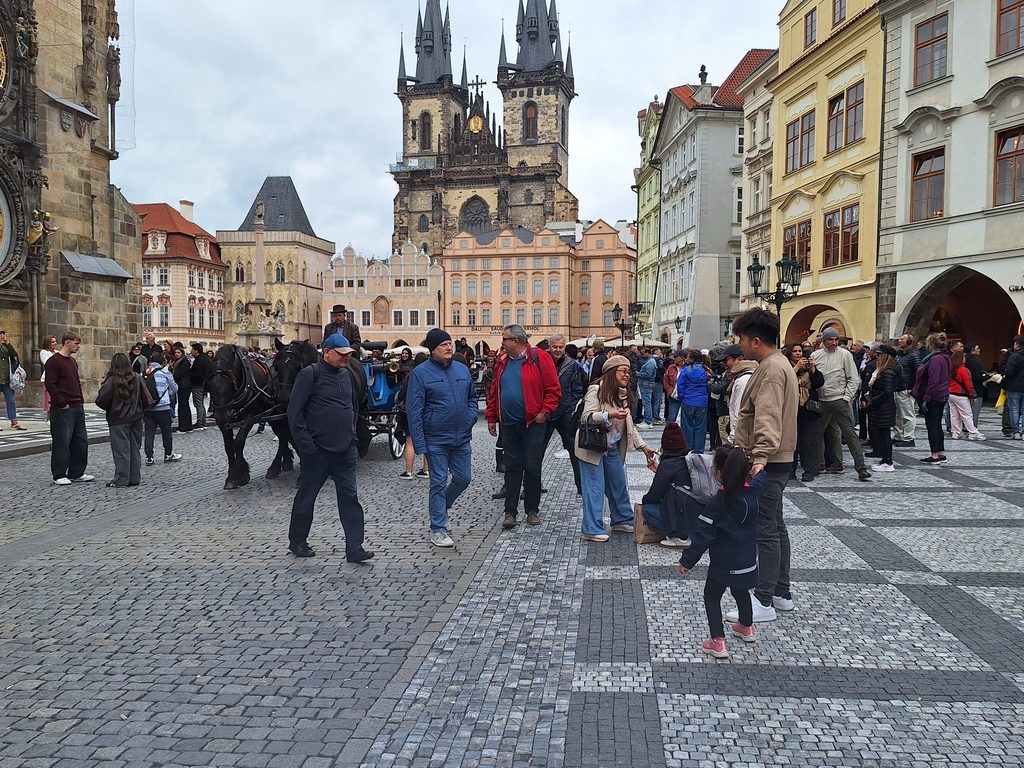
People were making their way towards one of the city’s most famous attractions, the Astronomical Clock.
When the square finally opened before me, it was magnificent.
Historic buildings, colourful façades, church towers and Gothic spires surrounded an enormous open space filled with visitors.
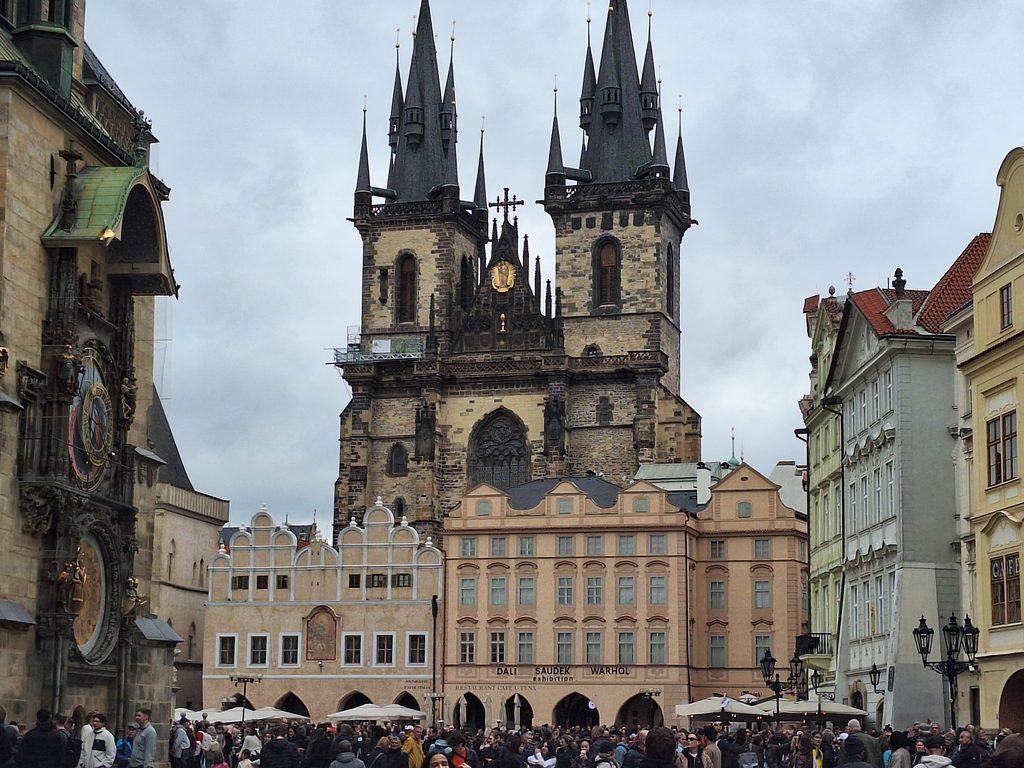
I’d seen photographs of Prague before arriving, but seeing the city in person was something entirely different.
Church of Our Lady Before Týn
Dominating one side of Old Town Square are the two extraordinary Gothic towers of the Church of Our Lady before Týn.
Their dark spires rise dramatically above the surrounding buildings, creating one of Prague’s most recognisable silhouettes.
The church has been an important place of worship for centuries, particularly during the religious and political upheavals of medieval Bohemia.
Standing beneath those towers, I tried to imagine the merchants, craftsmen and townspeople who had gathered in this same square hundreds of years earlier.
Inside, the atmosphere was quieter and more solemn.
There was beautiful religious artwork, historic architecture and the familiar sense of centuries of worship.
Unfortunately, photography wasn’t permitted.
An attendant was particularly vigilant about enforcing the rule.
The church sold postcards and photographs of the interior, which made me wonder whether that was part of the reason for the restriction.
I find it frustrating when historic places charge for images or prevent visitors from recording what they’ve travelled so far to see.
Nevertheless, the church was well worth visiting.
St Nicholas Church — Baroque Beauty
Across Old Town Square stands St Nicholas Church, a very different architectural experience.
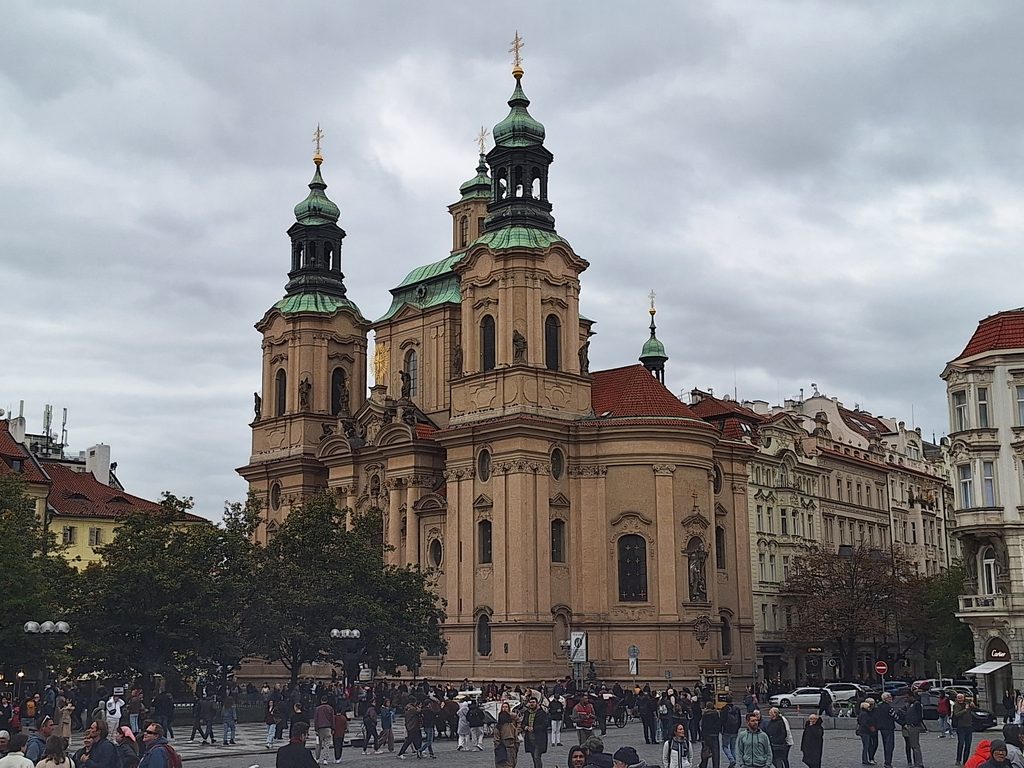
Where Týn Church is dominated by dark Gothic towers and medieval stonework, St Nicholas displays the elegance and decoration of the Baroque period.
The present church was constructed between 1732 and 1737 on the site of an earlier medieval church.
Inside, light poured across decorative details, ornate surfaces and beautiful frescoes.
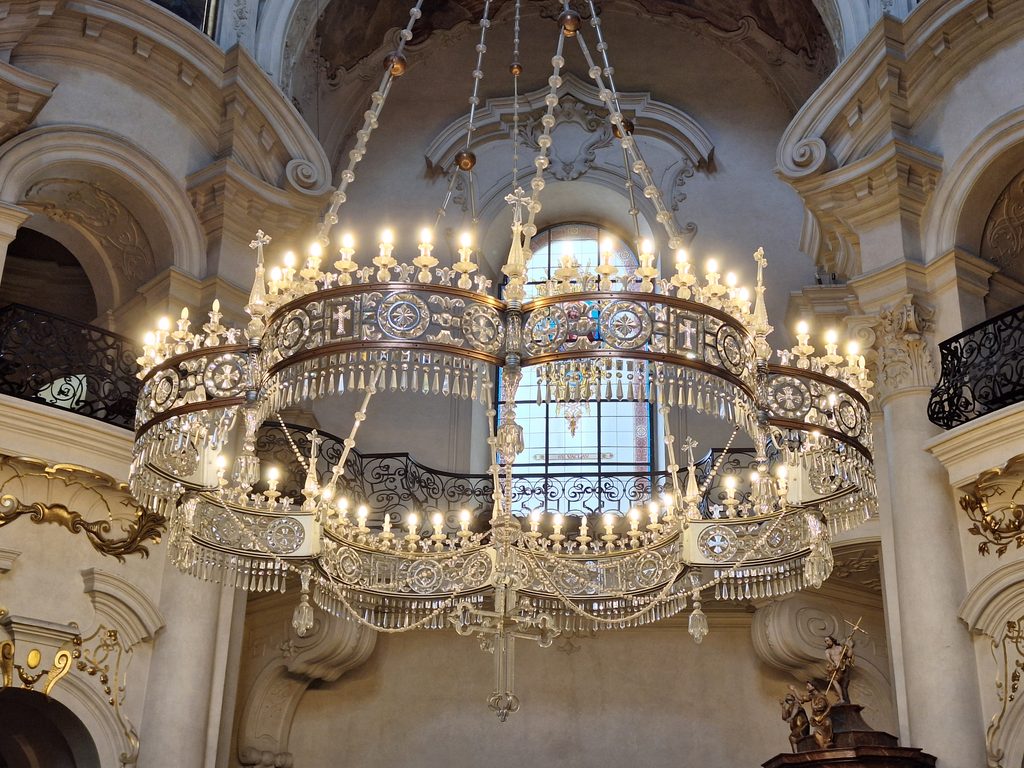
I sat quietly in one of the pews for a while, admiring the artwork and reflecting on the different ways religious faith has been expressed through architecture.
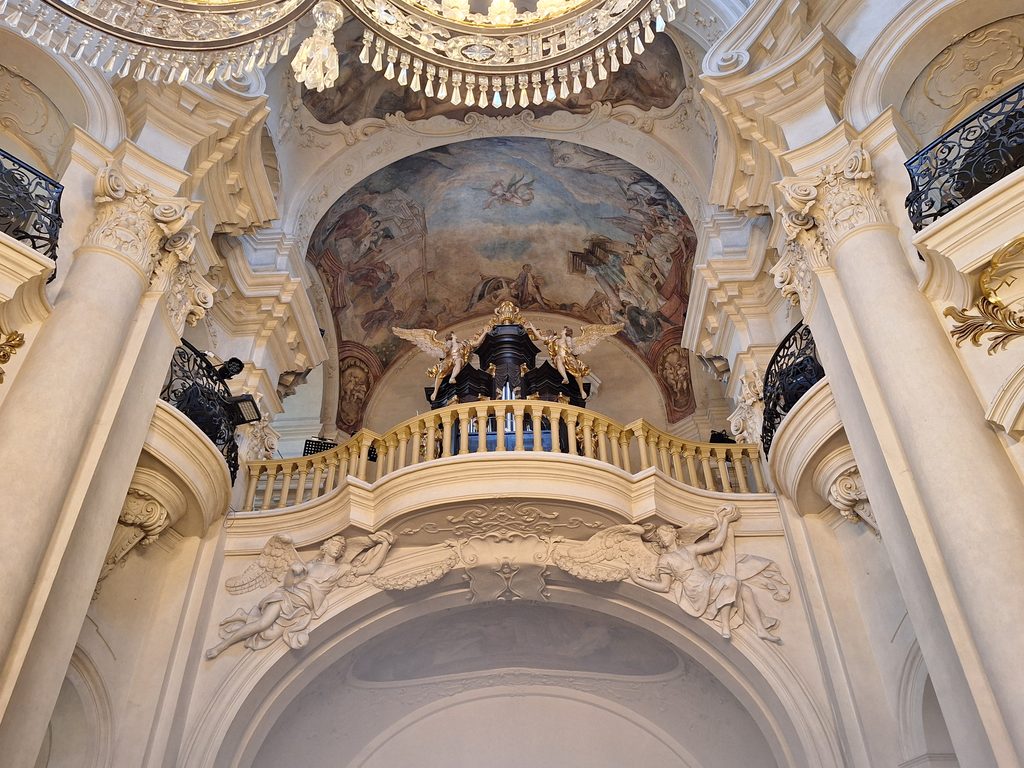
Every church seems to have its own atmosphere.
Some are enormous and overwhelming.
Others are small, peaceful and intimate.
St Nicholas certainly belonged to the grander tradition.
The building also played a role in modern history. During the Prague uprising in 1945, Czech resistance fighters used the church as a concealed location connected with Radio Prague while the main radio building was under attack.
Once again, a beautiful building revealed a much more complicated history than its appearance might suggest.
Prague’s Astronomical Clock — Six Centuries of Time
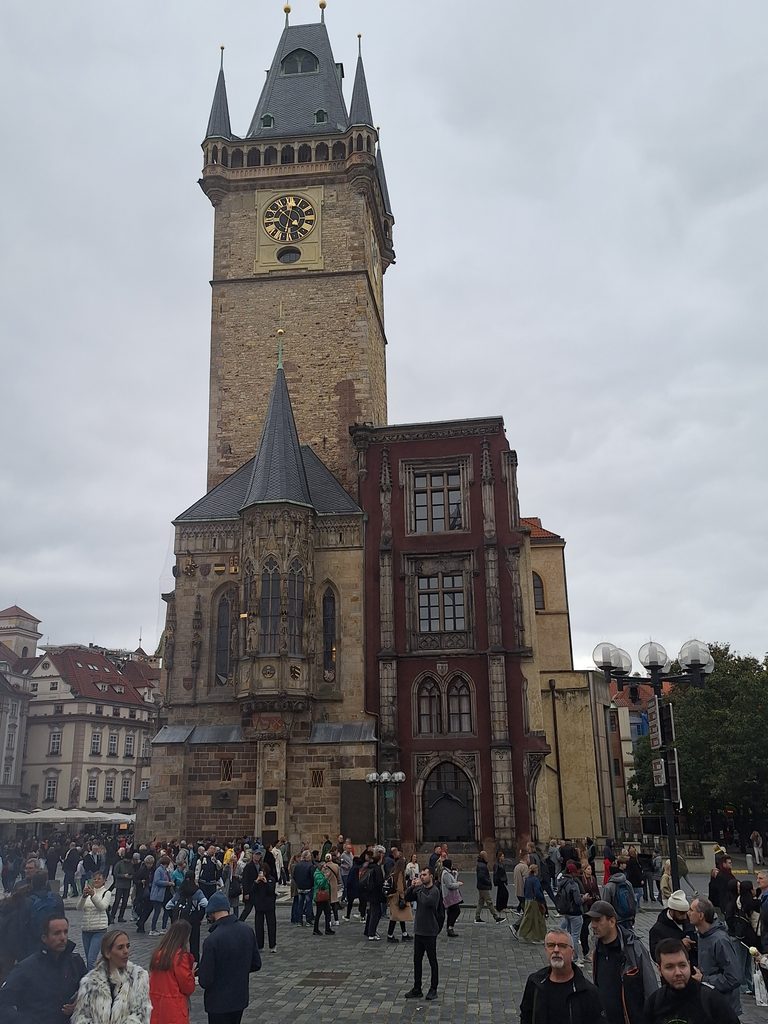
Back outside, I joined the crowds gathered beneath Prague’s famous Astronomical Clock.
Located on the Old Town Hall, the clock is one of the oldest working astronomical clocks in the world.
Its history dates back to 1410.
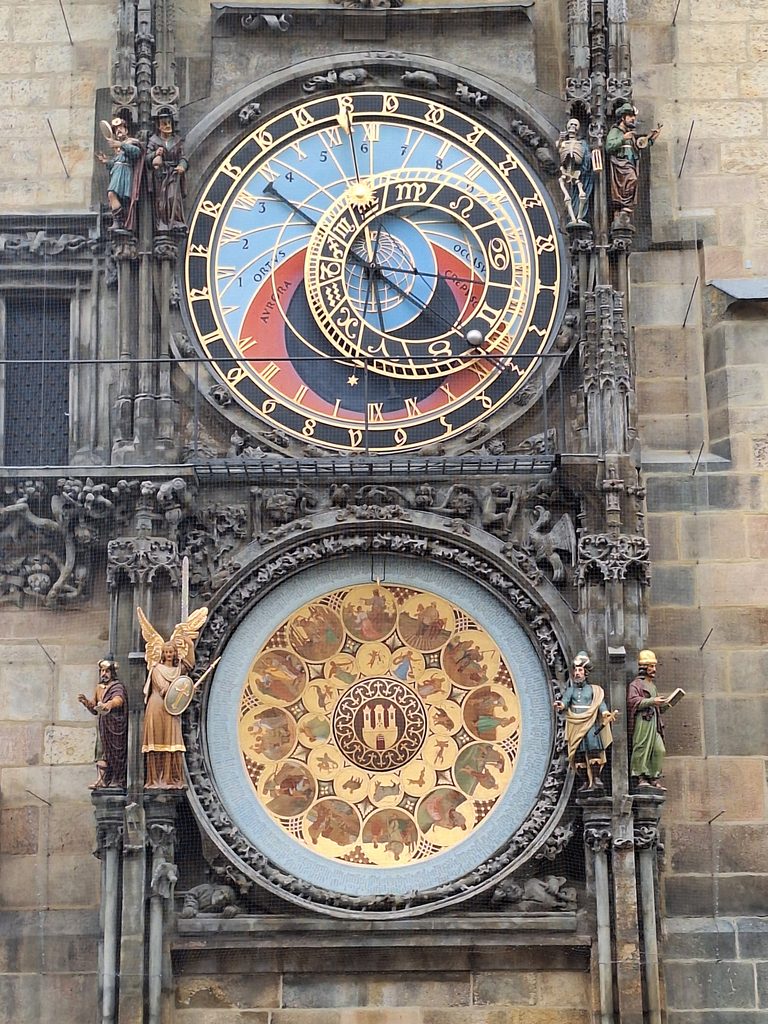
Over the centuries, additional figures and mechanical features were added, including the moving Apostles and the golden rooster.
The clock was damaged during World War II but underwent extensive repairs and restoration, with major work completed in 2018.
Every hour, visitors gather beneath it to watch the performance.
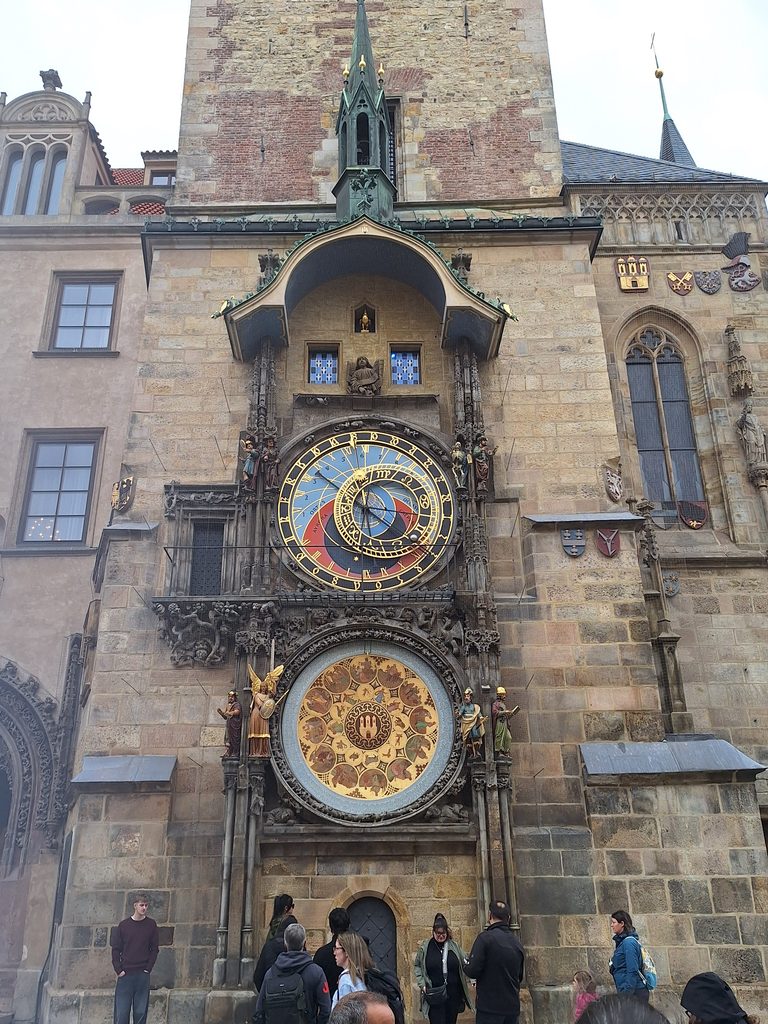
As the mechanism begins moving, figures appear in the small windows above the clock face.
It’s remarkable to think that medieval craftsmen created something that still attracts enormous crowds more than six hundred years later.
I’d seen another impressive astronomical clock at St Mary’s Church in Gdańsk, Poland, and couldn’t help comparing the two.
The Polish example is larger and more elaborate in some respects, but Prague’s clock has its own extraordinary character.
Standing among the crowds, looking upwards as the mechanism came to life, I thought about the generations of people who had watched this same spectacle.
Kings, merchants, soldiers, townspeople and tourists.
All looking up at a clock that has continued marking the passage of time through centuries of European history.
Karlova Street — A Walk Through the Old City
Leaving Old Town Square, I followed Karlova Street towards the river.
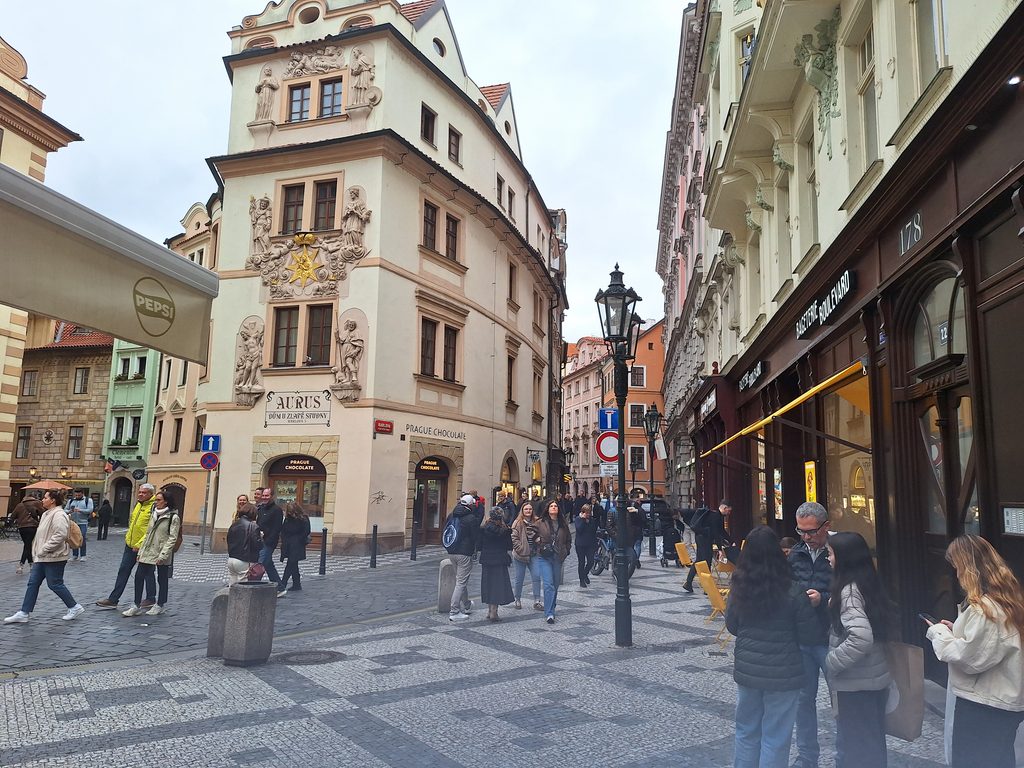
This narrow, winding street forms part of Prague’s historic Royal Route.
The cobblestones were uneven, the buildings crowded closely together, and souvenir shops seemed to occupy every available space.
There were tourists everywhere.
Yet despite the crowds, the street retained a wonderful atmosphere.
Different languages filled the air as visitors wandered between shops, cafés and historic buildings.
Then the smell of freshly baked trdelník caught my attention.
This popular sweet pastry is made by wrapping dough around a cylindrical spit, baking it and coating it with sugar, often with nuts or other toppings.
Although commonly sold throughout Prague, its historical origins lie in the wider Central European region, with strong connections to Hungarian, Slovak and Moravian traditions.
It was an enjoyable excuse to slow down and savour the atmosphere.
Sometimes the best way to experience a city is simply to walk through it without rushing.
The Powder Tower — Gateway to the Royal Route
Continuing along Celetná Street, I reached Prague’s magnificent Powder Tower, also known as the Powder Gate.
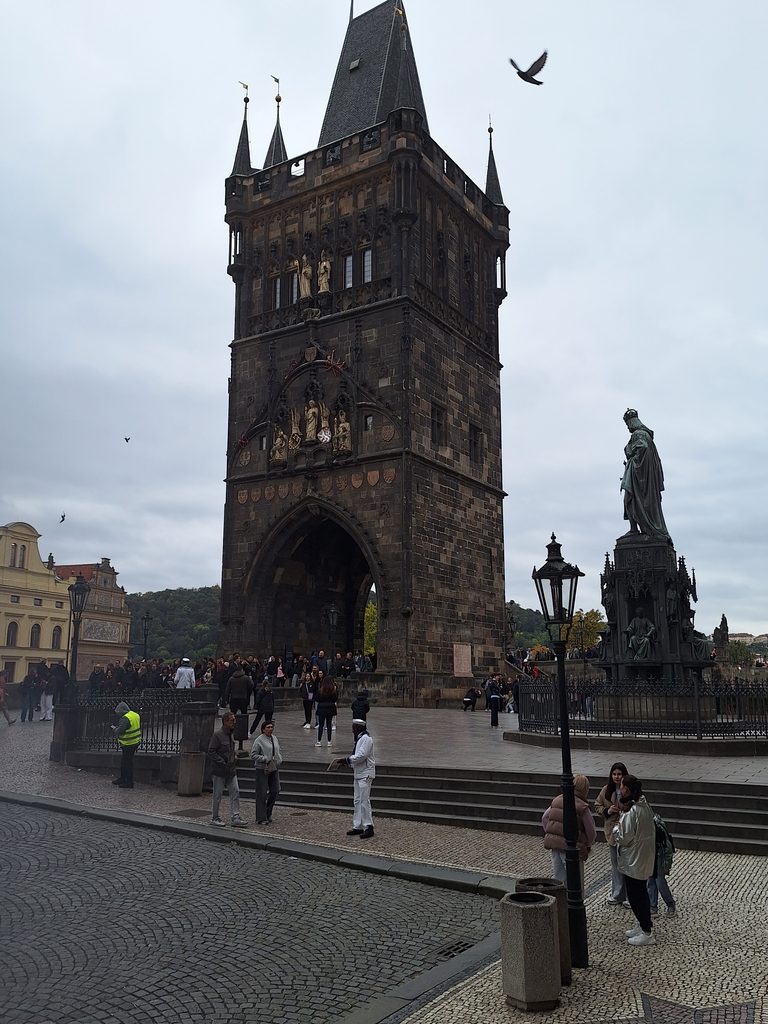
Its dark Gothic stonework rises dramatically above the surrounding buildings.
The tower was originally constructed as one of the monumental entrances to Prague’s Old Town.
It later became associated with the historic coronation route followed by Bohemian kings travelling towards Prague Castle.
The tower gained its present name from its later association with gunpowder storage.
Standing beneath its enormous archway, I imagined the royal processions that once passed through here.
Horses, soldiers, nobles and elaborate ceremonial gatherings moving along streets that are now filled with tourists.
Walking through the arch myself felt like passing through another chapter of Prague’s history.
Charles Bridge — A Walk Across History
No visit to Prague would be complete without crossing the famous Charles Bridge.
The bridge spans the Vltava River and connects the Old Town with Malá Strana, below Prague Castle.
Construction began in 1357 during the reign of Charles IV, and the bridge eventually became one of the city’s most important connections.
Today, it is lined with magnificent statues and filled with visitors from around the world.
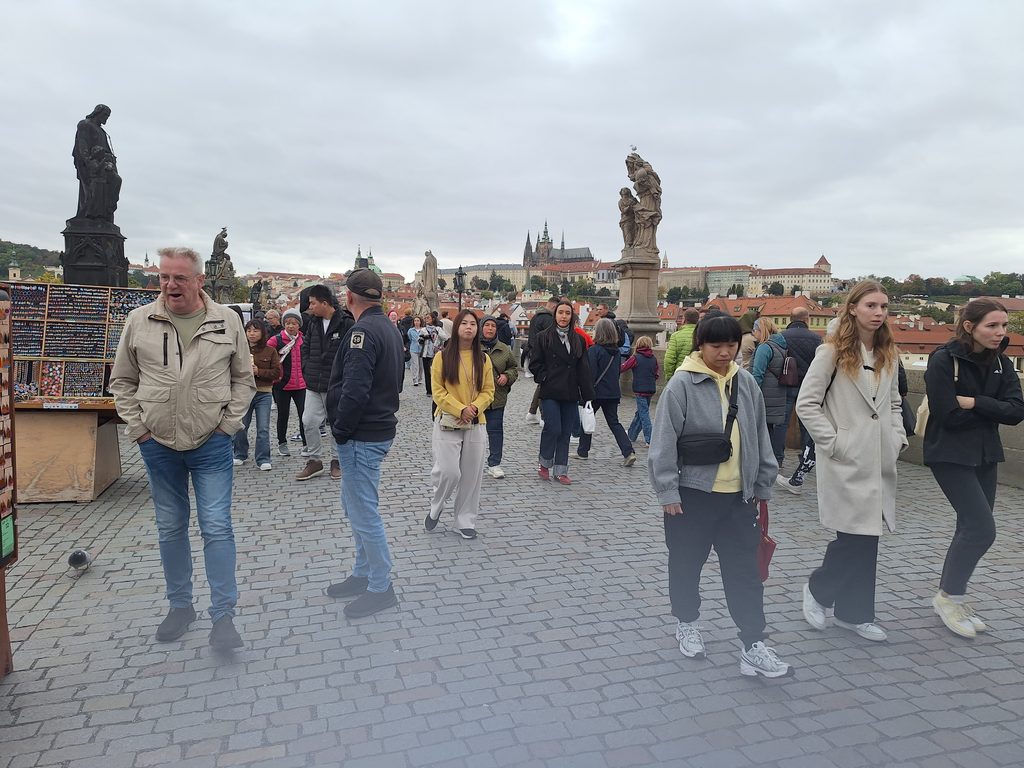
Artists displayed their paintings, street musicians performed, and tourists stopped constantly to photograph the river and surrounding buildings.
Despite the crowds, there was something wonderful about the atmosphere.
I paused along the bridge, admiring the statues and looking towards Prague Castle rising above the city.
The Vltava flowed beneath us, boats moved along the river, and the historic towers framed the scene.
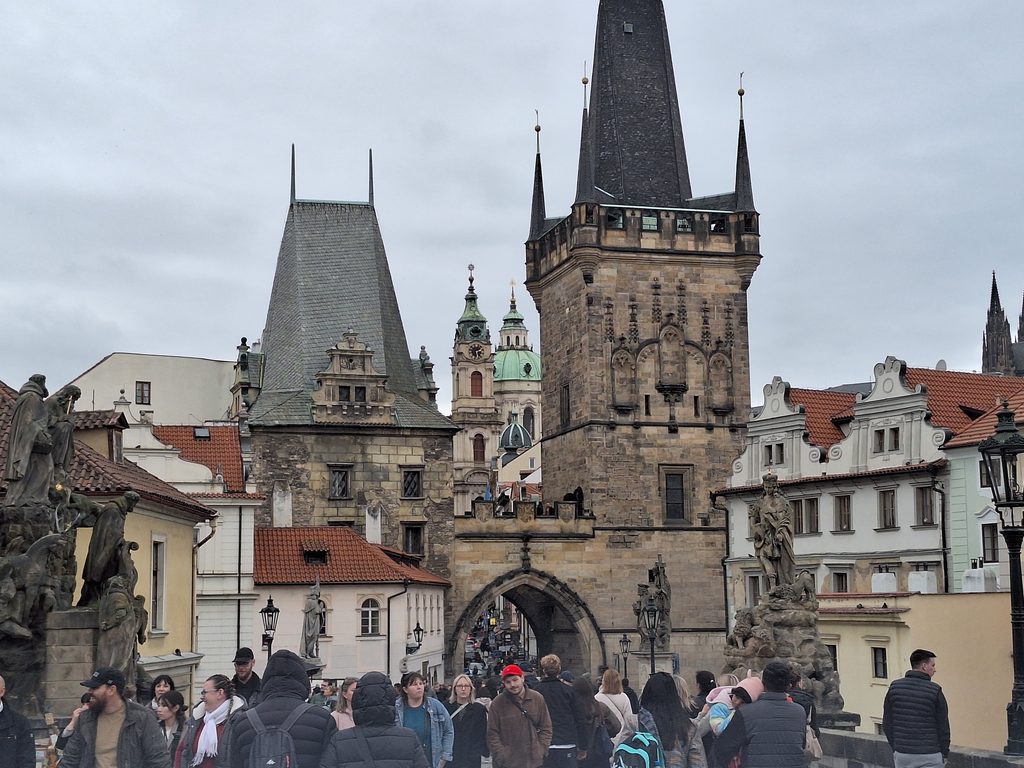
For a moment, I forgot about the crowds.
I was simply enjoying standing in one of Europe’s great historic cities.
The bridge has witnessed centuries of changing fortunes, from medieval royal processions to wars, floods and modern tourism.
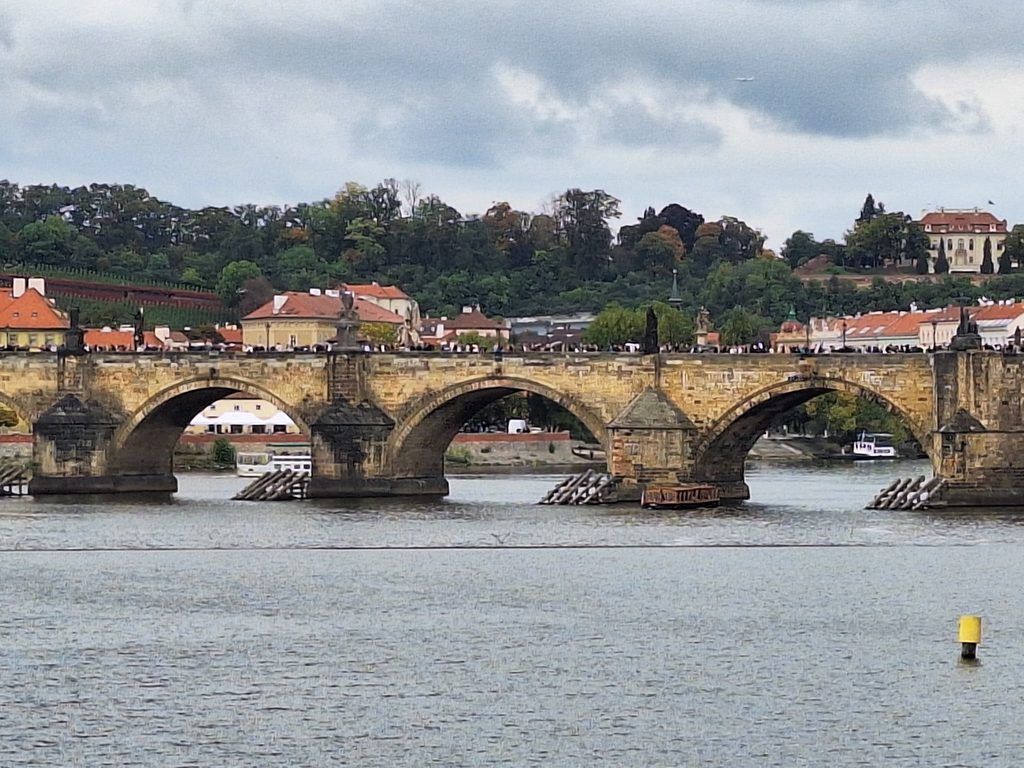
Yet it continues to connect the two sides of Prague, just as it has for generations.
Old Town Square — A Final Look
Eventually, I returned to Old Town Square.
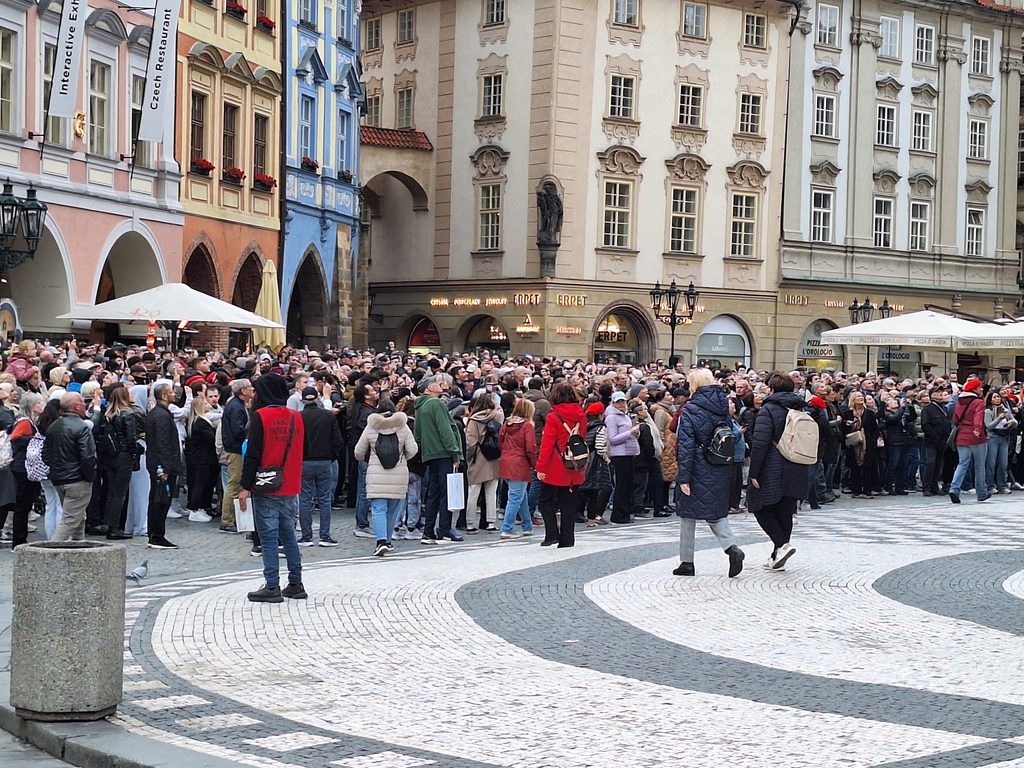
The historic buildings looked magnificent in the softer afternoon light.
Above the square, the Gothic tower of the Old Town Hall rose proudly, while the Astronomical Clock continued attracting visitors.
I stood looking around, taking in the church spires, architectural details and the thousands of people moving through the square.
Prague seemed to be a city where the past and present exist side by side.
History isn’t hidden away in museums.
It’s in the streets, the bridges, the churches and the buildings that surround you.
I’d walked another 10.74 kilometres exploring the city.
By the time I returned to the hostel, I was ready to put my feet up and enjoy another evening with my fellow travellers.
But there was still much more of Prague to discover.
Returning to Strahov — This Time by Scooter
After my earlier experience climbing Petřín Hill in sandals, I wasn’t particularly keen to repeat the journey on foot.
So when I decided to return to the Strahov Monastery area, I took an electric scooter instead.
Much more sensible!
The morning began with a visit to a chemist before I set off on the approximately five-kilometre journey.
The weather had improved, with sunshine and temperatures around 13°C.
It was still cool, but considerably more pleasant than the rain I’d encountered in Germany.
By midday, I was back near Strahov Monastery.
Some places were closed, possibly because of the weekend, but the surroundings were beautiful.
Prague’s rooftops, churches and towers stretched below the hillside.
And, of course, the monastery restaurant was calling.
Strahov Monastery — More Than a Brewery
Strahov is one of Prague’s great historical religious institutions.
The Premonstratensian community was established here in 1143, and the monastery developed into an important centre of learning, culture and religious life.
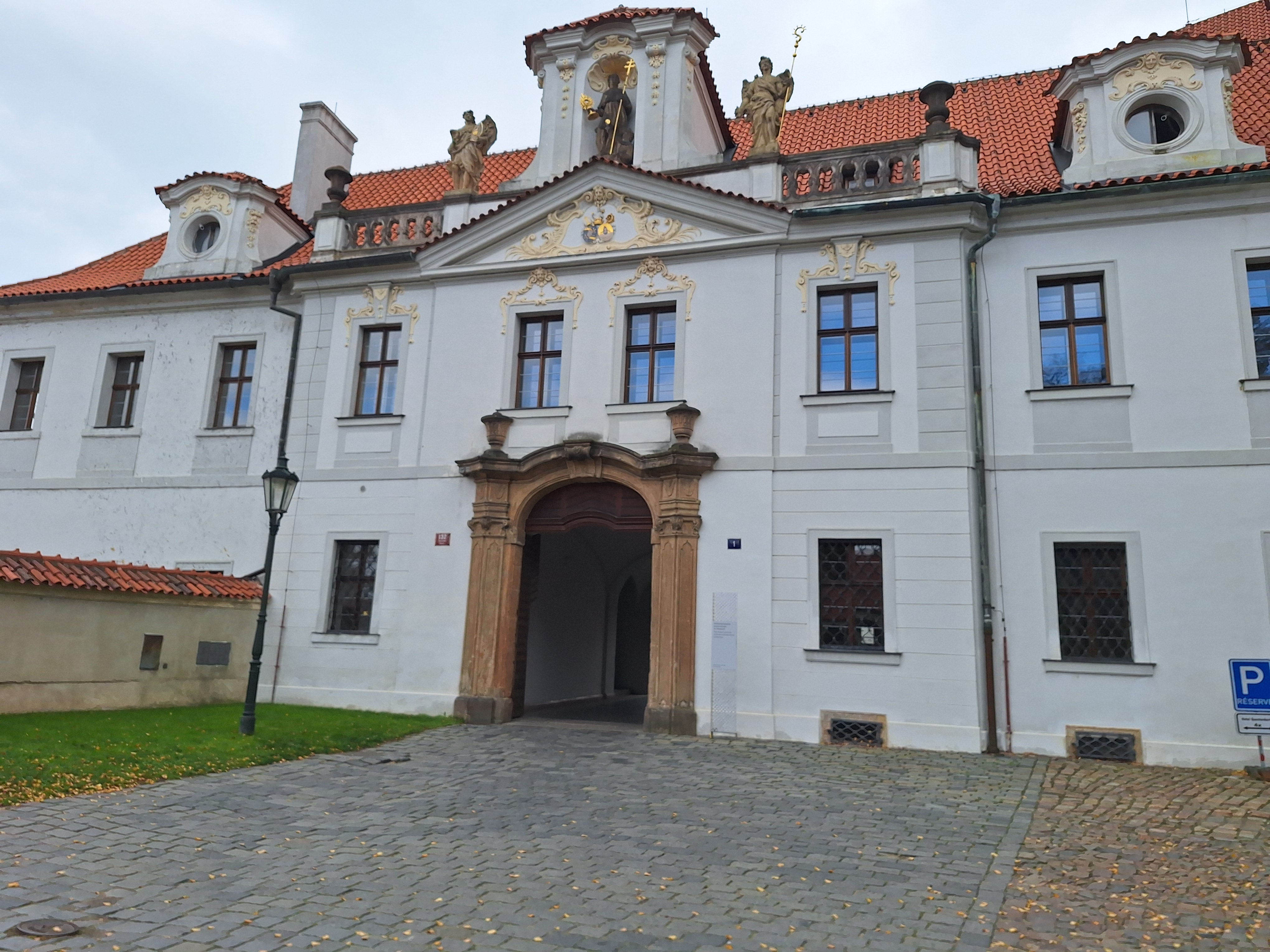
Over the centuries, its buildings were expanded and rebuilt, creating the impressive complex visitors see today.
The monastery’s famous library contains two magnificent halls, the Theological Hall and Philosophical Hall.
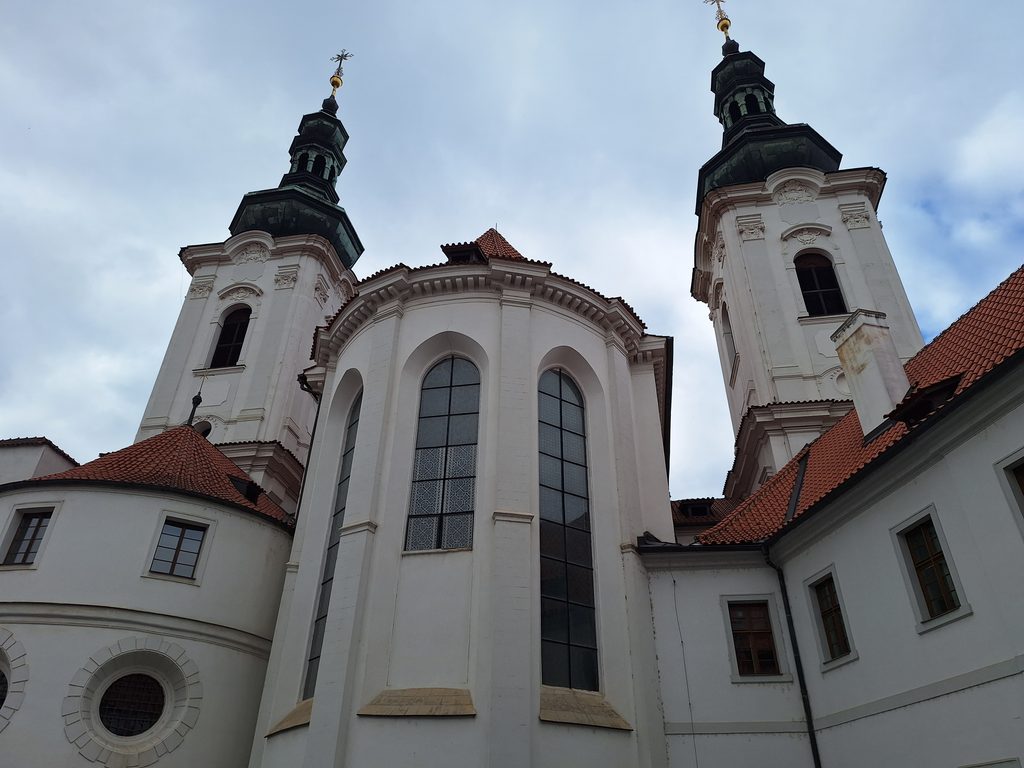
Their decorative ceilings, elaborate woodwork and historic collections have made them internationally renowned.
During the reforms of Emperor Joseph II in the eighteenth century, many monasteries were closed.
Strahov survived in part because of its scholarly activities and the importance of its collections.
Although I didn’t undertake a full visit to the library, I was fascinated by the monastery’s history and architecture.
And once again, the restaurant proved irresistible.
I hadn’t necessarily intended to have another substantial meal, but Czech food has a way of changing your plans.
Basilica of the Assumption of the Virgin Mary
Within the monastery complex stands the Basilica of the Assumption of the Virgin Mary.
The church dates back to the monastery’s earliest centuries, although its interior has been altered and decorated in later architectural styles.
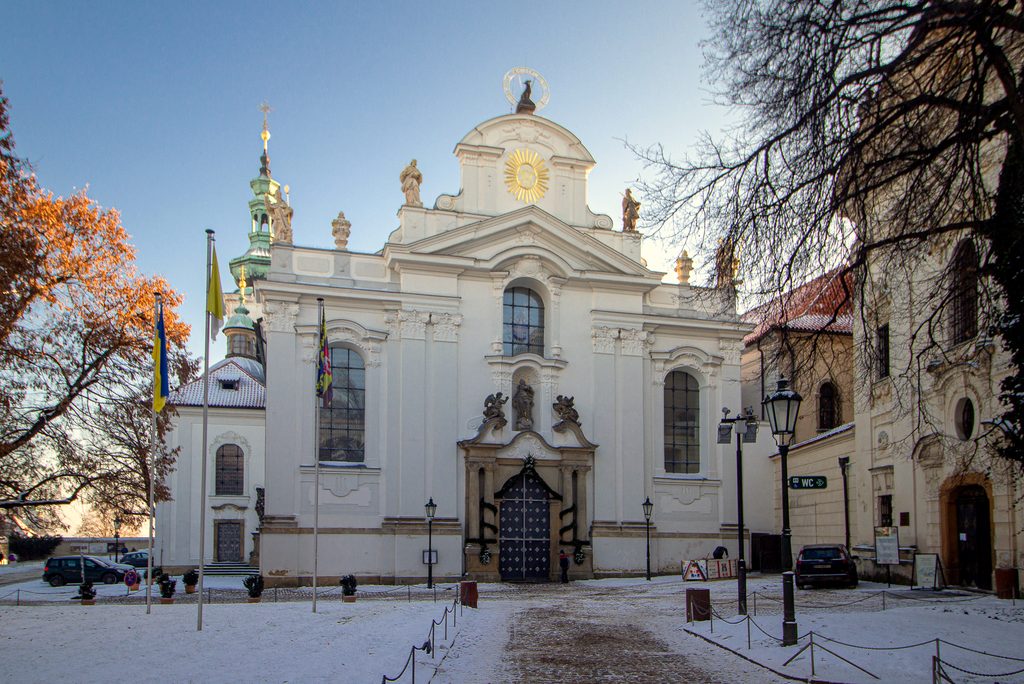
One particularly interesting connection is with Wolfgang Amadeus Mozart.
During his visit to Prague in 1787, Mozart is recorded as having played the organ at Strahov.
Standing there, I tried to imagine the sound of that music filling the church more than two centuries ago.
The ceiling frescoes and ornate religious decorations were magnificent.
Unfortunately, part of the interior was inaccessible behind a steel gate.
I could admire the church from a distance, but couldn’t explore everything I would have liked.
Nevertheless, it was another wonderful example of Prague’s rich religious heritage.
Czernin Palace — Beauty and a Troubled Past
Leaving the monastery area, I made my way downhill towards Czernin Palace.
This enormous Baroque building dominates Hradčany Square and is one of Prague’s most impressive palaces.
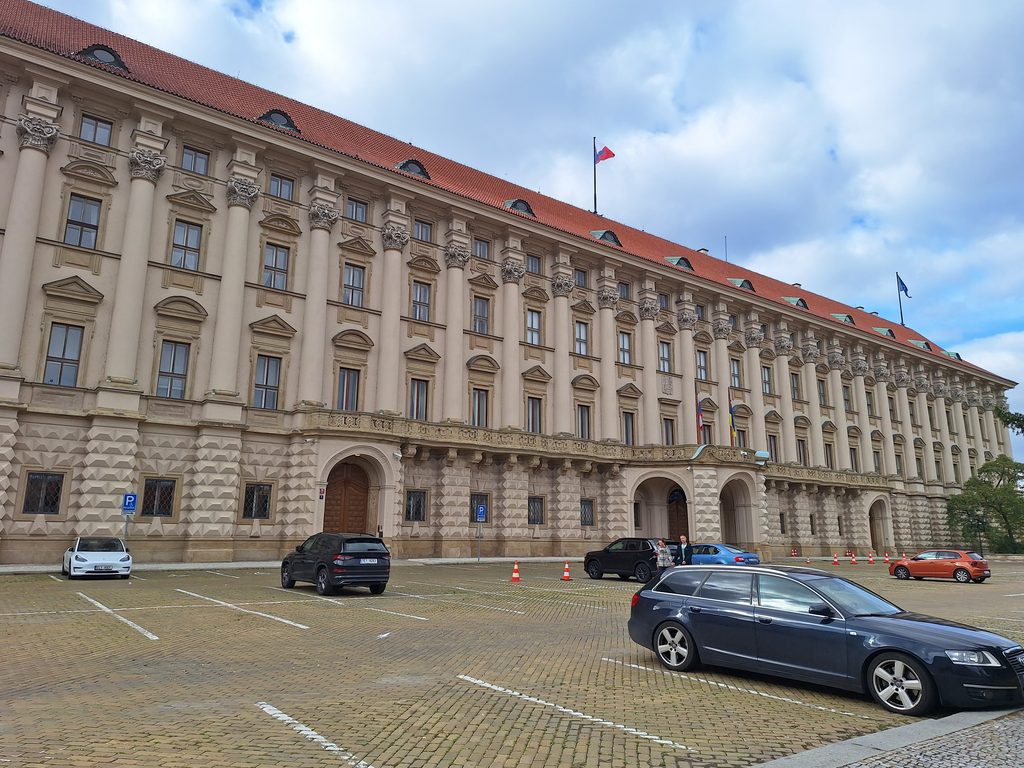
Completed in the late seventeenth century, its façade stretches approximately 150 metres.
Its construction required major changes to the surrounding neighbourhood, reflecting the enormous wealth and influence of the family responsible for building it.
But behind the beautiful architecture lies a darker history.
During World War II, the palace was associated with the German occupation authorities.
Following the war, it became the scene of one of Czechoslovakia’s most controversial political deaths.
In March 1948, Foreign Minister Jan Masaryk was found dead beneath a window of the building.
The circumstances remain the subject of historical debate and investigation, with theories ranging from suicide to murder.
Standing outside, looking up towards the enormous façade, I was reminded once again that beautiful buildings can have deeply troubled histories.
Loreta — A Place of Pilgrimage
Nearby stands the magnificent Loreta complex, one of Prague’s most important religious pilgrimage sites.
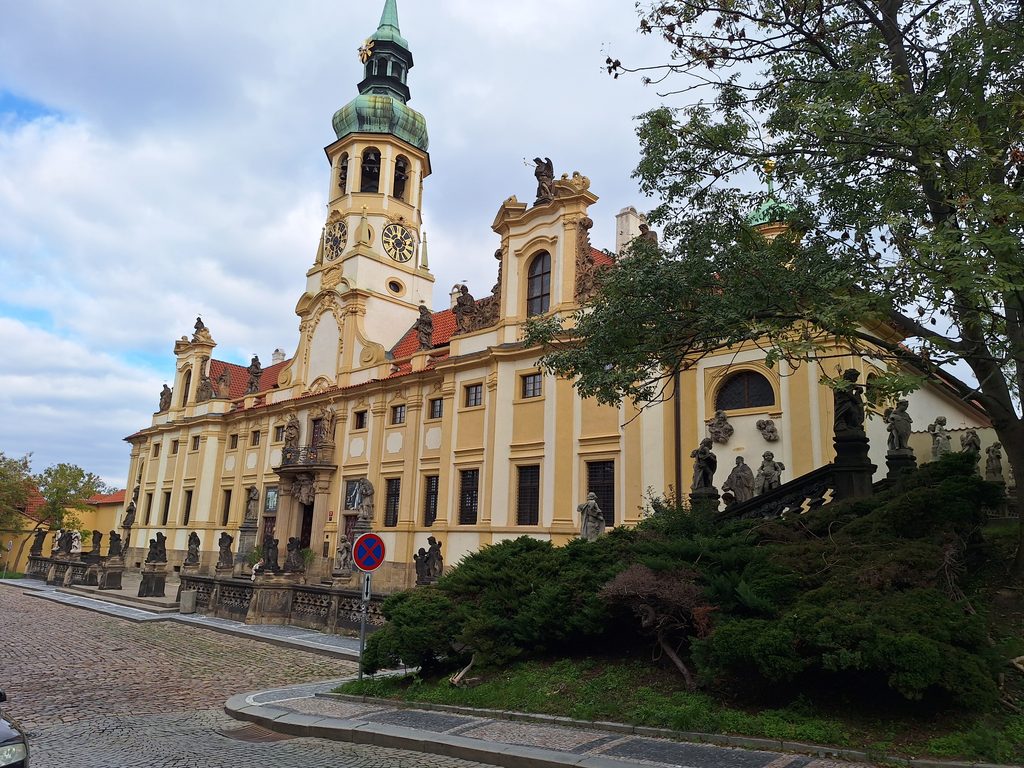
Established in the seventeenth century, Loreta centres on a replica of the Holy House of Loreto.
According to Christian tradition, the original Holy House is associated with the Virgin Mary and the life of Jesus in Nazareth.
The Prague complex developed into a major place of pilgrimage, attracting visitors from across Bohemia and beyond.
It also houses an extraordinary collection of religious treasures.
Among the most famous is the Prague Sun, a magnificent diamond-studded monstrance decorated with thousands of precious stones.
The contrast between religious devotion and the extraordinary wealth displayed in such objects is striking.
Photography could involve an additional charge, another familiar experience when visiting historic religious sites.
Nevertheless, the complex was a fascinating reminder of the importance religion once held in European public life.
Nový Svět — Prague’s Quiet Little World
A short distance from the grand palaces and religious monuments, I discovered Nový Svět, meaning New World.
What a contrast!
Instead of enormous buildings and busy tourist attractions, I found narrow cobbled streets, small historic houses and a much quieter atmosphere.
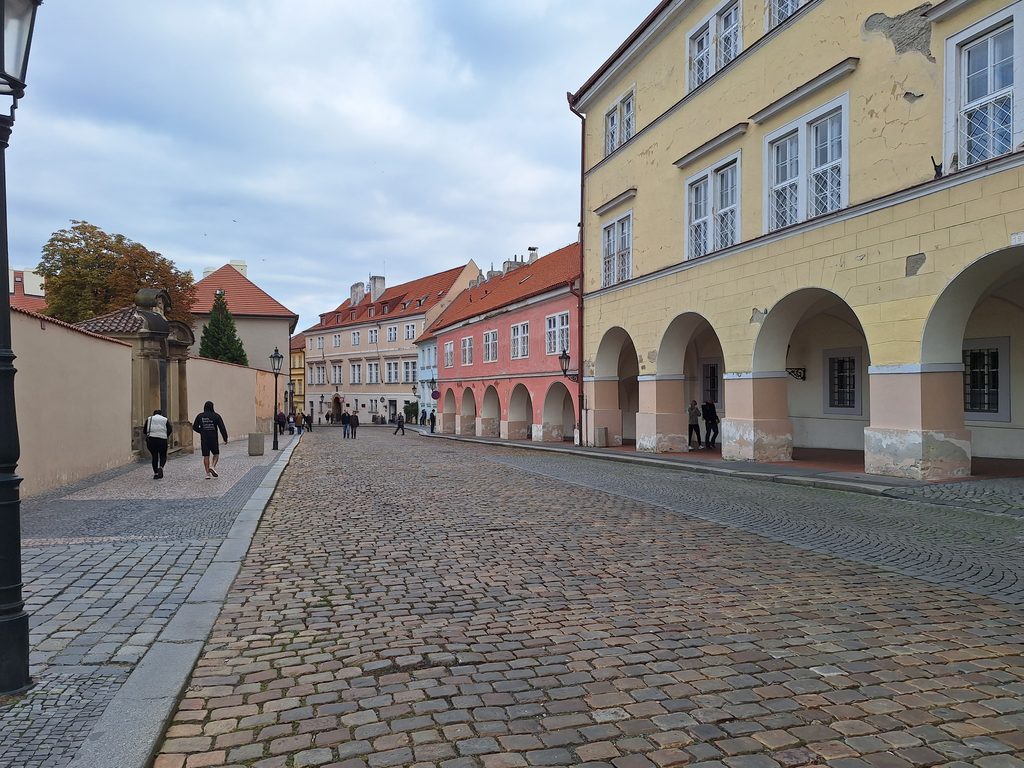
It felt almost like stepping into a village hidden within the city.
Old walls, colourful façades and winding lanes created a wonderful sense of intimacy.
For a while, the crowds seemed far away.
Places like this remind me that some of the most rewarding travel experiences don’t involve famous monuments or expensive admission tickets.
Sometimes a quiet street and a little curiosity are all you need.
Schwarzenberg Palace and the Archbishop’s Palace
Continuing towards Prague Castle, I passed the magnificent Schwarzenberg Palace.
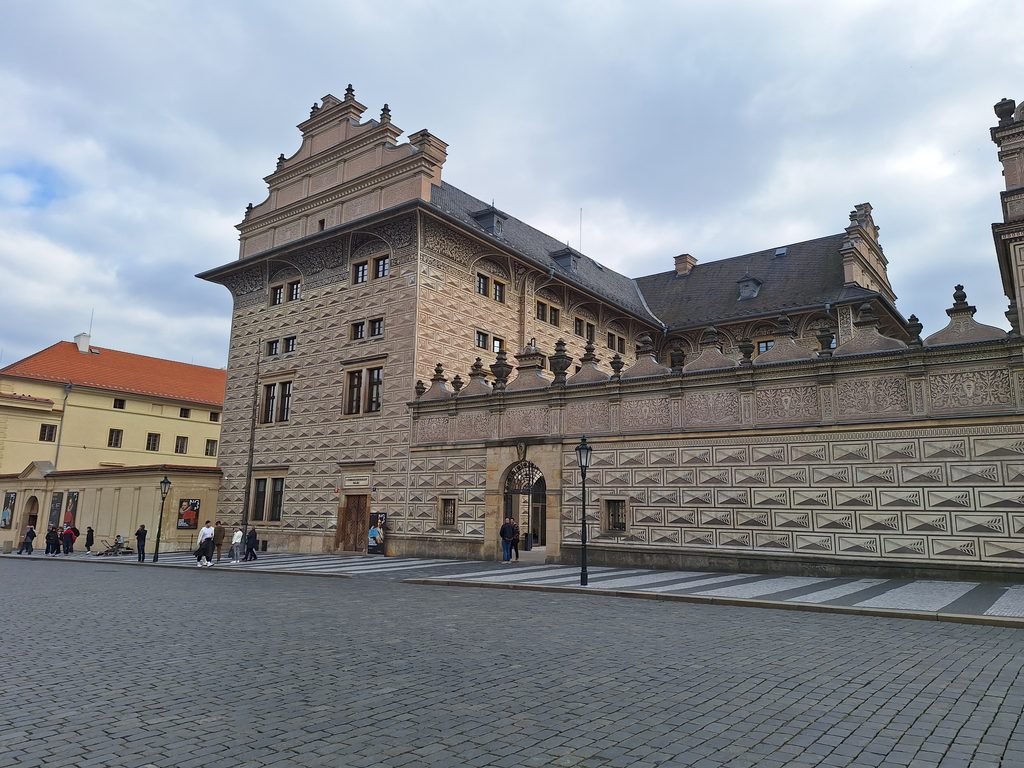
Its Renaissance façade is particularly unusual, decorated with elaborate sgraffito patterns that create the illusion of three-dimensional stonework.
From a distance, the surface almost appears to be covered with sculpted geometric blocks.
I found myself examining the patterns from several angles, fascinated by the skill involved in creating the effect.
Nearby stands the Archbishop’s Palace, with its elegant Rococo façade and soft pastel colouring.
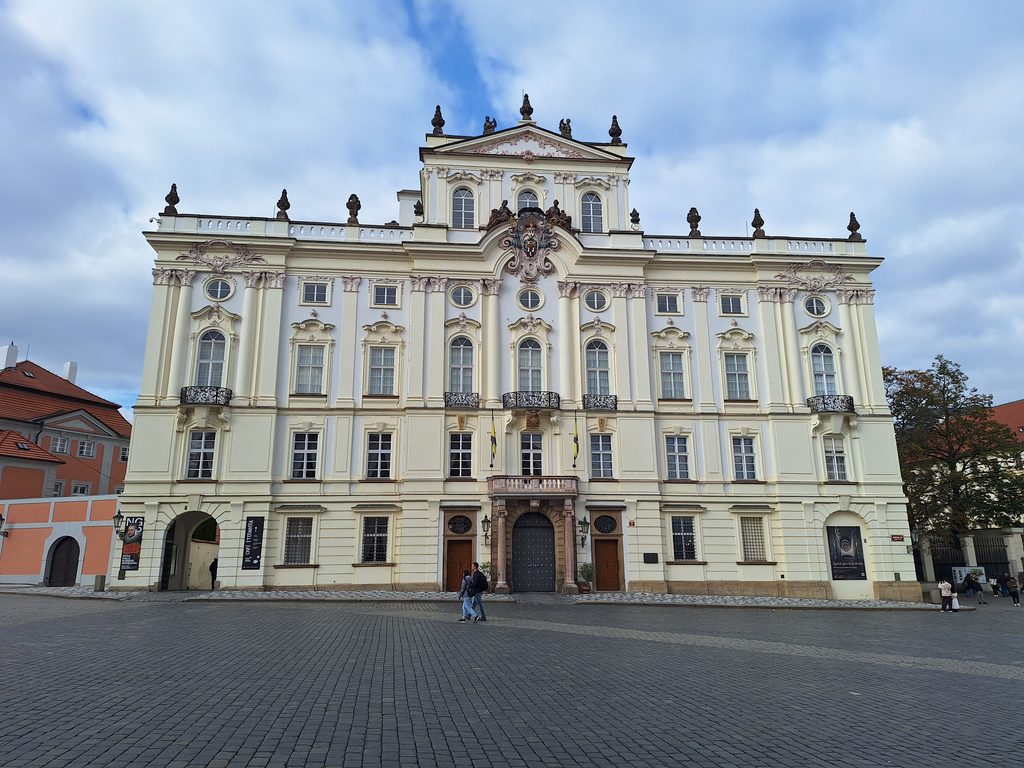
The palace reflects the long historical relationship between the Catholic Church and political power in Bohemia.
Although the buildings weren’t open for me to explore, their exteriors alone made the walk worthwhile.
Prague certainly knows how to impress a visitor with architecture.
Prague Castle — A City Within a City
Eventually, I arrived at Prague Castle.
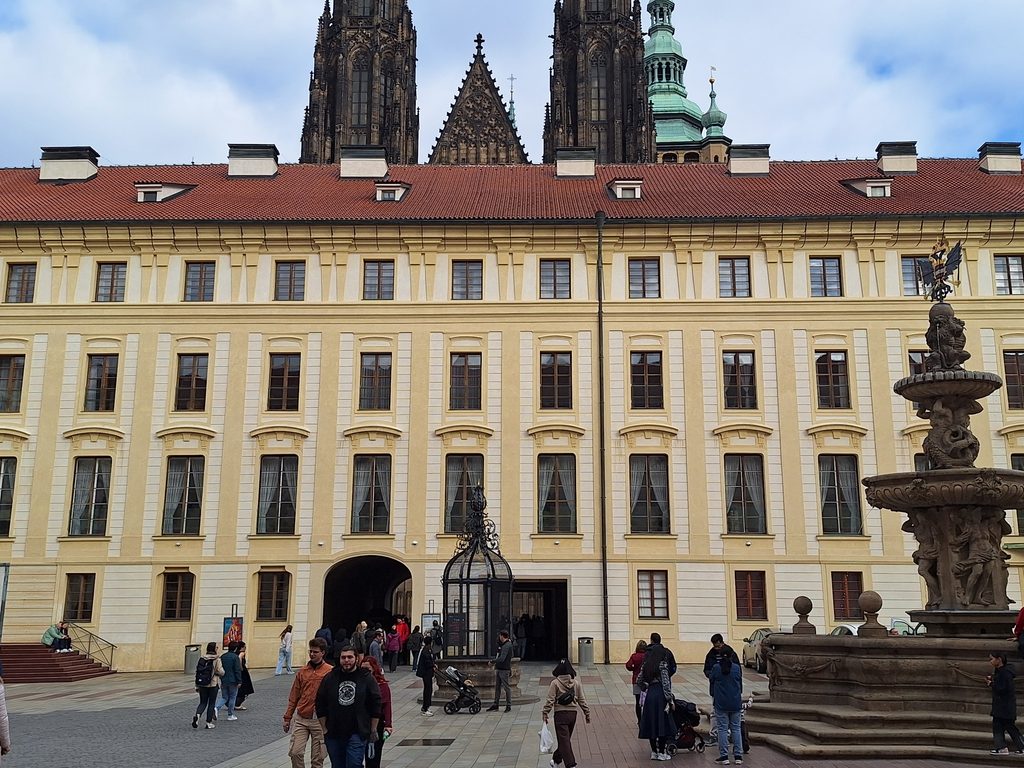
Calling it a castle almost seems inadequate.
The complex covers approximately seventeen acres and includes palaces, courtyards, churches, museums, gardens and government buildings.
For centuries, it has been associated with the rulers of Bohemia, and today it remains an important centre of Czech national life.
I purchased a senior admission ticket and began exploring.
Everywhere I looked, there seemed to be another doorway, courtyard, tower or piece of history waiting to be discovered.
Prague Castle is not simply one building.
It’s almost a small city within the city.
St Vitus Cathedral — Gothic Grandeur
The highlight of the castle complex for me was St Vitus Cathedral.
The cathedral’s enormous Gothic structure dominates the skyline above Prague.
Its towering spires, intricate stone carvings and magnificent stained-glass windows make it one of Europe’s great religious buildings.
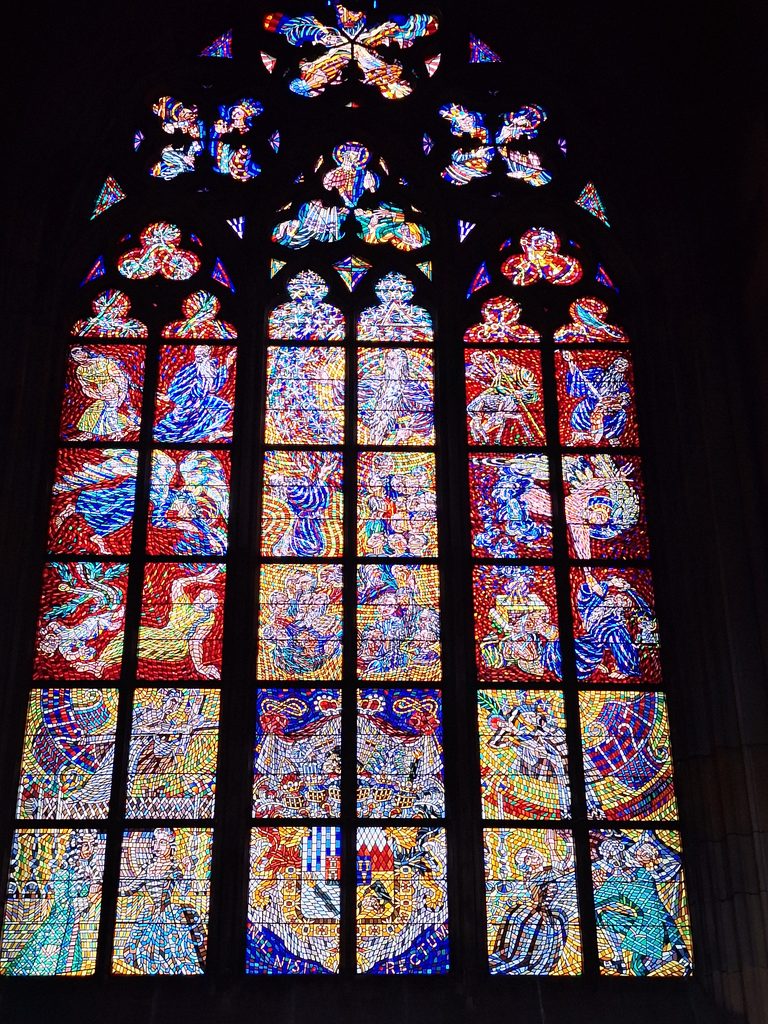
Construction began in the fourteenth century, although the building wasn’t completed until the twentieth century.
Inside, the scale is breathtaking.
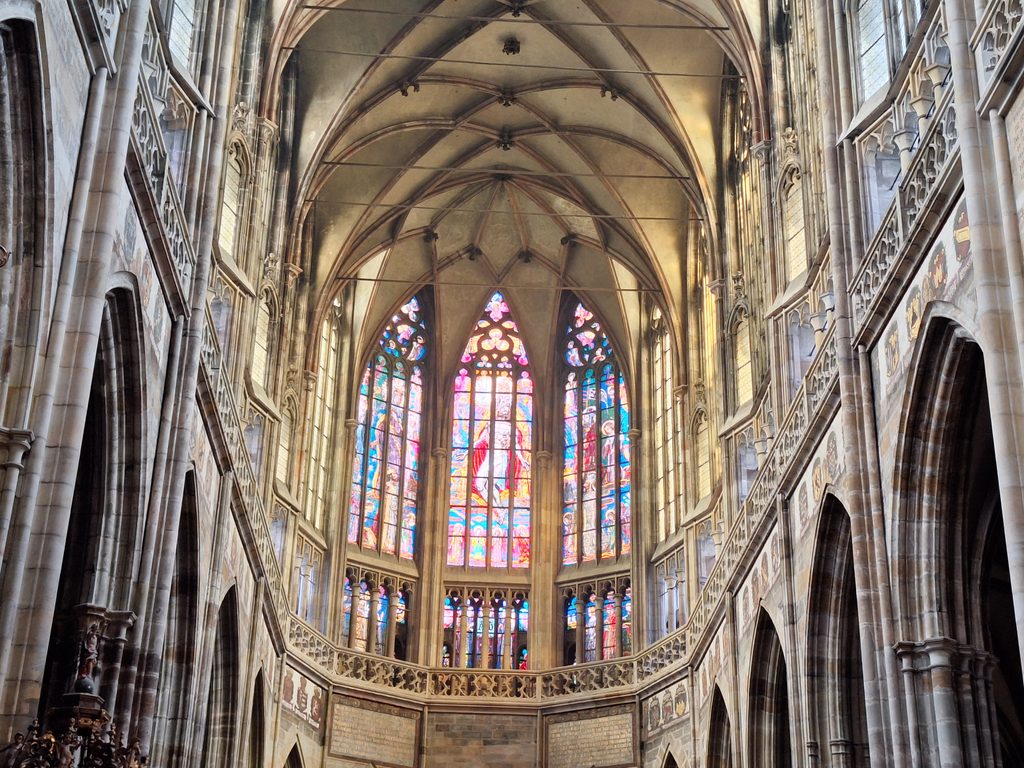
Great stone columns rise towards vaulted ceilings, while coloured light filters through beautiful stained-glass windows.
One of the most celebrated windows was designed by the Czech artist Alfons Mucha, whose distinctive style brings a wonderful richness to the interior.
The cathedral also contains the elaborate silver tomb of St John of Nepomuk, an important figure in Czech religious history.
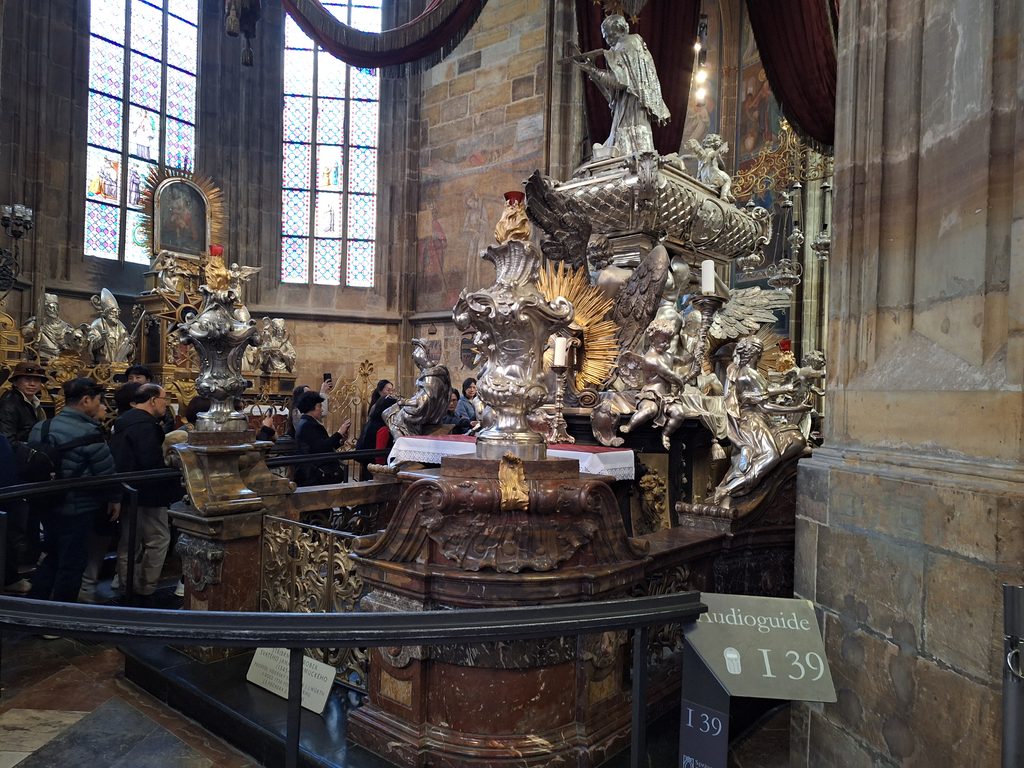
Outside, the Golden Gate displays a magnificent mosaic of the Last Judgment, while the Great South Tower houses the enormous Sigismund Bell.
I spent time looking upwards, admiring the workmanship and imagining the generations of craftsmen who had contributed to the building over hundreds of years.
Places like this make you realise how little time our own lives occupy compared with the centuries of human history surrounding us.
St George’s Basilica — Simplicity and History
After the grandeur of St Vitus Cathedral, St George’s Basilica offered a different experience.
Founded in the tenth century, it is among the oldest surviving religious buildings within Prague Castle.
Its Romanesque interior is comparatively simple, with strong stone arches and a quieter atmosphere.
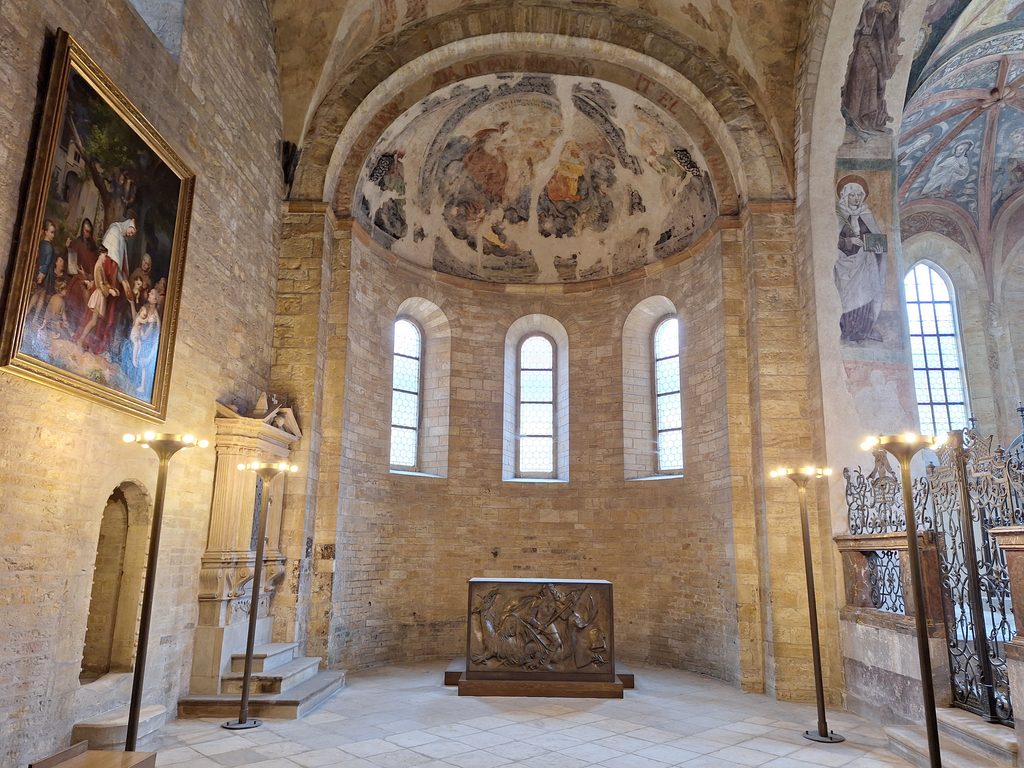
The exterior, however, has an elegant Baroque façade added during later alterations.
The basilica is associated with members of the early Přemyslid dynasty, including important figures from Bohemia’s early history.
Walking through the building, I appreciated the contrast with the elaborate Gothic cathedral nearby.
Sometimes simplicity can be just as impressive as grandeur.
Golden Lane — Tiny Houses and Famous Residents
Next came Golden Lane, one of Prague Castle’s most famous attractions.
This narrow street is lined with tiny, brightly painted cottages that once housed castle guards, craftspeople and other residents connected with the castle.
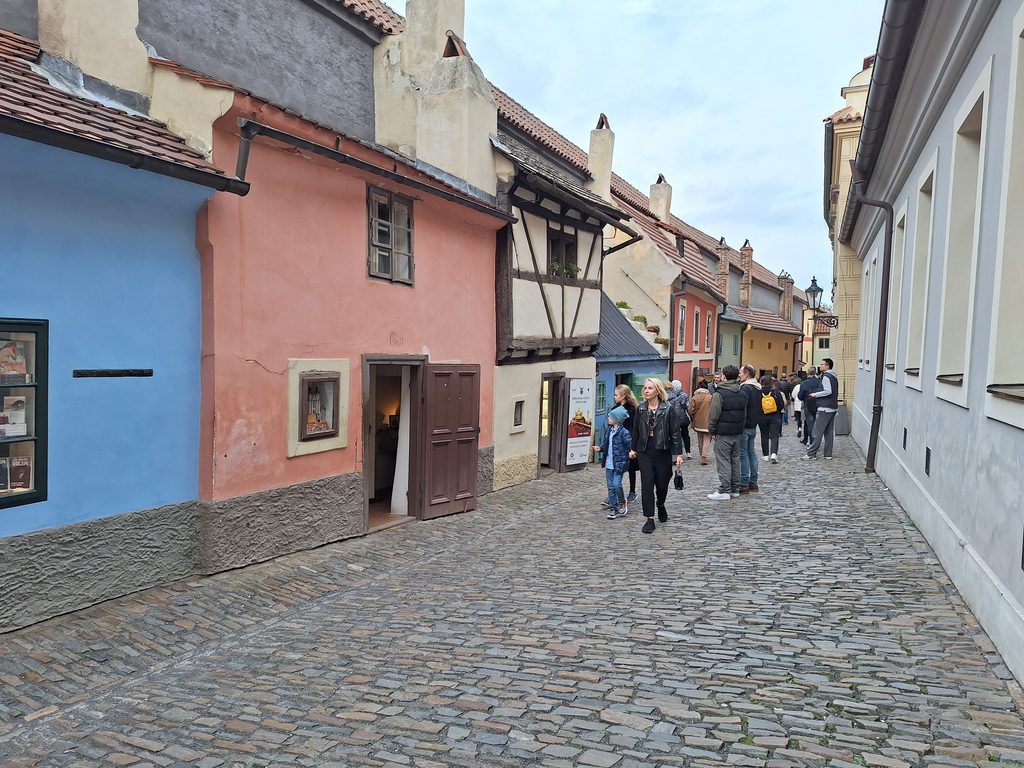
Over time, the lane became associated with artists and writers.
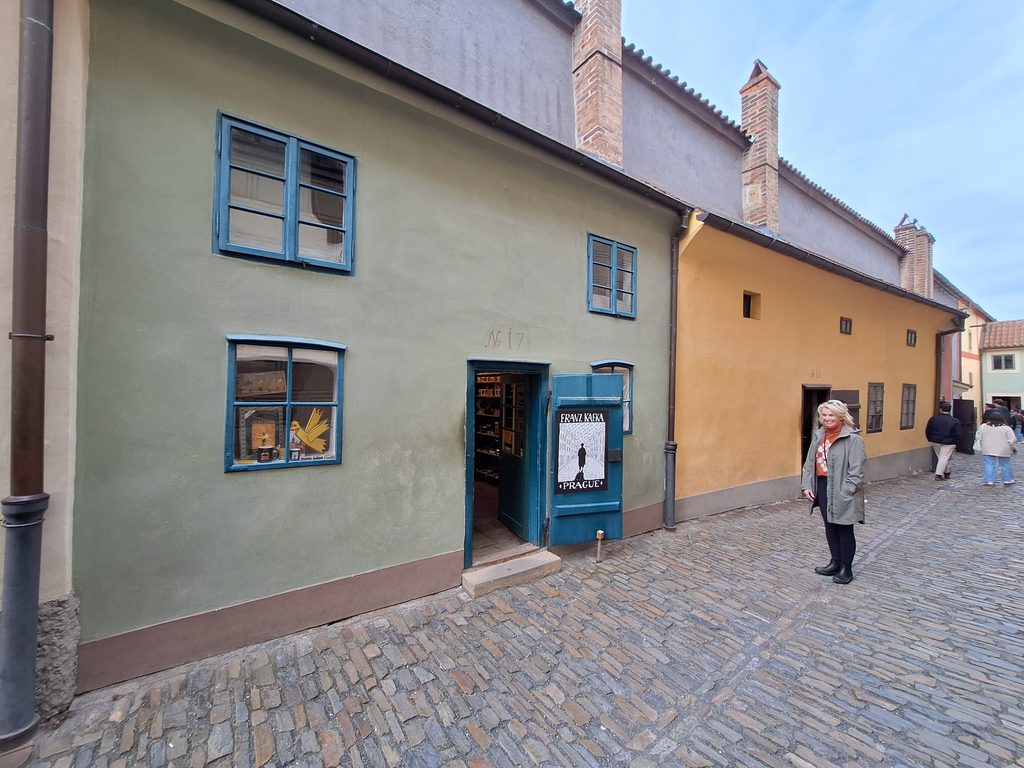
Franz Kafka famously spent time writing in one of its small houses during the early twentieth century.
The buildings are delightful.
Unfortunately, the lane was packed with visitors.
Trying to take photographs without somebody walking into the frame was almost impossible.
I stopped several times, waiting for a clear view, but there always seemed to be another group coming through.
Nevertheless, the tiny cottages were fascinating.
It’s difficult to imagine how people managed everyday life in such confined spaces.
Standing there, I thought about the writers, craftsmen and ordinary families who had once called this narrow street home.
Another reminder that history isn’t only about kings and rulers.
It’s also about the people who lived and worked in their shadows.
Villa Richter — A Magnificent View Across Prague
As the afternoon drew towards evening, I made my way towards Villa Richter, situated among the terraced vineyards below Prague Castle.
What a wonderful place to finish the day.
The villa stands near the old castle walls, with remarkable views across Prague’s rooftops, towers, bridges and the Vltava River.
After hours of walking through historic buildings and crowded streets, it was a pleasure to find somewhere I could simply stop and take in the scenery.
The vineyards stretched along the hillside, while the city unfolded beneath me.
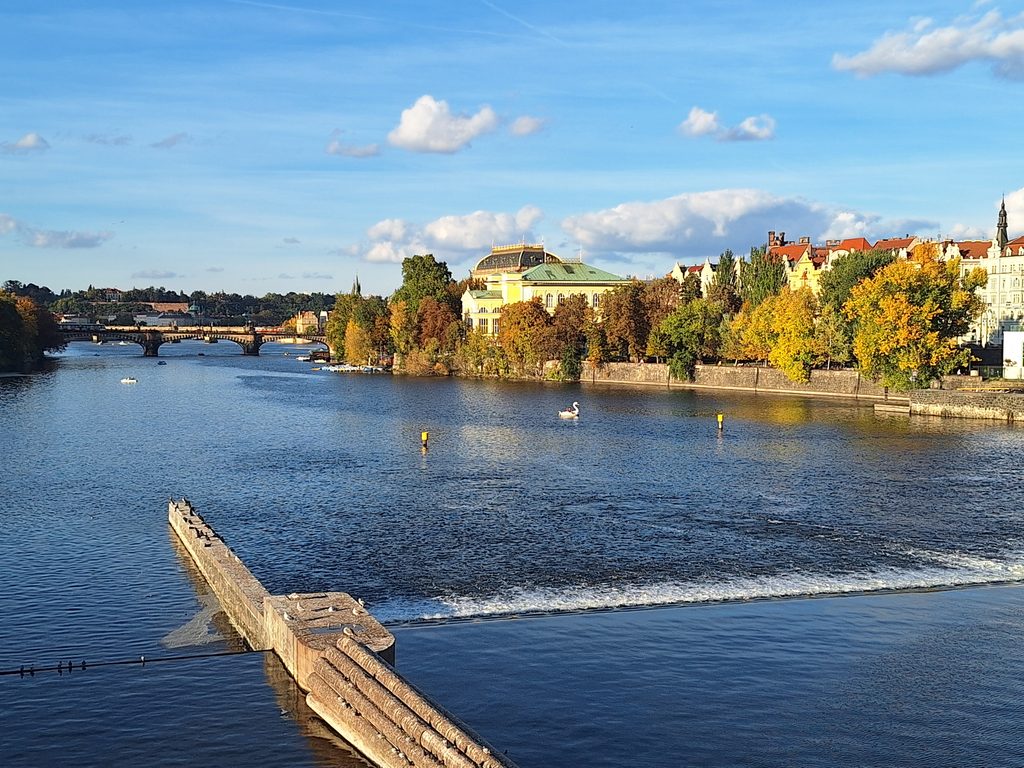
Church spires rose above the rooftops, bridges crossed the river, and centuries of architecture seemed to merge into one extraordinary panorama.
There were restaurants offering Czech food and wine, but I was just as happy appreciating the view.
I’d spent another day surrounded by extraordinary history.
Palaces, churches, medieval streets, castles, artists, kings and political intrigue.
And yet, some of my favourite moments had been the simplest: walking through the quiet streets of Nový Svět, enjoying a beer at Strahov and standing above Prague as the afternoon light softened across the city.
Reflections on Prague — A City Where History Lives
Prague has been a wonderful contrast to my experiences in Germany.
The journey here wasn’t straightforward, particularly after missing my tram and being turned away from two hostels because of my age.
But once I settled in, the city began revealing its treasures.
I’ve climbed Petřín Hill in sandals, discovered medieval fortifications, admired a miniature Eiffel Tower and enjoyed delicious Czech goulash with some excellent dark lager.
I’ve wandered through Old Town Square, watched the Astronomical Clock, explored ancient churches and crossed the magnificent Charles Bridge.
I’ve walked through the enormous Prague Castle complex, admired the grandeur of St Vitus Cathedral and discovered little streets that seem almost untouched by time.
And, as always, I’ve enjoyed the company of fellow travellers.
The conversations around hostel kitchen tables and shared meals are every bit as much a part of my journey as the famous landmarks.
Travelling at seventy-two isn’t about rushing to see everything.
It’s about having the courage to keep going, even when plans fall apart, and remaining curious about the world around you.
Prague has reminded me why I began this journey.
Sometimes the unexpected detours lead to the greatest discoveries.
And sometimes, after several difficult days, a city comes along that makes you appreciate the adventure all over again.
With my time in the Czech Republic drawing to a close, Austria and Slovenia are waiting further along the road.
There are still more countries, more capitals and more people to meet.
Stepping out of fear, one step at a time, into the unknown.
Andrew — Inspire Seniors Travel
inspireseniorstrav