

Estonia — Tallinn: Medieval Towers, Ancient Walls and Adventures Around Every Corner
Day 296 — Leaving Riga and Beginning a New Adventure in Tallinn
Weather: Fog, low cloud and sunny intervals. High 22°C
Elevation: Approximately 12 metres above sea level
A Final Night to Remember in Riga
Every journey has its highs and lows.
Today was one of those days that began with excitement and promise, descended into frustration and disappointment, but eventually ended with new friendships and laughter.
Before leaving Latvia, however, I must mention my final evening in Riga.
What a wonderful night!
I had joined fellow travellers for traditional Latvian dancing at Folkklubs ALA Pagrabs, an extraordinary underground venue filled with music, laughter and people enjoying themselves.
The bar was located within a maze of old passages and tunnels, once used as storage cellars.
Everywhere I looked, there were people laughing, clapping, dancing and enjoying beer and spirits.
The atmosphere was electric.
The sound of clapping echoed through the cavernous rooms, while groups of people gathered around tables and along the passageways.
It was the perfect way to end my visit to Latvia.
And, as I discovered the following morning, perhaps a little too enjoyable!
An Early Departure I Came to Regret
My alarm sounded at six o’clock.
I was up, dressed and preparing to leave Cinnamon Sally Backpackers for the final time.
After days of walking around Riga’s cobblestone streets, my body was reminding me that I wasn’t getting any younger.
There were a few aches and pains, but nothing that would prevent me from continuing the journey.
What disappointed me most was having to leave before breakfast.
Cinnamon Sally had provided some of the best hostel breakfasts I had enjoyed on my travels, but I had booked an early bus so I could arrive in Tallinn by lunchtime.
Looking back, I should have taken a later bus.
I could have enjoyed another leisurely breakfast, said goodbye properly and arrived in Tallinn around three o’clock.
Instead, I was leaving a hostel that had made a tremendous impression on me.
Since arriving on Saturday, I had experienced friendship, laughter, excellent hospitality and a wonderful atmosphere.
Some hostels are simply places to sleep.
Others become part of your travelling memories.
Cinnamon Sally was certainly one of the latter.
I genuinely didn’t want to leave.
But that is one of the difficulties of travelling from country to country.
Just as you begin to feel comfortable somewhere, it is time to move on.
On the Road to Estonia
The journey north towards Tallinn took us through attractive countryside, with wooden houses scattered among fields and small communities.
At first, a light fog hung over the landscape.
Visibility was limited, and the driver reduced speed accordingly.
The mist eventually lifted, giving way to low grey clouds that made everything look rather gloomy.
Despite it being the end of summer, the countryside had an almost wintry atmosphere.
During a conversation with a local person, I was told that summer officially ends towards the end of September.
Looking out of the bus window, I couldn’t help thinking that winter seemed to be arriving a little early!
Comparing Fuel Prices Across Europe
One thing that continues to fascinate me is the difference in fuel prices between countries.
During this part of my journey, I recorded the following prices:
- Poland: €1.38 per litre — approximately NZ$2.74
- Latvia: €1.58 per litre — approximately NZ$3.14
- Estonia: €1.49 per litre — approximately NZ$2.96
These differences can make a considerable impact on the cost of travelling by road.
Although I rely mainly on public transport, I still find it interesting to compare everyday costs between countries.
The more I travel, the more I realise how differently people experience the cost of living.
A Noticeable Difference in Roadside Rubbish
Another observation from my journey concerned the amount of rubbish along the roads.
During some of my travels through the Balkans, I had been disappointed by the amount of litter scattered across the countryside.
Plastic bags, bottles and discarded packaging could sometimes be seen along roadsides and in open spaces.
However, since leaving Sarajevo, I had noticed a significant improvement.
The roads and highways through the countries I had recently visited were generally much cleaner.
It was refreshing to travel through countryside where rubbish was not constantly spoiling the scenery.
Sometimes these everyday observations reveal as much about a country as its famous tourist attractions.
Arrival Confusion in Tallinn
The bus arrived on time.
Or at least, I thought it had.
There was some confusion about whether we had reached Tallinn’s main bus station.
I had been talking with Kristin, a Norwegian woman who lived inside the Arctic Circle.
She checked her phone, which suggested that we still had another 25 minutes to travel.
That didn’t seem quite right to me.
At the last moment, I checked my own phone.
According to my map, we had arrived at the correct station.
The driver was preparing to leave, and I suddenly realised I needed to get off.
This did not please him!
I hurriedly gathered my belongings and made my way towards the exit.
Kristin almost followed me, but eventually decided to remain on the bus.
I still think she had misunderstood the location.
Nevertheless, I was pleased to find myself standing in Tallinn.
Another capital city reached!
Walking Towards Tallinn’s Old Town
My hostel was approximately 2.3 kilometres from the bus station.
Google Maps estimated the walk at around 34 minutes.
After sitting on the bus, I welcomed the opportunity to stretch my legs.
The first part of the journey wasn’t particularly interesting.
There were modern buildings, ordinary streets and little to suggest the extraordinary medieval city I was approaching.
But gradually the surroundings began to change.
The architecture became more interesting.
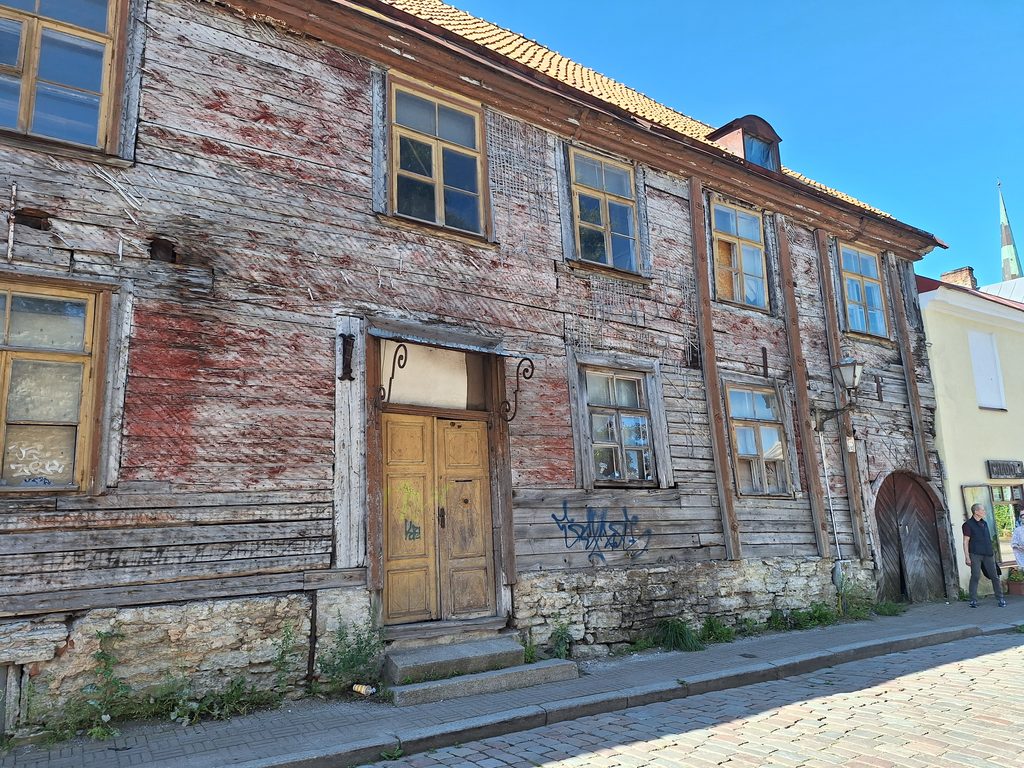
Older buildings appeared.
Narrower streets and historic features suggested that I was getting closer to Tallinn’s famous Old Town.
It was encouraging.
Unfortunately, my accommodation plans were about to unravel.
A Hostel That Didn’t Live Up to Expectations
Because I couldn’t check in until three o’clock, I stopped for a cold beer before making my way to the hostel.
Eventually, I arrived at the address.
There was a door opening directly onto the street.
No obvious hostel sign.
No welcoming reception.
Nothing to suggest that I had found a functioning backpackers’ hostel.
I knocked.
And knocked again.
For around five minutes, nobody answered.
Finally, the door opened.
To my surprise, the person who answered was someone I recognised from Riga!
It really is a small world.
Unfortunately, things didn’t improve once I was inside.
The hostel lacked the atmosphere I had enjoyed so much at Cinnamon Sally.
There was no working Wi-Fi available to me, and the whole place felt disappointing.
After only a short time, I decided it wasn’t somewhere I wanted to stay.
I telephoned the contact number and cancelled my booking.
Whether I would lose money because of the cancellation remained to be seen.
Not the beginning I had hoped for in Estonia!
Finding Another Bed for the Night
Fortunately, I managed to find accommodation at Imaginary Hostel, just around the corner.
The price was €15 for the night.
That was perfectly acceptable for my budget.
However, there was another complication.
I couldn’t book three consecutive nights because Saturday was already fully booked.
So I began searching again.
Eventually, I booked Zinc Old Town Hostel through Booking.com.
The reservation cost €57, approximately NZ$113.
But almost immediately after booking, I noticed something concerning.
When I returned to the property listing, Booking.com displayed a warning indicating that the hostel was not currently accepting reservations.
That was unsettling.
I began reading earlier reviews, and some of the comments did little to reassure me.
I hoped everything would work out, but after the earlier hostel disappointment, I wasn’t feeling particularly confident.
This was turning into one of those travelling days when almost everything seemed determined to go wrong.
A Welcome Change of Atmosphere
Despite the accommodation troubles, I still had work to do.
I finished my latest blog, including the photographs, and caught up with some of the messages people had sent about my journey.
I was particularly encouraged by comments from younger people who said my adventures had inspired them.
That means a great deal to me.
I began this journey partly to demonstrate that older people can continue exploring the world.
But I have discovered that the message reaches people of all ages.
Travel is not simply something for the young.
It is something that can bring people together across generations, cultures and backgrounds.
And I feel fortunate to have experienced so much kindness and encouragement along the way.
Meeting Yichen from Australia
Back at Imaginary Hostel, my day finally began to improve.
I met Yichen, a young woman from Sydney, Australia, who was volunteering at the hostel.
She was planning to continue her own travels through Latvia and Poland.
We began chatting about our experiences and the places we hoped to visit.
Later, she organised a trivia evening for the hostel guests.
Naturally, I decided to join in.
After the frustrations of the day, it was wonderful to spend time with other travellers, enjoying conversation and laughter.
Once again, a hostel had provided an opportunity to meet people I would otherwise never have known.
A Day of Ups and Downs
Looking back, it had been quite a day.
I had left a wonderful hostel in Riga with a heavy heart.
The bus journey had gone reasonably well, apart from the confusion when we arrived.
Finding suitable accommodation in Tallinn had been frustrating.
But the evening had brought new friendships and an enjoyable social gathering.
That’s travelling.
Some days everything works perfectly.
Other days you find yourself wondering why you ever left home!
But somehow, things usually have a way of coming together.
Tomorrow I would begin exploring Tallinn properly.
There were medieval walls, ancient towers, churches and narrow cobblestone streets waiting to be discovered.
After the travelling and accommodation problems, I was looking forward to getting out and exploring.
For today, there weren’t many photographs to share.
But tomorrow would be a different story.
Get your reading glasses ready!
Day 297 — Exploring Medieval Tallinn: Towers, Castles and Centuries of History
Weather: Sunshine, high 23°C
Elevation: Approximately 12 metres above sea level
Breakfast, a SIM Card and a New Adventure
After yesterday’s mixed experiences, I was ready for a proper day exploring Tallinn.
First on the agenda was buying a local SIM card.
At €4 for a week, it was excellent value.
Having reliable internet access makes an enormous difference when travelling independently.
I use my phone constantly for maps, public transport, accommodation bookings and keeping in touch with everyone following my journey.
Next came breakfast.
Nothing particularly elaborate this morning.
Just a slice of pizza!
With that taken care of, I was ready to go.
Up, up and away!
My first destination was Viru Gate, only about five minutes’ walk from Imaginary Hostel.
Viru Gate — Stepping Back into Medieval Tallinn
Tallinn is famous for its remarkably preserved medieval walls and defensive towers.
At one time, approximately 45 towers formed part of the city’s fortifications.
Remarkably, 26 remain today.
Considering the wars and destruction Estonia has experienced, including Soviet bombing during the Second World War, that is an extraordinary achievement.
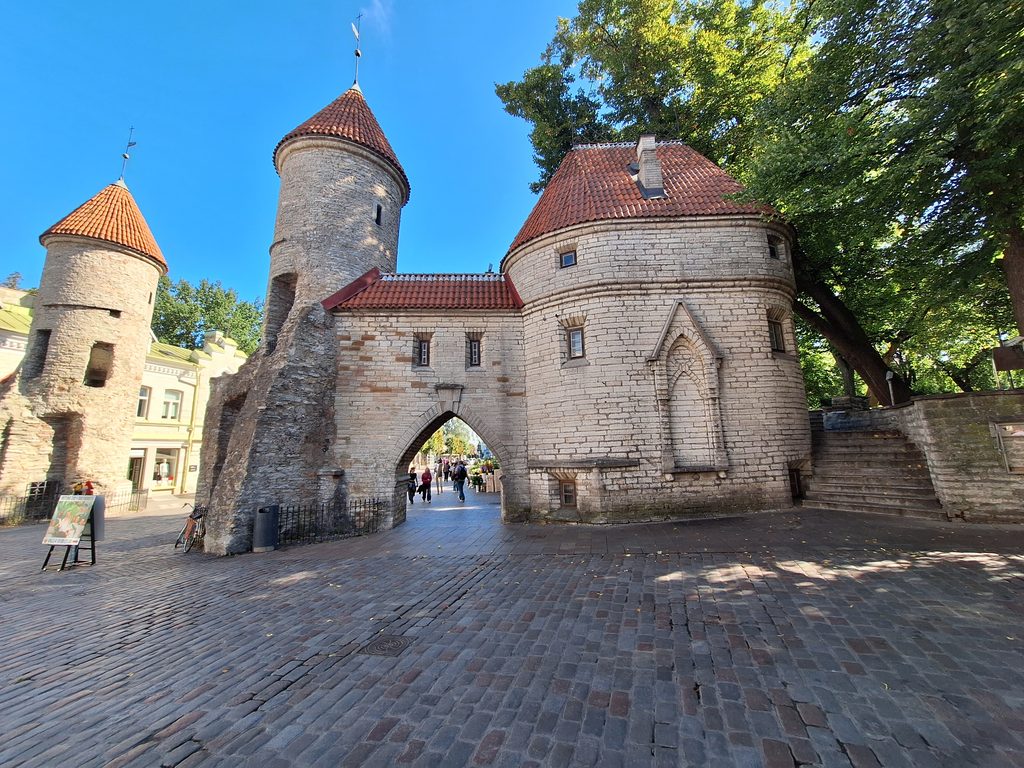
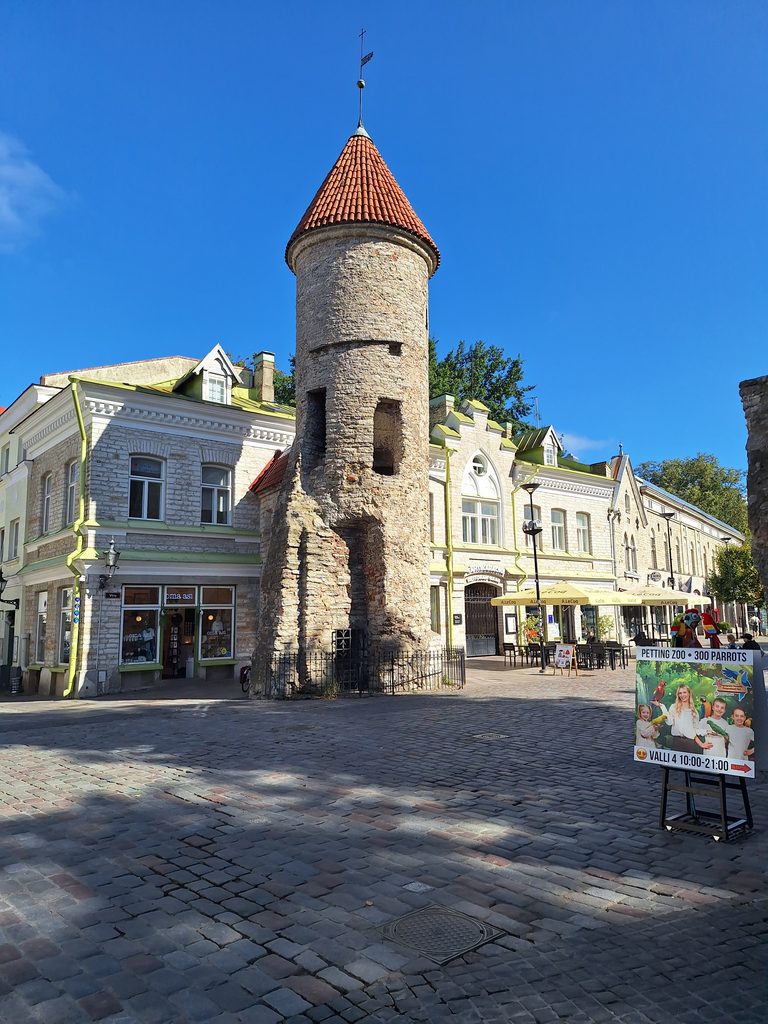
Viru Gate is one of the most recognisable entrances to Tallinn’s Old Town.

Its two round towers stand proudly on either side of the street.
For many years, ivy covered the towers, helping protect parts of the stonework from the weather.
Walking through the gate felt like stepping into another age.
Behind me were the streets of modern Tallinn.
Ahead were narrow lanes, ancient buildings and centuries of history.
The History of Viru Gate
The Viru Gate formed part of the medieval defensive system constructed around Tallinn during the fourteenth century.
As the city developed, its fortifications became increasingly sophisticated.
By the following centuries, Tallinn had several fortified entrances, with towers and connecting curtain walls designed to control access to the city.
The main towers were often square, while the outer defensive structures, known as barbicans, sometimes incorporated smaller round towers.
As Tallinn expanded, sections of the walls and gateways were demolished to improve access.
Part of Viru Gate was removed to make way for a horse-drawn tram route connecting the Old Market area with Kadriorg.
Fortunately, the distinctive corner towers survived.
Nearby, part of the old bastion known as Musumägi can still be seen.
Today, Viru Street is one of Tallinn’s busiest pedestrian streets, filled with shops, restaurants and visitors.
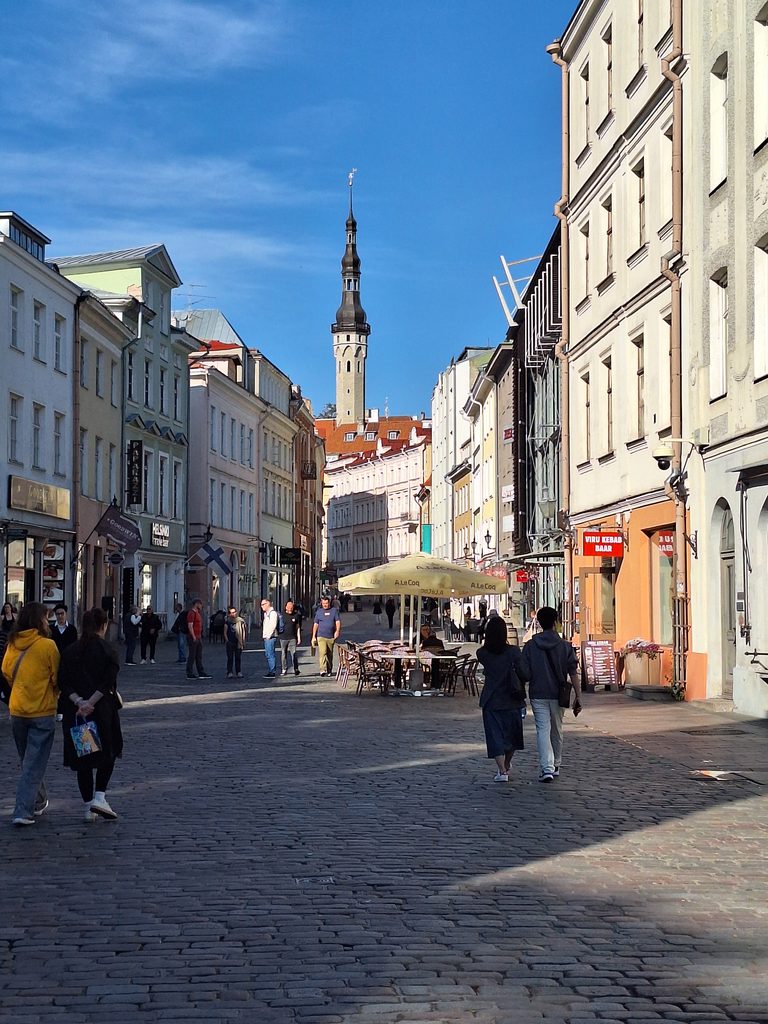
It is difficult to imagine the soldiers who once stood guard here, watching for enemies approaching the city.
A Few Unexpected Photographic Models
From Viru Gate, I made my way towards Tallinn Town Hall.
One of the advantages of Tallinn is that many important historic attractions are within relatively easy walking distance.
Along the way, I stopped to photograph an attractive old building.
Just as I was preparing to take the picture, three people stepped directly in front of me.
They began posing as though they were movie stars!
I waited patiently.
And waited.
After approximately ten minutes, they finally moved away.
At last, I managed to take my photograph.
The building was the Olde Hansa, a restaurant housed in a wonderfully historic setting.

Sometimes taking a photograph requires almost as much patience as travelling itself!
Tallinn Town Hall — A Gothic Treasure
A short walk brought me to Tallinn Town Hall.
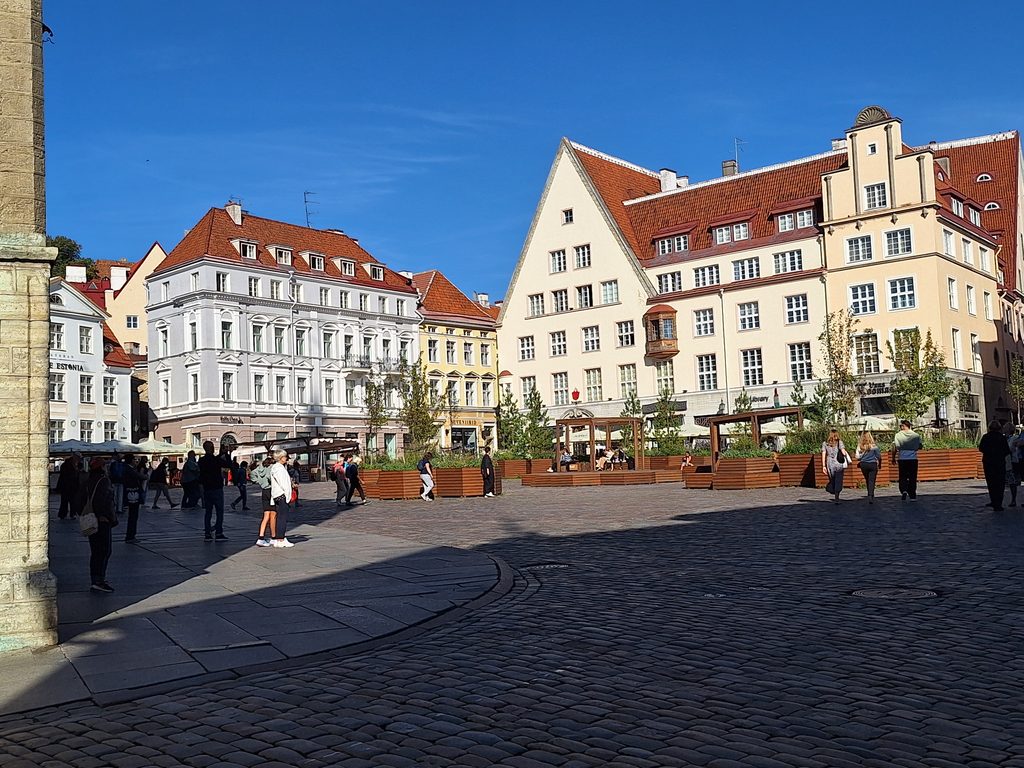
What a magnificent building.
It is considered the oldest surviving Gothic town hall in Northern Europe.

The building was first mentioned in historical records in 1322, although its origins extend back into the thirteenth century.
Its present Gothic appearance dates largely from 1404.
For centuries, the Town Hall served as the administrative and judicial centre of Tallinn.
It was here that important decisions were made about commerce, government and the lives of the city’s residents.
Tallinn was an important Hanseatic trading city, and its prosperity is reflected in the quality of its medieval architecture.
Inside are impressive Gothic arches, carved woodwork, paintings and historic furnishings.
Even the artwork carried messages about justice and fair judgement, reminding officials of their responsibilities when settling disputes.
Unfortunately, the building was closed to visitors during my visit.
So I had to admire it from the outside.
Nevertheless, it was well worth seeing.
St. Nicholas Church — History Comes at a Price
Just around the corner stood St. Nicholas Church.
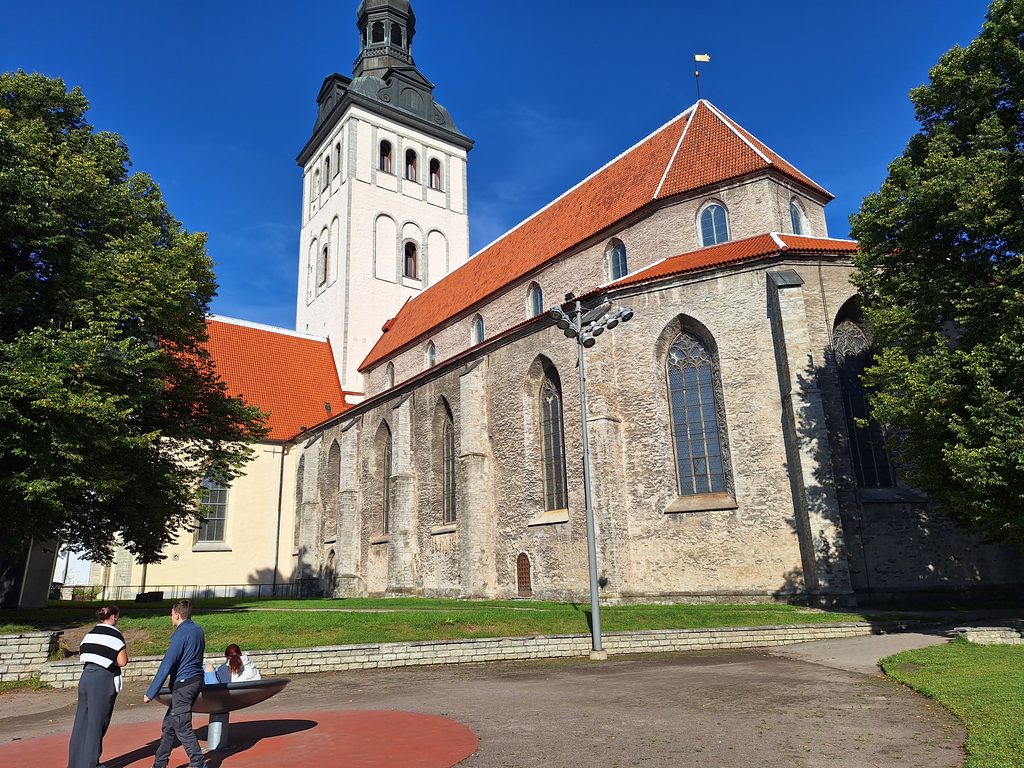
Unfortunately, it was closed when I first arrived.
I returned later, hoping to see the interior.
However, I discovered that entry was now €15, approximately NZ$29.85.
Some online information had suggested free entry, but the building operates as a museum.
I wasn’t particularly interested in exploring the museum exhibitions.
I simply wanted to admire the church’s architecture.
So I decided to save my money.
When you are travelling on a pension, you have to make decisions about what is worth paying for.
A few euros here and there might not sound like much.
But when multiplied across dozens of cities and hundreds of attractions, the costs quickly add up.
A Church That Survived War and Destruction
St. Nicholas Church has its origins in Tallinn’s medieval past.
Dedicated to Saint Nicholas, the patron saint of sailors and merchants, it reflects the city’s long association with maritime trade.
Originally a Catholic church, it became Lutheran during the Protestant Reformation in the sixteenth century.
The building suffered severe damage during Soviet bombing in the Second World War.
It was later restored.
Today, rather than serving as a regular place of worship, it houses important examples of Tallinn’s surviving medieval religious art.
Although I didn’t go inside, I appreciated the building’s historical significance.
And there was still plenty more to see.
Kiek in de Kök and the Bastion Tunnels
Leaving St. Nicholas Church, I began walking uphill towards one of Tallinn’s most impressive defensive structures.
Kiek in de Kök.

What an extraordinary name!
It comes from Low German and translates approximately as “Peep into the Kitchen.”
The story is that guards high in the tower could look down into the kitchens of nearby houses.
The tower formed an important part of Tallinn’s medieval defences.

I decided to pay the admission fee, taking advantage of a senior discount.
And I am glad I did.
It was worth every cent.
Walking Along the Ancient Fortifications
Standing on the old fortifications, I could almost imagine the soldiers who had defended Tallinn through the centuries.
I walked along the ramparts, climbed the tower and explored the museum displays.
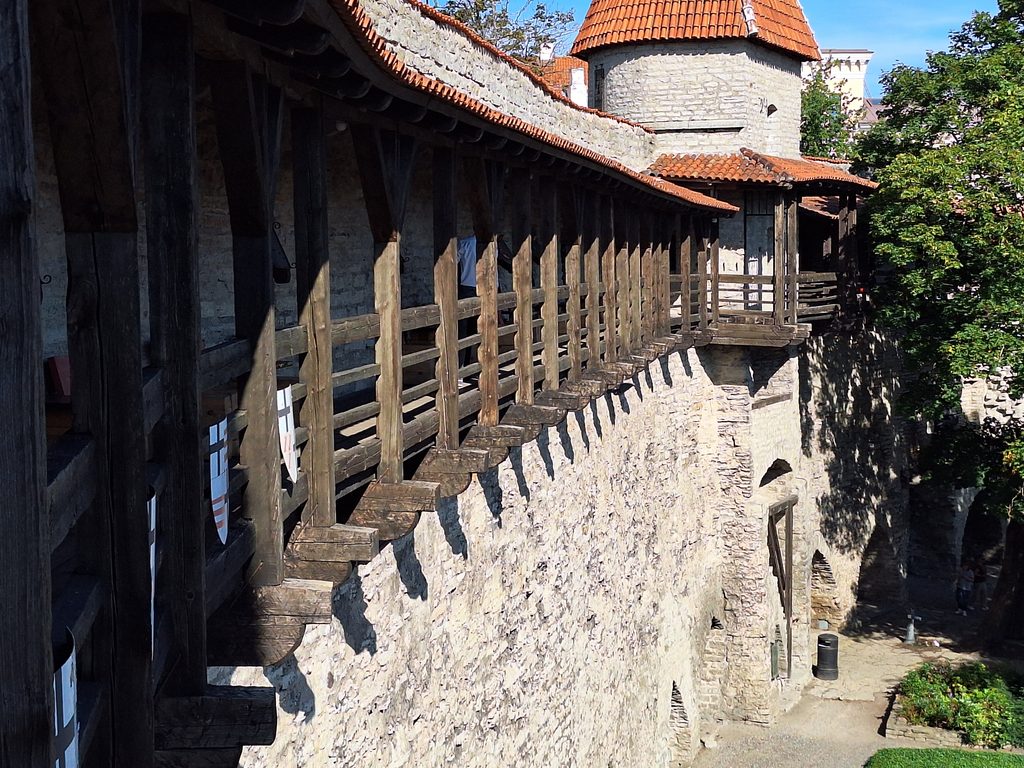
The views and historical atmosphere were magnificent.

There is something extraordinary about standing where people stood hundreds of years ago, looking across the same city but seeing a completely different world.
After exploring, I treated myself to a coffee in the museum café.
A well-earned break.
Beneath Tallinn — The Bastion Passages
The underground tunnels were particularly fascinating.
These passages were constructed mainly during the seventeenth and eighteenth centuries as part of the city’s expanding defensive system.
They allowed soldiers to move through the fortifications while remaining protected from enemy fire.
They were also used to transport supplies and ammunition and to monitor attempts by attacking armies to tunnel beneath the walls.
As cannon technology developed, the nature of warfare changed.
Tall medieval walls were increasingly vulnerable to artillery.
Military engineers began designing lower, wider defensive structures supported by massive earthworks capable of absorbing cannon fire.
The Ingrian and Swedish bastions formed part of an ambitious fortification programme associated with Swedish military engineer Erik Dahlbergh.
By 1857, many of these defensive works were no longer required for military purposes.
Over time, parks and public spaces were developed above the old bastions.
It is remarkable to think that people now enjoy peaceful gardens on structures originally designed for war.
Toompea Castle — The Seat of Estonian Government
Leaving the bastions, I crossed towards Toompea Castle.
Perched on Toompea Hill, this historic fortress is now home to the Estonian Parliament.
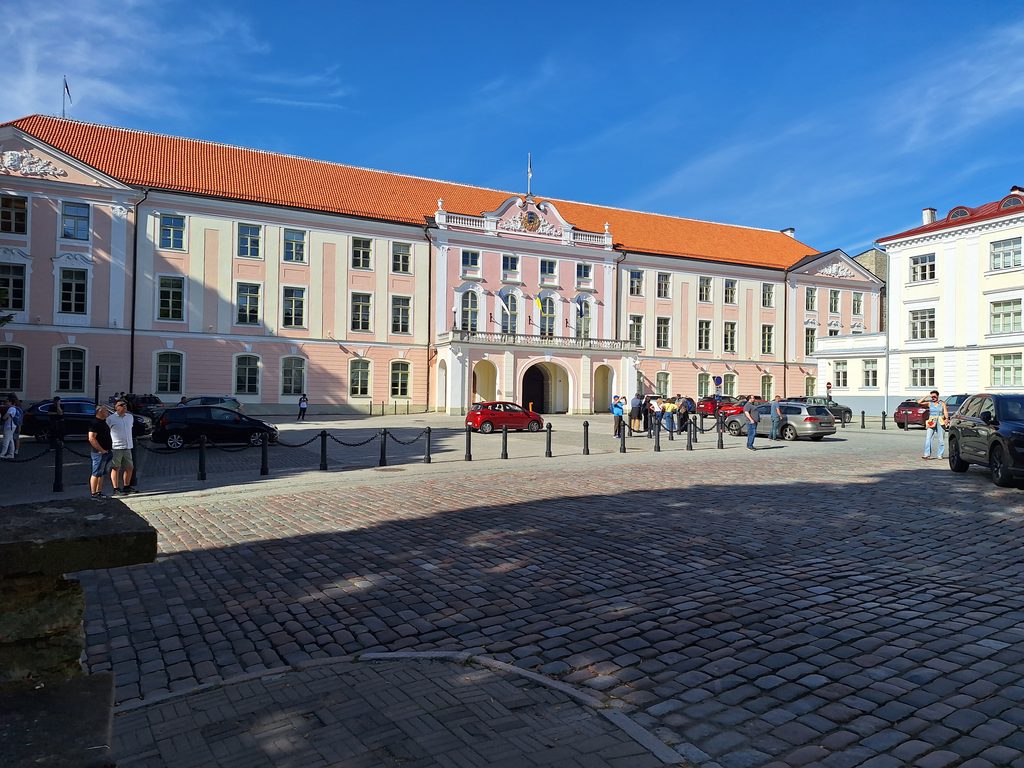
Its history stretches back many centuries.
The hill was occupied by an early stronghold, and its strategic position made it an important centre of power.
Danish crusaders captured the site in 1219.
In 1227, the Order of the Brethren of the Sword gained control and further developed the fortifications.
Over time, different rulers modified the castle.
Today, the complex combines medieval defensive structures with later architectural additions.
Access to parts of the site is restricted because it remains an important centre of government.
Standing outside, it was fascinating to consider how a fortress once associated with foreign rulers had become the home of Estonia’s own democratic parliament.
Alexander Nevsky Cathedral — A Symbol of Russian Rule
Across the square stands the magnificent Alexander Nevsky Cathedral.
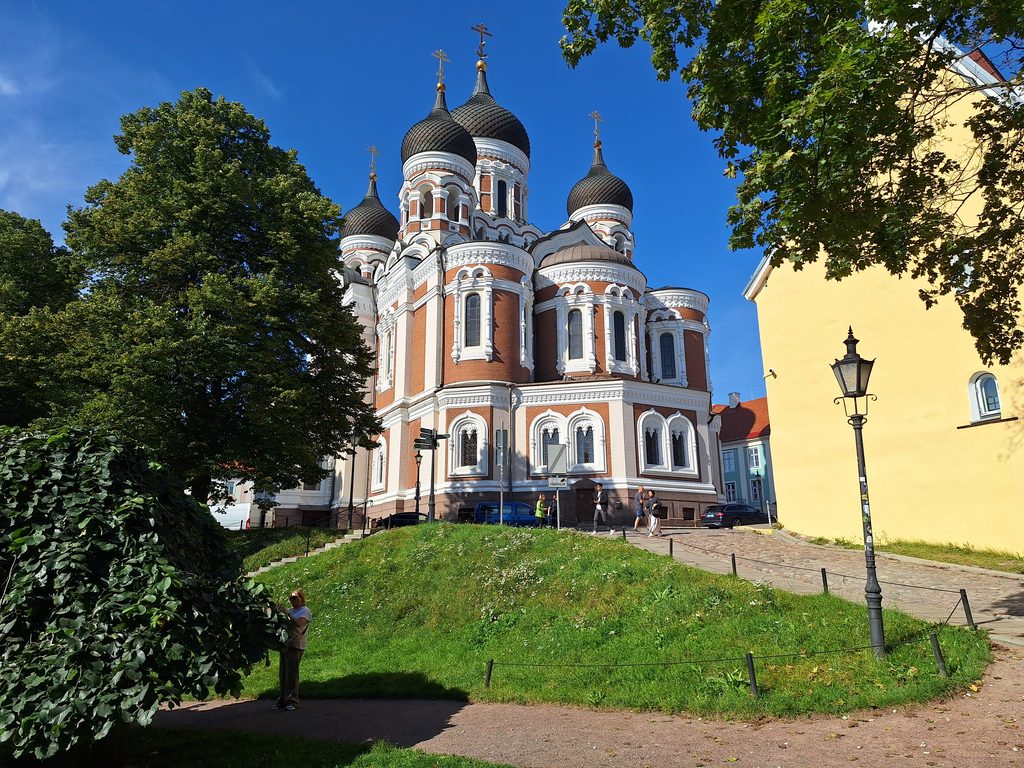
With its onion-shaped domes and elaborate decorations, it is one of Tallinn’s most striking buildings.
The Orthodox cathedral was completed in 1900, when Estonia was part of the Russian Empire.
Its location directly opposite Toompea Castle was highly symbolic.
The building represented Russian imperial power and the influence of the Orthodox Church.
Today, it remains a prominent feature of Tallinn’s skyline.
Inside the Cathedral
Entry was free, which was a pleasant change!
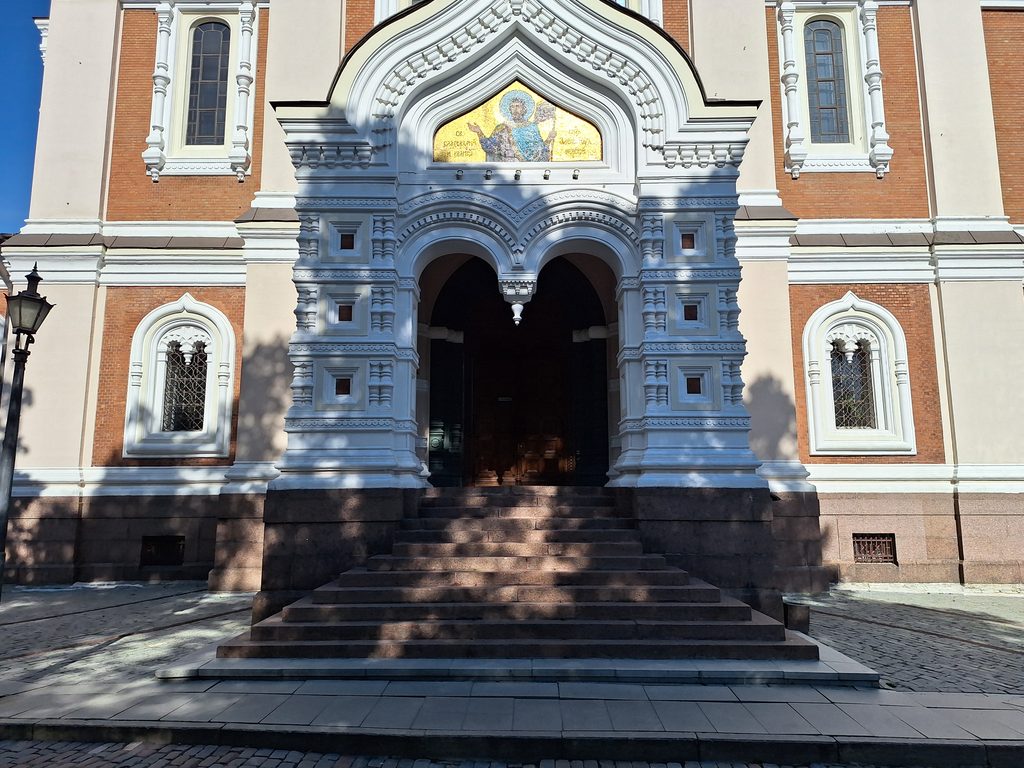
However, photography was not permitted inside.
The interior was magnificent.
Beautiful mosaics, icons and religious decorations created a rich and impressive atmosphere.
The cathedral also has an extraordinary collection of eleven bells.
The largest weighs approximately fifteen tonnes, making it one of Tallinn’s most impressive bells.
During the Soviet period, the cathedral suffered neglect, but it has since been restored.
Standing inside, I reflected on how buildings can acquire very different meanings as political circumstances change.
A monument once associated with foreign domination can also become an important part of a city’s architectural and religious heritage.
Pikk Hermann — Flying Estonia’s Flag
Around the corner stands Pikk Hermann, the southwestern tower of Toompea Castle.
The tower was first built during the 1360s and later extended in the sixteenth century.
Today, it stands approximately 45.6 metres high.
At the top flies the Estonian national flag.

The flag is raised at sunrise and lowered at sunset, accompanied by music associated with the country’s national traditions.
For Estonians, this is an important daily expression of national identity.
I learned that the flags require regular replacement because of the weather.
Strong autumn winds can damage a flag very quickly.
During calmer summer conditions, one may last considerably longer.
An average of fifteen flags may be required in a year.
I was also interested to learn that the historical cost had been recorded as 420 Estonian krooni, approximately €27, and that damaged flags were sometimes repaired to reduce expense.
Such small details help bring history to life.
St. Mary’s Church — Another Admission Fee
Continuing around Toompea Hill, I came across St. Mary’s Church.
Unfortunately, there was another entrance fee.
Photography also cost an additional €3.
The person supervising the entrance made a rather surprising comment.
“God does not live here.”
That struck me as an unusual thing to hear at the entrance to a historic church.
Perhaps the point was that the building was being presented more as a historical attraction than a place of worship.
Whatever the explanation, I decided not to go inside.
There are only so many admission fees a traveller on a pension can pay.
The Long Leg Gate — A Road with a Dangerous Past
I continued downhill towards the Lower Town.
My route took me through the Long Leg Gate.

What an interesting name!
The passage connects Tallinn’s Upper Town with the Lower Town.
Today, it is simply a historic route used by pedestrians.

But centuries ago, things were very different.
During the medieval period, horses were a common form of transport.
Later, horse-drawn carriages became more widespread.
The steep road leading down from Toompea Hill could be extremely dangerous.
At the bottom, the route curved sharply and connected with several busy streets.
Coachmen were expected to shout warnings as they approached.
Accidents were common, and some were fatal.
Eventually, the road was widened and improved during the late eighteenth century.
A Wall of Mistrust
One of the most fascinating things I learned concerned the relationship between Tallinn’s Upper and Lower Towns.
They were not always on friendly terms.
The Upper Town was associated with rulers, nobles and governing authorities.
The Lower Town developed as a centre of merchants, craftsmen and ordinary townspeople.
These communities often had different interests and loyalties.
The defensive wall along Long Leg Street, completed during the fifteenth century, became known as the “wall of mistrust.”
What a remarkable description!
Imagine living in a city where two neighbouring districts were separated by such suspicion that a wall was needed between them.
Walking through the gate today, it is difficult to imagine the tensions that once existed.

But the stones remain, carrying centuries of history.
Checking into Zinc Old Town Hostel
After a long day of sightseeing, I headed towards Zinc Old Town Hostel.
I had been slightly apprehensive following the booking problems the previous day.
Fortunately, the facilities were much better than I had feared.
The reception staff weren’t particularly sociable, which seemed consistent with some earlier reviews.
However, the accommodation itself was comfortable.
The showers and toilets were well maintained.
There was also a laundry service costing €4.
That was considerably cheaper than the €10 charged at Imaginary Hostel.
My room was surprisingly spacious.
It had a table, chairs and even a sofa.
After spending so many months in cramped dormitories, those little comforts were very welcome.
Almost Twelve Kilometres of Walking
By the end of the day, I had walked 11.77 kilometres.
What a day!
After spending so much time in Poland eating, drinking and dealing with laptop problems, I certainly needed the exercise.
Tallinn had already provided a remarkable introduction to Estonia’s medieval history.
From ancient city gates and defensive towers to magnificent churches and historic castles, there seemed to be something interesting around every corner.
Meeting Remy from France
During the day, I also met Remy, a traveller from France.
He was heading towards Riga.
Naturally, I told him about Cinnamon Sally Backpackers.
I gave him directions and encouraged him to stay there.
After my wonderful experience, I was confident he would enjoy it.
I also introduced him to Inspire Seniors Travel and encouraged him to follow my journey.
Meeting people and sharing information is one of the great pleasures of independent travel.
You never know when a conversation might help someone enjoy their next destination a little more.
Time for a Well-Earned Rest
It had been a busy day.
My feet were tired, and I had certainly covered plenty of ground.
But I was delighted with what I had discovered.
There was still much more of Tallinn waiting to be explored.
For now, however, sleep was calling.
Take care, fellow travellers.
And if you’re sitting at home watching television, there’s nothing wrong with that either.
But remember, there is a wonderful world outside waiting to be discovered.
Day 298 — Another Day Among Tallinn’s Medieval Walls and Hidden Treasures
Weather: Sunshine, high 23°C
Elevation: Approximately 12 metres above sea level
A Quiet Morning in Tallinn
Another day in Tallinn began with blue skies and beautiful sunshine.
I spent some time finishing yesterday’s blog and organising the photographs before preparing breakfast.
Three eggs on toast.
A simple but satisfying start to the day.
Before heading out, I wished Remy a safe journey to Riga.
He was continuing towards Latvia, and I hoped he would enjoy Cinnamon Sally as much as I had.
Then it was time to explore more of Tallinn.
The streets seemed unusually quiet.
Over the previous few days, cruise ships had brought large numbers of tourists into the Old Town.
At times, the narrow medieval streets had been so crowded that it was difficult to move without bumping into someone.
Today was different.
There was room to walk, stop and admire the architecture without constantly negotiating crowds.
Wonderful!
Kohtuotsa Viewing Platform — Tallinn from Above
My first destination was Kohtuotsa Viewing Platform, high on Toompea Hill.
It is one of Tallinn’s most popular viewpoints.
People visit throughout the day, particularly around sunrise and sunset, to admire the extraordinary panorama.
From the platform, the medieval Old Town spreads out below.
Red-tiled rooftops, church spires, ancient walls and defensive towers create a magnificent scene.
Beyond them, the modern city stretches towards the horizon.
It is a wonderful contrast.
On one side, centuries of history.
On the other, the modern capital of an independent European nation.
I could identify several landmarks I had already visited, including the towers of the city walls and the spire of St. Olaf’s Church.
This was one of those views that made me grateful I had continued travelling.
Tallinn’s Remarkable Medieval Defences
Tallinn’s surviving fortifications are among the city’s greatest treasures.
Around 1.85 kilometres of the medieval defensive wall remain.
Twenty-six towers have survived, along with sections of the old gateways.
Considering the wars, invasions and political upheavals Estonia has experienced, their survival is remarkable.
No matter which direction I walked, I seemed to encounter another section of wall or another ancient tower.
The whole city felt like an enormous open-air history museum.
Nun’s Tower and Golden Foot Tower
Leaving Kohtuotsa Viewing Platform, I descended a staircase towards the Lower Town.
Before long, I came across an impressive stretch of Tallinn’s city walls.
Here stood Nun’s Tower, also known as Nunnatorn, together with Sauna Tower and Kuldjala Tower, or Golden Foot Tower.

The towers date back to the fourteenth century.

The connecting wall stretches for several hundred metres.
Standing there, I could see the defensive structures rising along the hillside.
Nun’s Tower stood near the gate.
Sauna Tower rose farther along the wall.
Golden Foot Tower completed the impressive scene.
It was one of the most memorable sections of Tallinn’s fortifications I had seen.
Photographs help capture the scale of these buildings.
But standing there in person is something else entirely.

I felt as though I had stepped back hundreds of years.
The Church of the Holy Spirit
My next destination was the Church of the Holy Spirit.
It is tucked away within Tallinn’s Old Town.
Getting there from the city wall required a little backtracking and walking around the surrounding streets.
From the outside, the church appeared relatively plain.
I almost walked past without giving it much thought.
But inside was something extraordinary.
A One-Euro Entrance to History
When I reached the entrance, I discovered that admission was charged.
Another church asking for money!
After paying several entrance fees around Tallinn, I was becoming rather selective.
I began talking with the custodian.
Instead of paying the full admission price, I asked whether I could make a donation.
He asked how much I wanted to give.
I suggested one euro.
I half expected him to object or negotiate.
But to my surprise, he accepted immediately.
One euro!
That small donation opened the door to one of the most beautiful church interiors I had encountered in Tallinn.
Magnificent Painted Interiors
The inside was magnificent.
Decorative painted panels covered parts of the timber interior.
The craftsmanship was extraordinary.
I could only imagine how bright the colours must have been when they were first created.
Over centuries, dust and age have naturally affected their appearance.
But their beauty remains.
The stained-glass windows were another highlight.
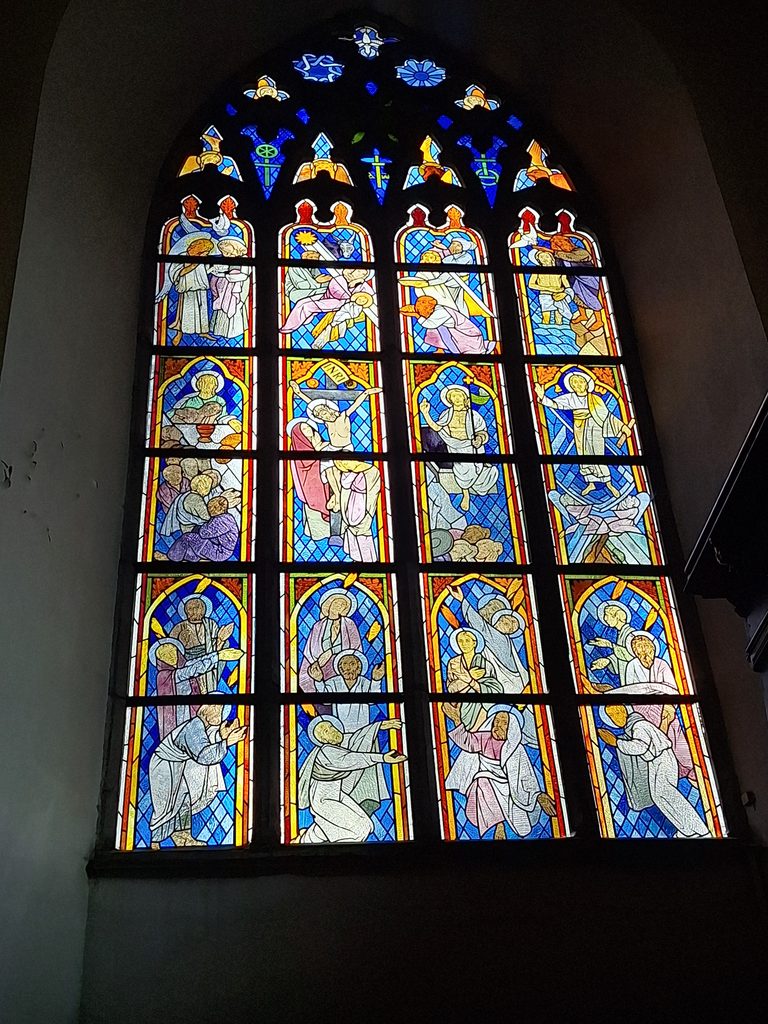
I counted twenty-five individual panels, illuminated by the sunlight outside.
The colours were wonderful.
Standing there, looking around the church, I felt I had discovered one of Tallinn’s hidden treasures.
I hoped my photographs would help convey some of what I was seeing.
The History of the Church of the Holy Spirit
The Church of the Holy Spirit was first mentioned in written records in 1319.
It is one of Tallinn’s oldest religious buildings.
Unlike many medieval churches, its orientation was influenced by the surrounding street layout.
Its distinctive white exterior and slender tower make it an important landmark within the Old Town.
One of its most recognisable features is the historic clock on the façade.
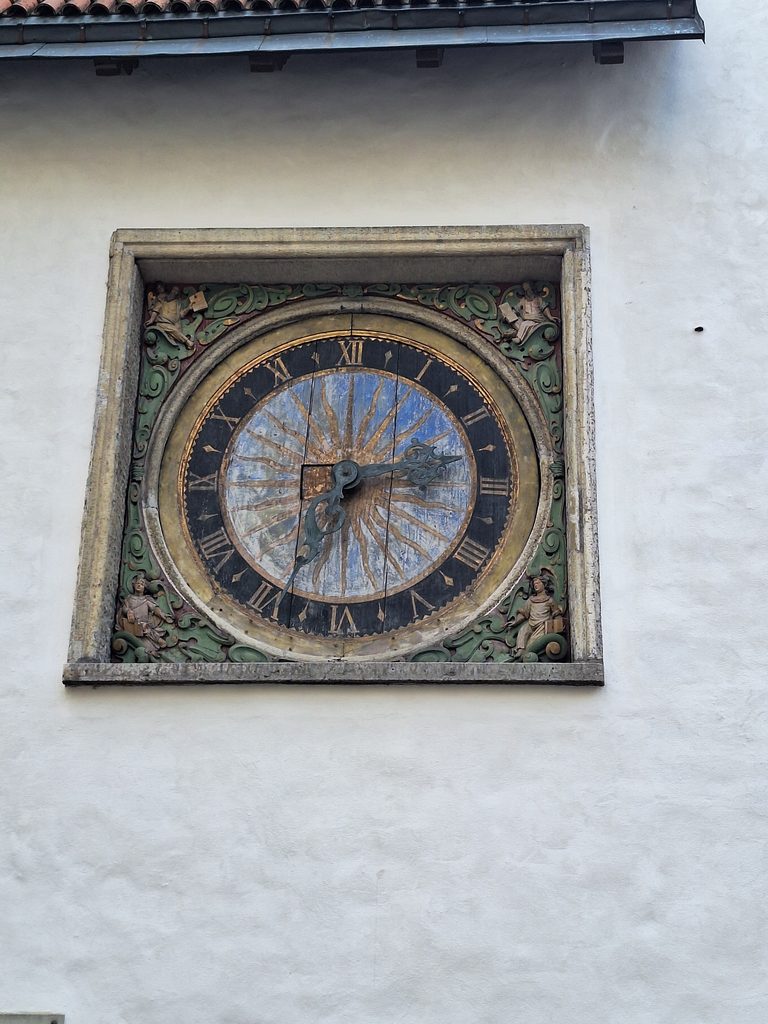
The clock dates from the seventeenth century and has been telling the time for generations.
Inside are several remarkable works of art.
The altar was created by the famous medieval artist Bernt Notke during the fifteenth century.
There is also an impressive pulpit dating from 1597.
These features provide a fascinating glimpse into Tallinn’s religious and artistic history.
A Church for Ordinary People
During medieval times, the Church of the Holy Spirit was especially important to ordinary townspeople.
Following the Reformation, it became one of the first churches in Tallinn where sermons were delivered in Estonian rather than German.
This represented an important development in the use of the Estonian language.
Johann Koell’s catechism, published in 1535, is associated with the earliest printed works in Estonian.
The church itself has undergone many alterations.
Its original wooden ceiling was replaced by Gothic vaulting during the fourteenth century.
Larger windows were also added.
The tower suffered damage from fires in 1684 and again in 2002, but was subsequently restored.
The building has survived centuries of religious and political change.
And there I was, enjoying its extraordinary interior for the price of a one-euro donation.
Not bad at all!
Encouraging Another Couple to Visit
As I was leaving, I encountered a young couple standing near the entrance.
They were debating whether to pay to go inside.
I could see they were tempted to leave.
I told them how much I had enjoyed the church and encouraged them to take a look.
After hearing my recommendation, they decided to go in.
I hope they enjoyed it as much as I did.
Sometimes the best travel advice comes from someone who has just stepped outside the door.
St. Olaf’s Church — Another Famous Tallinn Landmark
My next stop was St. Olaf’s Church, also known as St. Olav’s.
This impressive church is one of Tallinn’s most recognisable buildings.
Admission to the church itself was free.
However, climbing the tower cost €9.
I decided not to pay for the climb.
Tallinn has so many wonderful viewpoints that I didn’t feel the need to spend more money looking over the city.
After all, I had already enjoyed spectacular views from Toompea Hill.
The History of St. Olaf’s Church
St. Olaf’s Church is believed to have origins stretching back to the twelfth century.
It was an important religious centre for Tallinn’s Scandinavian community before the Danish conquest of 1219.
Originally a Roman Catholic church, it later became Lutheran during the Protestant Reformation.
Over the centuries, it experienced numerous changes in both religious use and administration.
By the twentieth century, the church’s congregation had changed considerably.
In 1950, Soviet authorities transferred the building to a Baptist community.
During the Soviet era, its tall spire was also associated with radio surveillance and communications.
Today, the church remains an active place of worship.
It is another reminder of Tallinn’s complicated history.
What may appear to be simply a beautiful medieval church has also played a role in the political struggles of the modern era.
Choosing Which Attractions to Visit
One of the lessons I have learned during this journey is that you cannot visit every museum, church, castle and historical attraction.
Not when you are travelling on a pension.
Tallinn has an extraordinary number of beautiful old buildings.
Many churches operate partly as museums.
Other historical buildings charge admission for exhibitions and towers.
If you paid to visit everything, the cost would soon reach hundreds of euros.
So I choose carefully.
Some attractions are worth paying for.
Others can be enjoyed perfectly well from the outside.
And occasionally, as at the Church of the Holy Spirit, a little conversation can lead to a wonderful experience.
The Great Coastal Gate
Leaving St. Olaf’s Church, I headed towards another part of Tallinn’s Old Town.
My intended destination was the House of the Brotherhood of Black Heads.
Google Maps began directing me towards the port.
At first, I wondered whether it was sending me in the wrong direction again.
Then I remembered that the Brotherhood had been associated with merchants and traders.
Perhaps being near the harbour made sense after all.
I checked the map and continued walking.
Along the way, I came across the Great Coastal Gate.
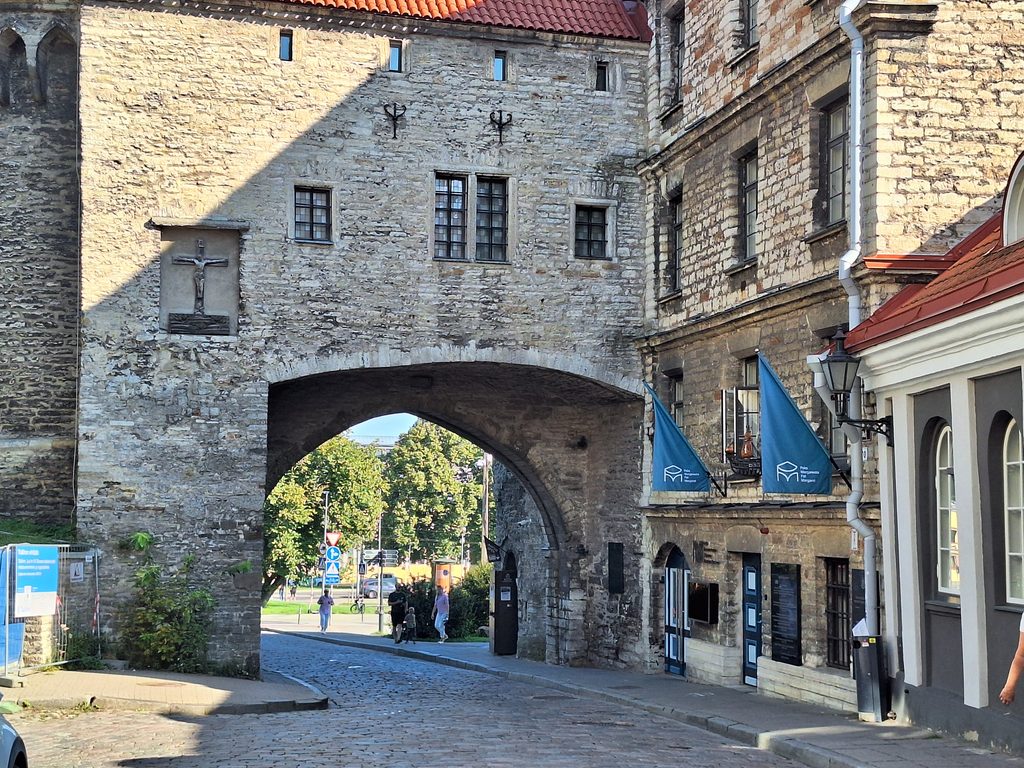
Another wonderful discovery!
Fat Margaret — Tallinn’s Massive Defensive Tower
Beside the Great Coastal Gate stands one of Tallinn’s most famous towers.
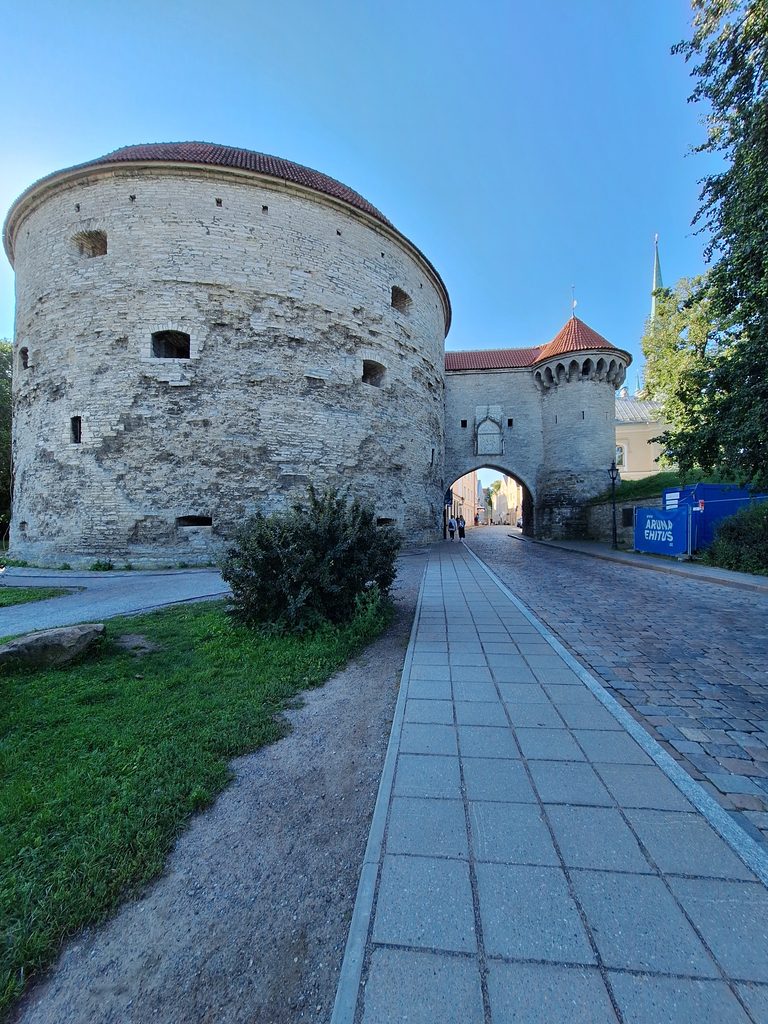
Fat Margaret.
What an extraordinary name for a defensive building!
The tower was constructed between 1511 and 1530 as part of improvements to Tallinn’s coastal fortifications.
Its enormous circular structure was designed to protect the harbour approaches.
The tower measures approximately 25 metres across and around 20 metres high.
Its walls reach up to five metres thick in places.
These dimensions made it one of the most formidable parts of Tallinn’s defensive system.
The tower was designed not only to defend the city but also to impress visitors arriving by sea.
In medieval times, the shoreline was much closer to the fortifications than it is today.
Ships approaching Tallinn would have been greeted by this massive symbol of the city’s wealth and military strength.
From Fortification to Prison
Over the centuries, Fat Margaret served several purposes.
It was used for storing gunpowder.
Later, it became associated with the prison system.
Today, it remains one of Tallinn’s most recognisable historical structures.
Standing beside it, I could appreciate just how enormous the building was.
The thick walls and heavy stonework were a reminder of an era when cities had to invest tremendous resources simply to protect themselves.
The Changing Design of Tallinn’s Walls
During my earlier visit to the Bastion Passages, I had learned how defensive architecture changed following the introduction of powerful artillery.
Tall medieval walls were gradually adapted.
Some were lowered.
Others were reinforced with massive earthworks and grassy embankments.
The aim was to make them better able to withstand cannon fire.
As I continued towards the port, I came across another excellent example of these strengthened defensive structures.

It was fascinating to see how military technology had influenced the physical appearance of the city.
Another Google Maps Adventure
I was still determined to find the House of the Brotherhood of Black Heads.
Unfortunately, Google Maps had other ideas.
Once again, it told me that I had arrived.
But all I could see was an area filled with food and drink establishments.
No obvious historic building.
No sign of the place I was looking for.
I was becoming frustrated.
It was warm, I had already walked quite a distance, and my phone didn’t seem to be helping.
Eventually, I decided to take a break.
I found a nearby casino and went inside to escape the sunshine.
A Four-Euro Beer and a New Navigation App
To my surprise, beer in the casino cost only €4.
That was considerably cheaper than the €6 to €10 I had encountered in some of Tallinn’s Old Town establishments.
So I sat down, enjoyed a cold drink and caught up on a little work.
While resting, I decided to take another look at an app I had previously tried.
GPSmyCity.
The annual subscription cost US$12.95.
The app provides detailed walking guides and information about places of interest.
I finally decided to subscribe.
Within minutes, I realised that the building I had been searching for was only a short distance from where I had originally started.
My unnecessary detour had cost me approximately four kilometres!
Wonderful.
Another lesson learned.
Sometimes the cheapest option isn’t necessarily the best, particularly when it results in hours of unnecessary walking.
The House of the Brotherhood of Black Heads
At last, I found it.
The House of the Brotherhood of Black Heads.
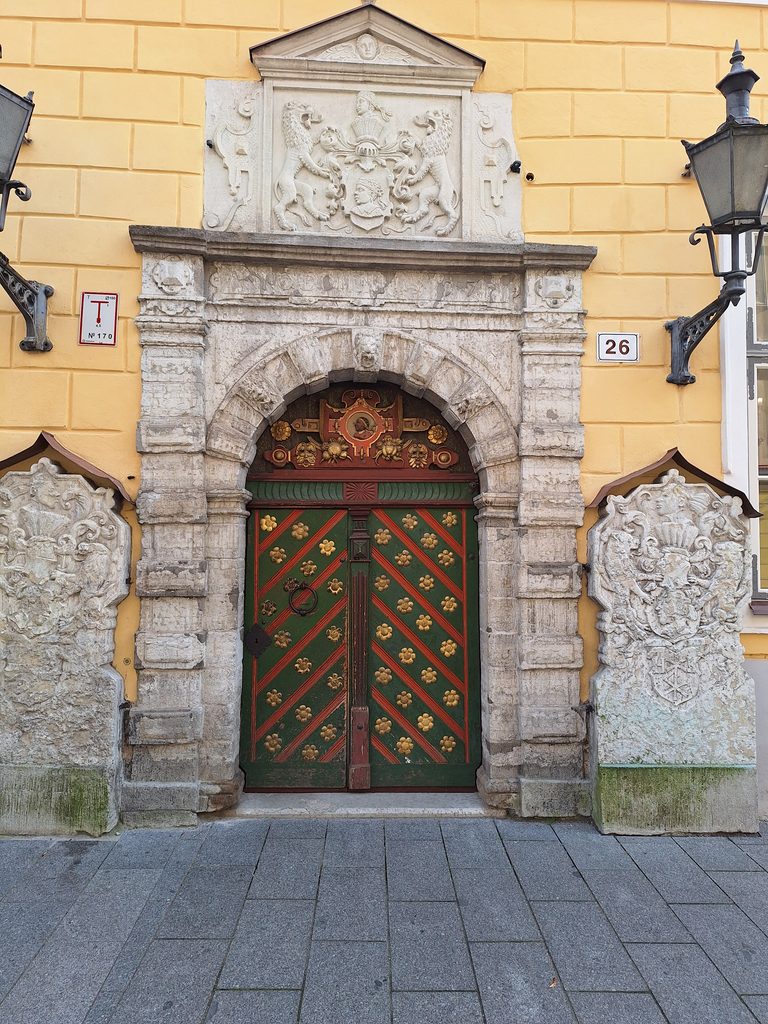
Of course, just as I prepared to take a photograph, a tour group gathered in front of the building.
Once again, patience was required.
I waited for them to move away before taking my picture.
The building was historically associated with the Brotherhood of Black Heads, an organisation of unmarried foreign merchants, shipowners and traders.
The Brotherhood operated in the historic region of Livonia, which included parts of modern Estonia and Latvia.
During the Soviet occupation in 1940, members of the organisation fled to Germany.
Their historic Tallinn building remains an important reminder of the city’s Hanseatic trading past.
A Beautiful Renaissance Building
The House of the Brotherhood of Black Heads displays strong influences from Dutch Renaissance architecture.
Its decorative façade is one of the building’s most attractive features.
The complex consists of three connected buildings.
Inside are several halls and rooms used for gatherings, ceremonies and events.
The White Hall dates back to the early sixteenth century, although significant alterations were made between 1909 and 1911.
The Brotherhood also acquired St. Olaf’s Guild Hall in 1919.
Parts of that building retain early fifteenth-century features.
Standing outside, I reflected on the merchants who had once gathered here.
These were people whose trading activities connected Tallinn with cities across the Baltic Sea and beyond.
It was another fascinating piece of history.
And after my four-kilometre detour, I was particularly pleased to have finally found it!
Catherine’s Alley — A Medieval Passageway
My next destination was Catherine’s Alley, also known as St. Catherine’s Passage.

What a wonderful place.
The narrow passage winds through part of Tallinn’s historic Old Town.
It connects Vene Street with Müürivahe Street and passes alongside the former Dominican Monastery.
The alley was previously known as Monk’s Alley.
Its present name comes from St. Catherine’s Church, which once formed part of the surrounding religious complex.
Walking along the passage felt like entering another century.

Ancient Tombstones and Historic Buildings
The southern side of Catherine’s Alley is lined with buildings dating from the fifteenth to seventeenth centuries.
The area underwent restoration during the 1990s, helping preserve its distinctive medieval atmosphere.
One of the most unusual sights is the collection of old tombstones displayed along the walls.
These stones are associated with the Dominican Monastery and the former cemetery of St. Catherine’s Church.
They are reminders of the generations who lived, worshipped and died in medieval Tallinn.
There is something quite moving about walking through a passage where history is so visible.
Traditional Crafts in Catherine’s Alley
Today, Catherine’s Alley is also known for its traditional craft workshops.
Artists and craftspeople produce ceramics, hats, glasswork and other handmade objects.
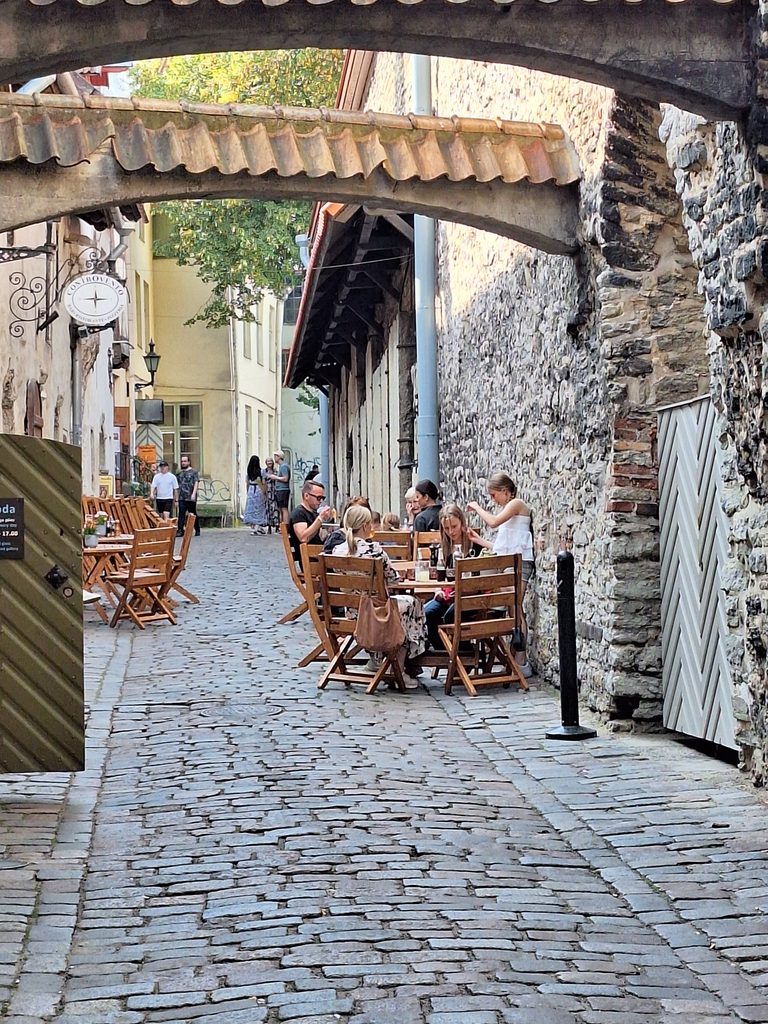
Visitors can sometimes watch them working.
I particularly enjoyed seeing how the historic surroundings had been given a new purpose.
Rather than becoming simply an abandoned relic of the past, the passage remains a living part of the city.
Here, history and modern craftsmanship exist side by side.
It was one of the most charming places I discovered in Tallinn.
Hellemann Tower and the City Wall
At the end of the alley stands Hellemann Tower.
The tower forms part of a surviving section of Tallinn’s defensive wall.
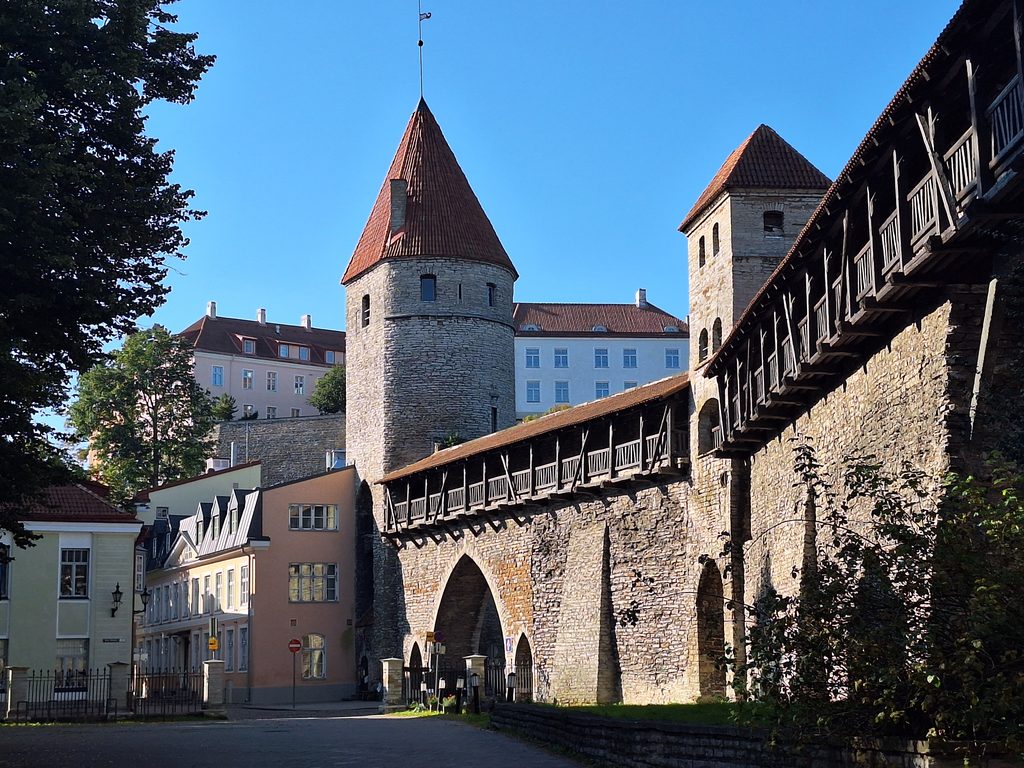
A stretch of wall nearly 200 metres long connects it with Munkadetagune Tower.
Visitors can climb steep stairs inside the tower to reach an upper level and viewing platform.
The tower is thought to have been named after a local citizen, Helle Holleman.
Its position near Viru Gate gave it strategic importance in medieval Tallinn’s defences.
Standing there, surrounded by the ancient walls, I was again struck by how much of this remarkable city has survived.
Another Wonderful Meeting with Travellers
While exploring the area, I met a German couple who had previously visited New Zealand.
Naturally, we began chatting.
It is always interesting hearing how visitors from other countries experienced the place I call home.
We shared travel stories and talked about some of the places we had visited.
It was another small but enjoyable encounter.
After travelling through so many countries, I have come to appreciate these conversations enormously.
The buildings and monuments are fascinating.
But it is often the people you meet along the way who provide the most lasting memories.
A Simple Dinner After Another Long Day
By now, the afternoon was drawing to a close.
I had spent hours walking through Tallinn’s historic streets, climbing hills, exploring churches and discovering ancient buildings.
It was time to return to the hostel.
Dinner was simple.
Pasta with stewed red peppers and tuna.
Nothing particularly fancy.
But after a long day of sightseeing, it was filling and satisfying.
When travelling on a budget, preparing your own meals is one of the easiest ways to control expenses.
And sometimes a simple meal tastes wonderful after a day spent walking.
What Makes a Good Hostel?
After another enjoyable day in Tallinn, I found myself thinking about the hostels I have stayed in during this journey.
Some have been absolutely wonderful.
Others have been disappointing.
I would love to hear what everyone following Inspire Seniors Travel thinks.
What is the one thing you love most about staying in hostels?
And equally important:
What is the one thing you dislike?
For me, the best hostels are those that create a welcoming social atmosphere.
Somewhere travellers can gather around a table, enjoy a cup of tea or coffee and share stories about their adventures.
That sense of community can transform an ordinary overnight stay into a memorable experience.
The thing I dislike most is inconsiderate noise when people are trying to sleep.
I understand that travellers arrive and depart at different times.
But there is no reason to wake an entire dormitory simply because you have an early bus or train.
I always try to pack my belongings the evening before departure.
That way, I can leave quietly in the morning without disturbing everyone else.
It is simply common courtesy.
Looking Ahead to Finland
My time in Estonia was proving to be another fascinating chapter of this journey.
Tallinn had exceeded my expectations with its beautifully preserved medieval walls, towers, churches and historic streets.

There seemed to be something remarkable around every corner.
But the journey must continue.
I have already booked my ferry to Finland for Monday.
Another country.
Another capital city.
Another opportunity to explore somewhere new.
After travelling through the Baltic states, I am looking forward to crossing the Gulf of Finland and discovering Helsinki.
Thank You for Travelling with Me
I hope these stories continue to encourage you to explore the world, whether you are young, retired or somewhere in between.
Inspire Seniors Travel isn’t just about encouraging older people to travel.
It is about encouraging anyone who has a sense of curiosity and adventure.
You don’t have to travel enormous distances to discover something wonderful.
Sometimes the most interesting experiences happen close to home.
For me, this journey has become a way of life.
There are challenges, frustrations and days when things go wrong.
But there are also new friendships, unexpected kindness, fascinating history and moments that remind me why I started.
Thank you for continuing to follow my adventures.
I always enjoy hearing from you and learning about your own travelling experiences.
Next stop — Finland!
Peace,
Andrew Matthews
Inspire Seniors Travel
https://inspireseniorstravel.com
Stepping out of fear, one step at a time, into the unknown.