

Inspire Seniors Travel — Travelling Through the World, One Step at a Time
Day 1: Travelling to Nepal — An Unexpected Welcome
Leaving Bangladesh Behind
After a sleepless final night in Dhaka, it was time to move on to another country and another capital city.
My destination was Kathmandu, Nepal.
I was looking forward to leaving the chaos of Dhaka behind and discovering what Nepal had to offer. Of course, travelling independently means that even getting from one country to another can become an adventure.
At the airport, I had trouble trying to exchange my remaining Bangladeshi currency. It’s one of those frustrating little problems that travellers encounter. Money that is perfectly useful in one country can suddenly become difficult to exchange once you’ve crossed the border.
Eventually, I boarded my Biman Bangladesh flight and headed towards Kathmandu.
Arriving in Nepal
After landing in Kathmandu, I joined the arrivals process and prepared to organise my visa.
The visa queues were confusing, and I wasn’t entirely sure where I was supposed to go.
Fortunately, someone came to my assistance and helped me through the process.
It was a welcome change to have someone offer a helping hand when I needed it.
After collecting my belongings, I headed outside to work out how to reach my hostel.
Meeting Krishna
This was where I met a young man named Krishna.
He was extremely helpful, explaining where I needed to go and how I could catch a bus towards the city.
He also helped arrange an inexpensive motorbike ride for the final part of my journey to the hostel.
When you’re arriving somewhere unfamiliar, especially after a tiring journey, small acts of kindness make an enormous difference.
I was grateful for his help.

With Krishna, whose kindness made my arrival in Kathmandu so much easier.
Settling into Kathmandu
Eventually, I reached my accommodation and could finally relax.
After my time in Bangladesh, I was looking forward to exploring a city with such a fascinating history and the Himalayan mountains nearby.
And there was one small pleasure I’d been missing.
I could finally enjoy a beer!
It might not sound particularly exciting, but after a tiring day of travelling, sitting down with a cold drink felt wonderful.
My Nepal adventure had begun.
Day 2: Exploring Kathmandu — Lost, Found and Finding My Feet
Weather Update: Sunny. High 19°C.
Elevation Above Sea Level: Approximately 1,324 metres (4,344 feet).
A Different Kind of Morning
Kathmandu was enjoying some lovely sunshine, although the temperature was considerably cooler than what I’d become accustomed to.
I noticed tourists walking around in shorts and T-shirts while many locals were wearing warm jackets.
It was an interesting contrast.
At this altitude, mornings and evenings can be chilly even when the afternoon sunshine feels pleasant.
Trying to Exchange My Money
One of my first jobs was to find somewhere to exchange the Bangladeshi currency I still had.
A helpful local person directed me towards a bank, but unfortunately, I couldn’t exchange the money there.
I continued searching, visiting money-changing booths and trying to find a solution.
It’s one of the less glamorous parts of travelling.
You can spend hours organising something that would take only a few minutes at home.
Finding My Way Around
During my wanderings, I also needed to find a pharmacy.
Once again, someone offered assistance and helped point me in the right direction.
These encounters were beginning to give me a favourable impression of Kathmandu.
I found people willing to help, even when communication wasn’t always straightforward.
Of course, I still managed to get myself lost.
At one point, I had difficulty finding a restaurant close to my hostel.
It’s remarkable how easily you can lose your bearings in a city filled with narrow streets, shops and unfamiliar landmarks.
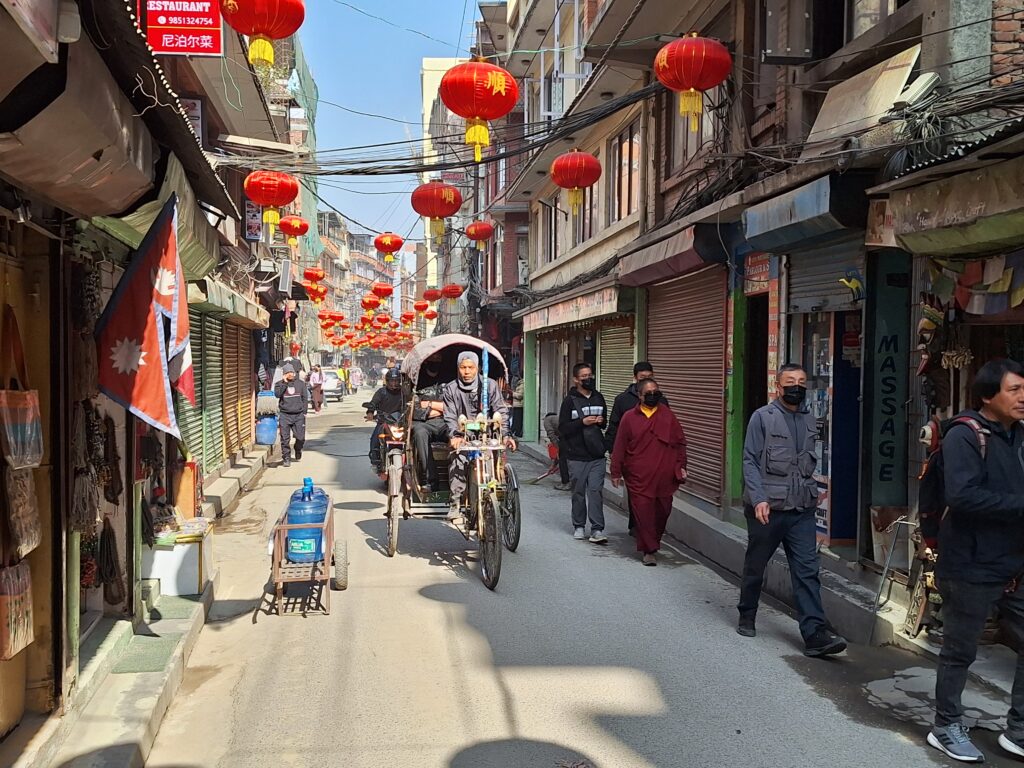
Exploring Kathmandu’s narrow streets beneath colourful hanging lanterns.
A Beer with a View
Eventually, I found somewhere to sit and enjoy a beer while looking across Kathmandu Valley.
In the distance, I could see the surrounding mountains.
The views reminded me of some of the high places I’d experienced during my Camino de Santiago walk in 2017.
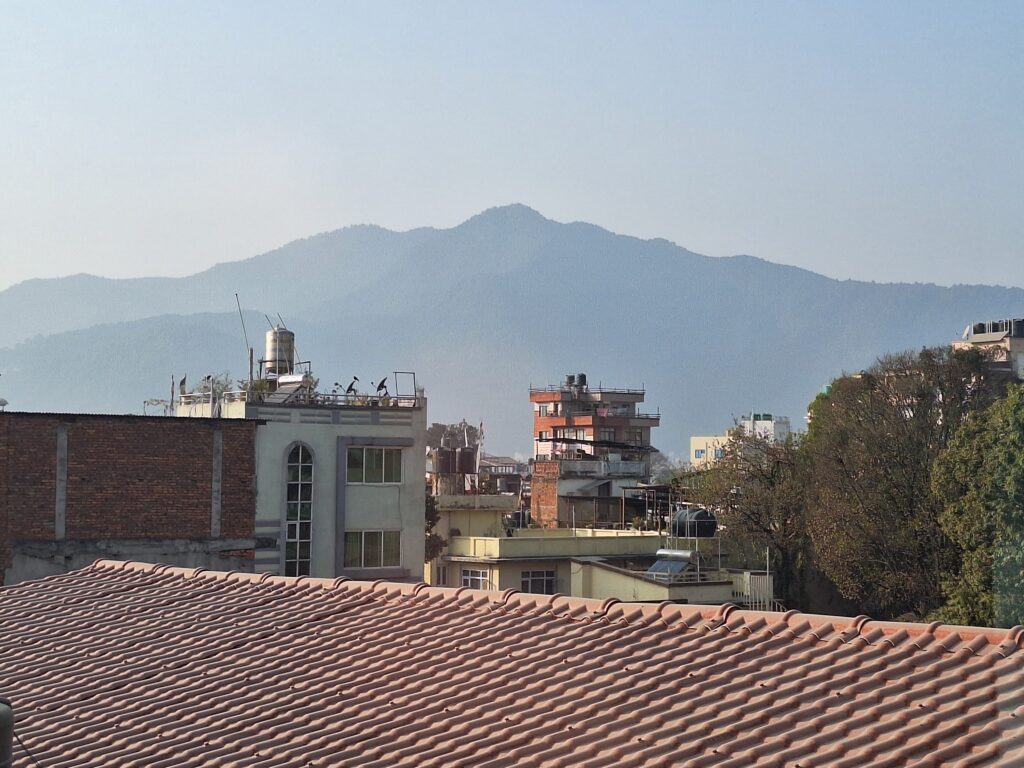
Looking towards the hills surrounding Kathmandu Valley.
There’s somLooking towards the hills surrounding Kathmandu Valley.ething special about looking towards mountains and wondering what lies beyond them.
Nepal is famous for its extraordinary landscapes, and I was beginning to understand why so many people travel here.
Looking Ahead
Tomorrow, I plan to visit Swayambhunath, better known as the Monkey Temple.
It promises to be an interesting walk.
Travelling alone has its challenges, particularly when you don’t speak the local language, but it also gives you an enormous sense of freedom.
You decide where to go, how long to stay and what to do next.
And after more than a year of travelling, I’m still discovering new things about myself and the world around me.
Day 3: The Monkey Temple — Sacred History and Uncomfortable Realities
Weather Update: Sunny with occasional showers. High 18°C.
Elevation Above Sea Level: Kathmandu, approximately 1,324 metres (4,344 feet).
Breakfast — My First Taste of Momo
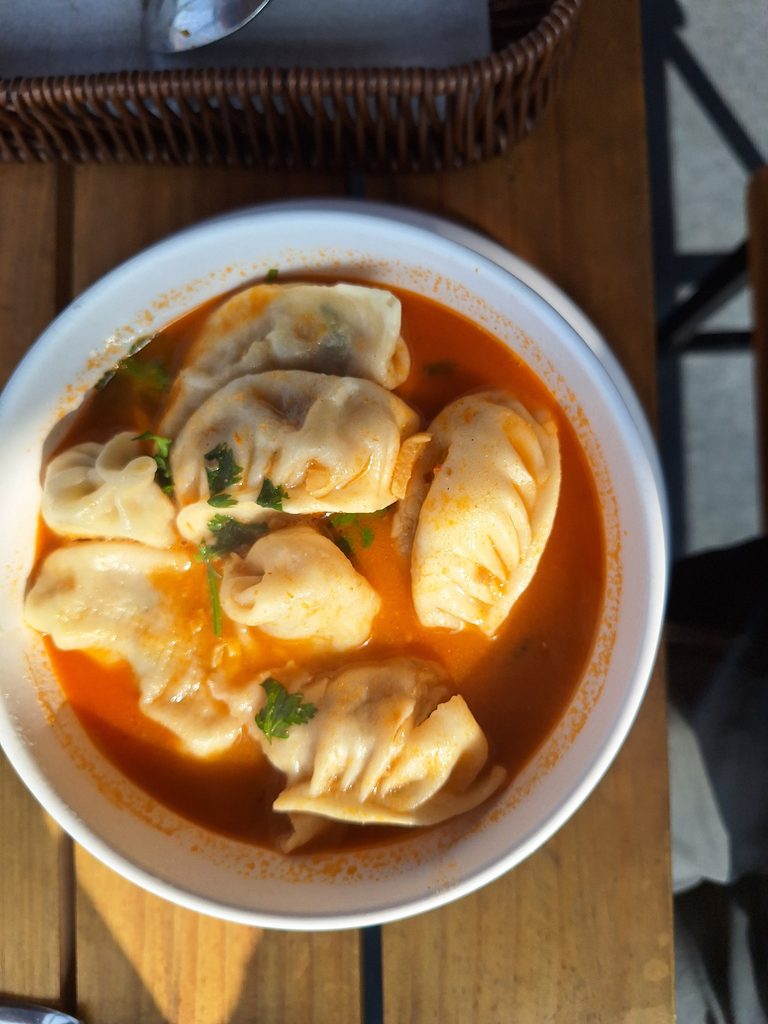
My day began with a serving of chicken momo dumplings accompanied by a spicy soup.
Momos are popular throughout Nepal, and I can understand why.
They’re a satisfying meal and a good way to prepare for a day of walking.
Setting Off for the Monkey Temple
I left the hostel at approximately 11 am and began walking towards Swayambhunath, commonly known as the Monkey Temple.
The distance was around 2.6 kilometres.
The temple stands on a hill approximately 1,406 metres above sea level.
That’s only about 82 metres higher than central Kathmandu, but the walk isn’t quite as straightforward as those figures suggest.
First, I had to walk downhill towards the river, which meant climbing back up again on the other side.
And at my age, every uphill section seems to make itself known!
A Shocking Discovery at the Bagmati River
During the walk, I crossed a footbridge over the Bagmati River.
Looking down, I saw something that disturbed me.
An enormous accumulation of rubbish was swirling around in the water, trapped by the movement of the current.
Plastic, discarded packaging and other waste had collected in one area, creating a depressing sight.

Rubbish collecting in the Bagmati River, a disturbing sight on my walk to the Monkey Temple.
Here I was, visiting a country famous for its magnificent mountains and natural beauty, yet beneath me was a river struggling under the weight of human pollution.
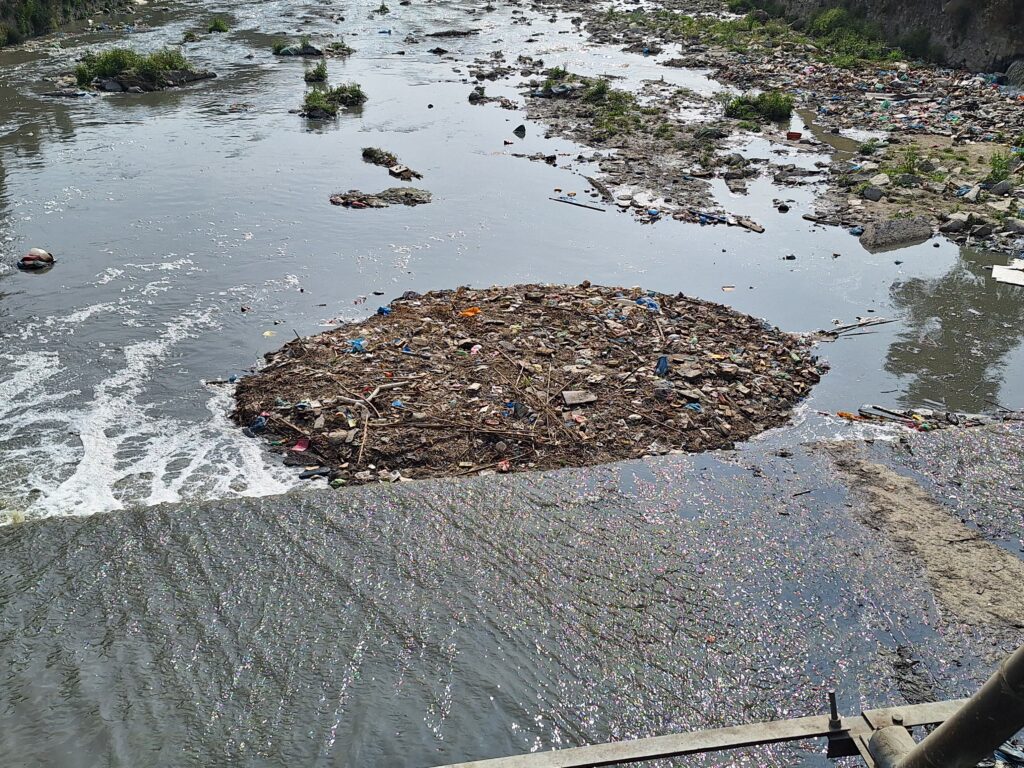
A disturbing accumulation of rubbish floating in the river.
It’s something tourists don’t always see.
When you travel by organised transport from one attraction to another, you can miss the everyday realities of the places you’re visiting.
Walking gives you a different perspective.
You see the beautiful parts, but you also see the problems.
Where Does All This Rubbish Go?
Seeing the waste reminded me of the enormous areas of floating plastic and other debris accumulating in the world’s oceans.
Scientists have identified five major subtropical ocean gyres where circulating currents concentrate floating rubbish.
These include the North Pacific, South Pacific, North Atlantic, South Atlantic and Indian Ocean gyres.
The Great Pacific Garbage Patch is probably the best known.
Despite its name, it isn’t a solid island of rubbish. Much of the pollution consists of scattered plastic fragments and tiny particles suspended in the water.
Nevertheless, the scale of the problem is enormous.
Looking down at the Bagmati River, I wondered how much waste from rivers around the world eventually finds its way into our oceans.
It’s a sobering thought.
Arriving at Swayambhunath
Eventually, I reached the Monkey Temple.
Swayambhunath is one of Nepal’s oldest and most important Buddhist religious sites.

Standing at the foot of the long staircase leading up to Swayambhunath, Kathmandu’s famous Monkey Temple. Quite a climb ahead!
There is a steep climb to the top, but along the way there are places to sit, rest, and relax; beware the monkeys; they are always up to mischief.
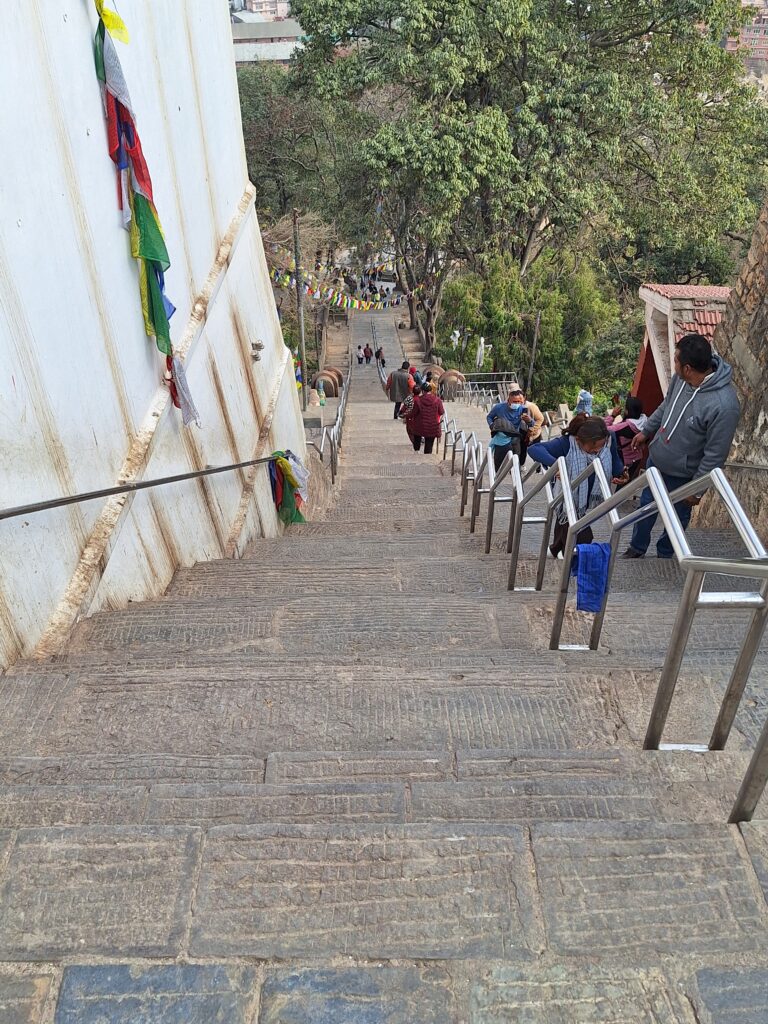
The complex stands on a hill overlooking Kathmandu Valley and is recognised as part of the Kathmandu Valley UNESCO World Heritage Site.
Its most recognisable feature is the large white stupa topped by a gilded structure bearing the famous eyes of Buddha.
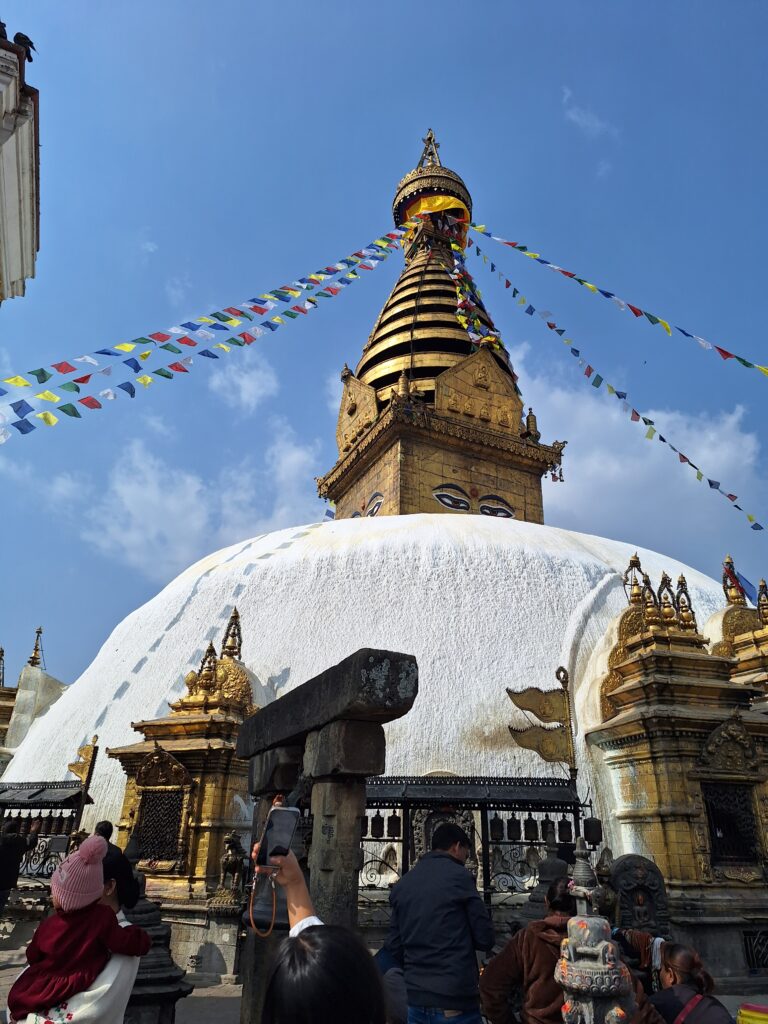
The white stupa and gilded spire at Swayambhunath, adorned with prayer flags.
The eyes face in four directions, symbolising awareness and wisdom.
Prayer flags stretch across the complex, while smaller shrines and religious structures surround the main stupa.

Kathmandu spreading across the valley below the Monkey Temple.
The site is sacred to Buddhists and also holds significance for many Hindus.
The Legend of the Kathmandu Valley
According to Buddhist tradition, Kathmandu Valley was once covered by a great lake.
A beautiful lotus appeared upon the water, carrying a sacred light.
The bodhisattva Manjushri, associated with wisdom, is said to have cut a gorge through the surrounding hills, allowing the lake to drain.
The land that emerged eventually became Kathmandu Valley.
The sacred light is associated with the hill where Swayambhunath now stands.
It’s a fascinating legend, connecting the religious importance of the site with the landscape itself.
Why Is It Called the Monkey Temple?
The temple is home to numerous monkeys, which wander around the buildings and grounds.
According to one traditional story, monkeys appeared when lice in Manjushri’s long hair were transformed into the animals.
Whatever their legendary origins, the monkeys have become an unmistakable part of the temple’s character.
They’re entertaining to watch, although visitors need to be careful with food and belongings.

A Temple with Centuries of History
Swayambhunath has undergone numerous restorations throughout its long history.
A major renovation completed in 2010 included the restoration of the gilded upper structure, using approximately 20 kilograms of gold.
The work was supported by Buddhist organisations and donors, including the Tibetan Nyingma Meditation Center in California.
It’s remarkable to think about the generations of worshippers who have visited this hill long before modern Kathmandu existed.
Sacred Worship and Commercial Tourism
One thing that struck me was the contrast between the spiritual importance of the temple and the commercial activity surrounding it.
There were stalls selling souvenirs, trinkets and religious items close to the sacred structures.
I understand that tourism provides an income for local families, but I couldn’t help wondering whether such commercial activity takes something away from the atmosphere of worship.
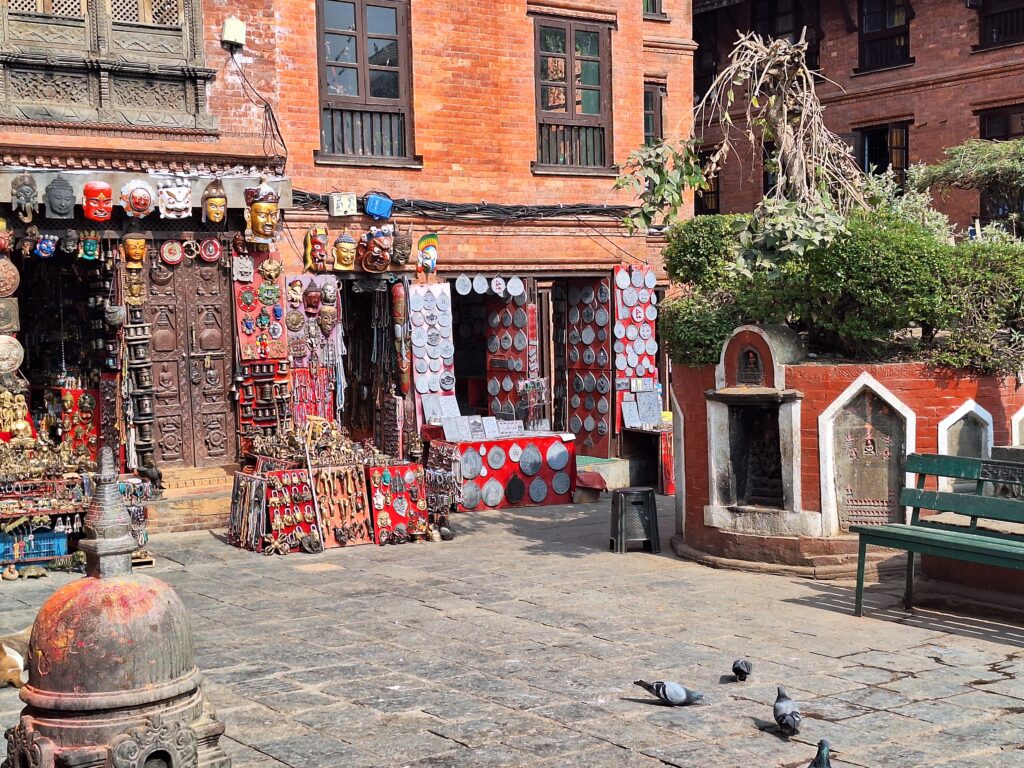
Souvenir stalls beside the sacred buildings — a striking contrast between worship and commerce.
It reminded me of the biblical story of Jesus driving the money changers and merchants from the Temple in Jerusalem.
The religious traditions are different, of course, but the question of balancing commerce with spirituality remains interesting.
Imagine entering a church and finding stalls selling crosses, ornaments and souvenirs all around the altar.
Would it change how you felt about the place?
These were simply my thoughts as I wandered through the complex.
Returning to the Hostel
After exploring the temple, I made my way back towards the hostel.
It had been an interesting day.
I’d seen one of Kathmandu’s most important religious sites, learned about its history and legends, and witnessed a disturbing example of river pollution.
Sometimes a day’s walk gives you much more to think about than you’d expected.
Day 4: A Day Off — Sunshine and a New Travel Bag
Weather Update: Sunny. High 19°C.
Elevation Above Sea Level: Approximately 1,324 metres (4,344 feet).
A Well-Deserved Rest
After several busy days exploring Kathmandu, I decided to take things easy today.
I got up late, enjoyed the sunshine and did very little.
Sometimes, when you’re travelling for months at a time, it’s important to have a day when you don’t feel obliged to visit another temple, explore another street or walk another ten kilometres.
There’s nothing wrong with doing absolutely nothing!
My Australian Bargain That Wasn’t
I did, however, have one important job to take care of.
Remember the travel bag I purchased in Australia, thinking I’d found myself a bargain?
Well, it turned out to be anything but!
I paid AUD $59.99 for it, and after less than three months of travelling, it had started falling apart.
To look at it, you’d think I’d been dragging it around the world for ten years.
Not exactly what you’d expect from a bag supposedly designed for travelling.
I’ve contacted Strand Bags in Australia, supplying photographs of the damage along with my original receipt.
Hopefully, they’ll agree to refund the purchase price.
In the meantime, I’ve bought myself a replacement made from hemp.
It looks like a practical alternative, and I’m hoping it will prove considerably more durable than the Australian purchase.
Only time will tell!
Tomorrow — Another Temple and a Long Walk
Apart from replacing my bag, today has been wonderfully uneventful.
I’ve enjoyed the sunshine, rested my legs and given myself a little breathing space.
Tomorrow, it’s back to exploring Kathmandu, with another temple on the agenda and what promises to be a long walk.
For now, I’m quite happy doing nothing.
After all, even an adventure needs the occasional day off!
Day 5: Pashupatinath Temple — A Long Walk and a Disappointing Visit
Weather Update: Sunny. High 20°C.
Elevation Above Sea Level: Approximately 1,324 metres (4,344 feet).
A Morning Walk Through Kathmandu
I left the hostel at around 10:30 am, planning to walk approximately five kilometres to Pashupatinath Temple, one of Nepal’s most important Hindu religious sites.
By the time I returned to the hostel, I’d walked 12.74 kilometres.
Surprisingly, I wasn’t feeling too sore, which I considered a positive result!
The roads were dusty, and the traffic was as unpredictable as ever.
As I’ve discovered in many Asian cities, crossing the road can be quite an adventure.
You stand on the pavement, look for a gap in the traffic, step forward and hope everyone has seen you.
I’ve been nudged by vehicles a few times during my travels, although thankfully nothing serious has happened.
Today, I somehow acquired a bruise on my upper left arm. I’m not entirely sure when or how it happened.
Perhaps another souvenir from Kathmandu’s busy streets!
Walking at Altitude
Kathmandu sits at approximately 4,344 feet above sea level.
That might not sound particularly high compared with the great Himalayan mountains, but I can certainly notice the difference when walking uphill.
At my age, climbing slopes takes more effort than it once did.
The thinner air, combined with the dusty roads and traffic fumes, makes some sections of the walk quite demanding.
Still, I managed the distance reasonably well, and I’m pleased that my legs are continuing to cope with the challenges of travelling.
Arriving at Pashupatinath Temple
It took me approximately 75 minutes to reach the temple.
Pashupatinath is one of the most sacred Hindu temples in Nepal and an important pilgrimage destination for followers of Lord Shiva.
The complex stands beside the holy Bagmati River and contains temples, shrines, courtyards and religious structures.
The entrance fee for foreign visitors was 1,000 Nepalese rupees, approximately NZ$12.76 at the exchange rate I was using.
That’s quite expensive by local standards.
The main temple is restricted to Hindu worshippers, although visitors of other faiths can explore permitted areas and observe parts of the complex from across the river.
I was looking forward to learning more about the site and taking in its atmosphere.
Unfortunately, my visit didn’t go quite as planned.
Five Minutes Was Enough!
Almost as soon as I entered, I was approached by people offering their services or trying to sell me something.
Guides, vendors and others seemed determined to get my attention.
I politely declined, but that didn’t always discourage them.
Some continued following me, offering trinkets, hookah, cannabis or hashish.
All I wanted was an opportunity to walk around quietly, admire the surroundings and absorb the atmosphere of this sacred place.
Instead, I felt constantly interrupted.
Eventually, I’d had enough.
I stopped, turned around and walked straight back out.
It had taken me 75 minutes to get there, and after only about five minutes inside, I was leaving!
I remember thinking to myself that I’d wasted part of my day.
Perhaps I was simply unlucky with the people I encountered, but it certainly wasn’t the peaceful spiritual experience I’d hoped for.
A Tip for Senior Travellers
If you’re planning to visit Pashupatinath, it’s worth doing a little research beforehand.
Find out which areas you’re permitted to enter, whether you’d benefit from an official guide and where you can observe the temple without being constantly approached.
If you don’t want a guide or wish to buy anything, a polite but firm refusal is usually the best approach.
Remember that this is an active place of worship, not simply a tourist attraction.
Respect the religious customs, observe photography restrictions and allow yourself enough time to explore at a comfortable pace.
The History and Significance of Pashupatinath
Pashupatinath Temple is dedicated to Lord Shiva, one of the principal deities of Hinduism.
The name Pashupatinath means “Lord of Animals” or “Lord of All Living Beings”, reflecting one of Shiva’s many forms.
The temple is considered one of the holiest Shiva shrines in the Hindu world.
The main pagoda-style temple contains a sacred Shiva lingam, an object of worship representing Shiva.
Only eligible Hindu worshippers are permitted to enter the inner temple, while other visitors must remain in designated areas.
Photography is restricted in sacred parts of the complex, and visitors should follow the instructions displayed at the site.
The temple complex has a long history and is part of the Kathmandu Valley UNESCO World Heritage Site.
Maha Shivaratri — The Night of Lord Shiva
One of the most important festivals celebrated at Pashupatinath is Maha Shivaratri, meaning “the Great Night of Shiva”.
During this festival, enormous numbers of devotees travel from Nepal and India to worship at the temple.
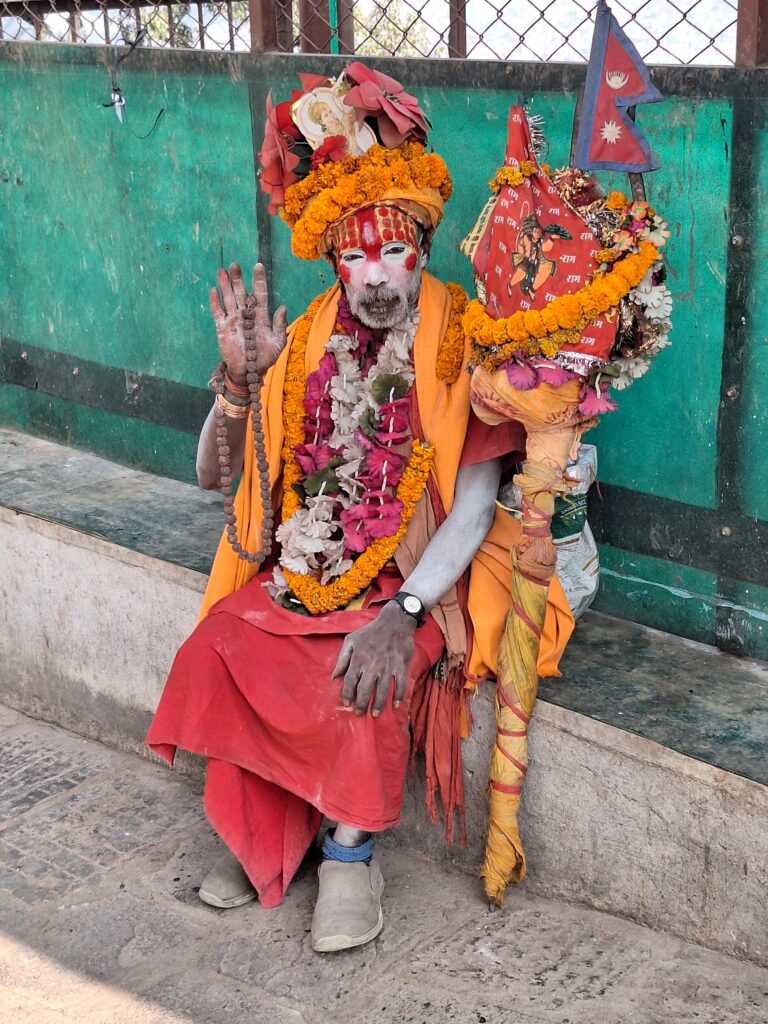
Among them are sadhus, Hindu holy men who have often renounced ordinary material life in pursuit of spiritual enlightenment.
Some wear saffron robes, while others cover their bodies in sacred ash and have long, matted hair.
Pilgrims gather to pray, make offerings and seek darshan — the blessing associated with seeing and being in the presence of a sacred deity or image.
The atmosphere during Maha Shivaratri is said to be extraordinary, with religious ceremonies and celebrations continuing throughout the night.
Teej — A Festival of Colour and Devotion
Another important festival associated with Pashupatinath is Teej, celebrated particularly by Hindu women.
During the festival, many women dress in beautiful red saris, often wearing colourful jewellery and necklaces.
They gather at temples to pray, sing and participate in religious observances.
Traditionally, some married women pray for the health and longevity of their husbands, while other participants observe the festival for personal spiritual reasons and family well-being.
The sight of thousands of women dressed in red creates an extraordinary display of colour.
It must be quite something to witness.
The Sacred Bagmati River
Pashupatinath stands beside the Bagmati River, which holds great religious significance for both Hindus and Buddhists.
The river begins in the Shivapuri Hills north of Kathmandu, near Bagdwar, at an elevation of approximately 2,690 metres.
From there, it flows through the Kathmandu Valley, passing between Kathmandu and Patan before continuing south through the Chobhar Gorge.
Eventually, the river crosses into the plains of India, where its waters join the wider river system of Bihar.
For centuries, the Bagmati has played an important role in the religious and cultural life of the Kathmandu Valley.
At Pashupatinath, its banks are especially sacred.
Hindu cremation ceremonies are performed at riverside ghats, where families gather to carry out traditional funeral rites.
The river represents an important connection between life, death, purification and spiritual belief.
A Sacred River Facing Serious Pollution
Despite its religious importance, the Bagmati River faces severe environmental problems.
Wastewater, discarded rubbish, urban development and industrial activities have contributed to pollution in parts of the river system.
I couldn’t help remembering what I’d seen a few days earlier when crossing the footbridge on my way to the Monkey Temple.
There, beneath me, was a swirling accumulation of rubbish trapped in the water.
It was a disturbing sight.
And now, here I was, visiting one of Nepal’s holiest religious sites beside the very same river.
It seemed an extraordinary contradiction.
A river considered sacred by millions of people was also struggling under the pressure of pollution.
Protecting waterways isn’t simply a matter of keeping them looking attractive for tourists.
Rivers provide water, support wildlife, sustain communities and form an important part of cultural and religious traditions.
Once polluted, restoring them can be an enormous challenge.
The Walk Back to the Hostel
After my disappointing experience at the temple, I decided to make my way back.
Interestingly, the return journey seemed much quicker, even though I was relying largely on my sense of direction.
And for once, my navigation skills didn’t let me down!
I managed to find my way back without too much trouble.
Along the way, I discovered a shop selling postcards.
That’s another little job taken care of.
The postcards will be on their way tomorrow.
Reflections on the Day
Today was a mixture of satisfaction and disappointment.
I was pleased to have walked 12.74 kilometres without feeling too sore, especially with the altitude and dusty streets.
I was also glad to learn more about Pashupatinath and the religious importance of the Bagmati River.
But I couldn’t help feeling disappointed by my brief experience inside the temple complex.
When visiting a sacred place, I want time to appreciate its history, atmosphere and spiritual significance.
Constantly being approached by people trying to sell something takes away from that experience.
Still, travelling is about accepting the good with the bad.
Not every attraction lives up to expectations, and sometimes the journey itself becomes more memorable than the destination.
Today, the walk was certainly more rewarding than the five minutes I spent inside the temple!
Day 6: Resting in the Mountains — Changing Plans and Looking Ahead
Weather Update: Sunny. High 20°C.
Elevation Above Sea Level: Approximately 1,324 metres (4,344 feet).
Sunshine Without the Mountain Views
The sunshine has been glorious today, but the mist hanging over the surrounding mountains has hidden the higher, snow-covered peaks.
It’s disappointing not to see them clearly, especially when you’re staying in a place surrounded by such magnificent scenery.
Nevertheless, I’ve enjoyed wandering around Kathmandu without any particular destination in mind.
Sometimes it’s nice to put the sightseeing aside and simply enjoy being somewhere different.
After several busy days of walking, visiting temples and navigating the crowded streets, a little relaxation is exactly what I need.

Changing My Travel Plans
One of the greatest challenges of travelling independently through so many countries is dealing with visas.
Every country seems to have different requirements.
Some offer visas on arrival, others require electronic applications, and some demand advance bookings, supporting documents and detailed travel arrangements.
The bureaucracy can become exhausting.
I’ve therefore decided to change my plans.
For now, I’m postponing visits to Sri Lanka, India, Pakistan, Afghanistan, Iran and Iraq.
These are countries I’d still like to explore, but I think it would be better to return with a more comprehensive itinerary and the necessary visas and bookings arranged beforehand.
There’s little point in spending my days worrying about paperwork when I could be enjoying the journey.
A New Route Through Georgia
My current plan is to leave Kathmandu on Tuesday and fly to Delhi, before continuing to Tbilisi, the capital of Georgia.
I’d originally booked an onward flight to Tel Aviv in Israel.
However, after reconsidering the route and the costs involved, staying in Georgia rather than continuing immediately to Israel seems the more sensible option.
Unfortunately, I’ve already paid for the final flight.
That’s one of the disadvantages of making travel arrangements as you go.
Sometimes plans change, and you have to accept the financial consequences.
I also realised that I’d left my carefully outlined travel map behind in Laos.
That certainly didn’t help!
Still, I now have a route in mind covering my next eleven countries.
Once I reach Europe, I hope to travel for another six to twelve months with fewer visa complications, although I’ll still need to pay attention to the entry and length-of-stay rules for each country.
These are the highs and lows of spontaneous travel.
Sometimes everything falls neatly into place.
Other times, you simply have to change direction.
Remembering Nepal’s Devastating Earthquake
Walking around Kathmandu, it’s impossible not to think about the devastating earthquake that struck Nepal on 25 April 2015.
The Gorkha earthquake measured magnitude 7.8 on the moment magnitude scale, with its epicentre northwest of Kathmandu.
It was followed by hundreds of aftershocks, including another major earthquake in May.
Nearly 9,000 people lost their lives, and tens of thousands were injured.
Homes, schools, hospitals, historic buildings and temples were damaged or destroyed.
The destruction affected communities across central Nepal, leaving families homeless and placing enormous pressure on the country’s infrastructure.
Even years later, the consequences of such a disaster can remain visible.
Rebuilding and Preparing for the Future
Nepal faces a difficult challenge.
Kathmandu is a densely populated city with many older buildings, narrow streets and limited open spaces.
Strengthening buildings and improving infrastructure takes time, money and effective planning.
I find myself wondering what would happen if another major earthquake struck close to the centre of Kathmandu.
Would the buildings withstand it?
Would emergency services be able to reach people quickly?
Would the roads remain passable?
These are worrying questions.
Nepal has made progress in reconstruction and earthquake preparedness, but the risks remain considerable.
Political instability and changes in government can also complicate long-term planning.
It’s easy for a visitor to identify problems, but finding practical solutions in a country facing so many economic and geographical challenges is another matter entirely.
The Bagmati River — A Continuing Concern
Another issue that continues to trouble me is the pollution of the Bagmati River.
I’ve already described the enormous accumulation of rubbish I saw swirling beneath a bridge on my walk to the Monkey Temple.
The sight has stayed with me.
The Bagmati is a sacred river, yet sections flowing through Kathmandu have suffered from sewage, rubbish and other forms of pollution.
Nepal’s courts and environmental authorities have repeatedly called for stronger action to protect and restore the river.
But cleaning a polluted waterway is about much more than removing visible rubbish.
It requires effective sewage treatment, waste collection, enforcement and ongoing maintenance.
I hope meaningful progress continues because the river deserves better, as do the people who live alongside it.
Is Kathmandu Worth Visiting?
Despite the problems I’ve described, I think Kathmandu is worth visiting.
A week gives you time to explore its temples, historic sites, markets and neighbourhoods.
There’s a great deal of history and culture here.
But for me, Nepal’s greatest attraction lies beyond the capital.
The mountains, valleys and high passes offer some of the most spectacular scenery in the world.
The country is famous for trekking, and it’s easy to understand why.
Of course, reaching some of these remote places can be difficult.
Mountain roads can be narrow, poorly maintained and vulnerable to landslides, particularly during periods of heavy rain.
Travelling through Nepal requires patience and careful planning.
Mount Everest — A Tempting Challenge
One of my sons asked whether I was planning to trek to Everest Base Camp.
It’s an interesting question.
After having both hips replaced, I’m naturally more cautious about taking on physically demanding adventures.
The trek to Everest Base Camp is something that appeals to me, but it isn’t a casual walk.
Depending on the itinerary, it generally takes around twelve to fourteen days for the return trek, allowing time to acclimatise to the altitude.
Everest Base Camp itself stands at approximately 5,364 metres above sea level.
That’s considerably higher than anything I’ve experienced so far.
Altitude sickness is a serious consideration, regardless of age or fitness.
For now, I think resting and enjoying Kathmandu is the better decision.
But I must admit, the thought of walking among those magnificent Himalayan peaks is very tempting.
The Environmental Cost of Everest Tourism
Another concern is the amount of rubbish left behind by expeditions and visitors in the Everest region.
Discarded equipment, food packaging, oxygen cylinders and other waste have created environmental problems along popular climbing routes.
Efforts have been made to improve waste management, including clean-up expeditions and requirements for climbers to bring rubbish down from the mountain.
Nepal’s Supreme Court has also called for stronger environmental protections and limits on climbing permits based on the mountain’s capacity.
I believe visitor numbers should be managed carefully, with strict rules requiring people to remove their waste.
Mount Everest is one of the world’s great natural wonders.
Surely we have a responsibility to protect it.
What Are We Leaving Behind?
Travelling around the world has made me think more deeply about the natural beauty of our planet.
I’ve seen magnificent landscapes, beautiful rivers, historic cities and extraordinary mountains.
But I’ve also seen pollution, overcrowding, rubbish-filled waterways and the consequences of poor environmental management.
Sometimes I wonder what the world would look like if humanity could reduce its impact on the environment.
Wouldn’t it be wonderful if future generations could enjoy the same natural beauty that we have today?
I think about my grandchildren and the world they’ll inherit.
Will they enjoy clean rivers, healthy oceans and unspoiled landscapes?
Or are we slowly heading towards the sort of bleak future portrayed in science-fiction films such as Blade Runner?
I certainly hope not.
We may not be able to solve every environmental problem overnight, but surely we can do better.
Sharing the Journey
I hope you’re enjoying following my travels.
My aim has always been to experience the world for myself and share what I discover along the way.
That includes the wonderful places, the difficult moments, the kindness of strangers and the things that sometimes leave me disappointed.
I want you to feel as though you’re walking beside me, seeing what I see and experiencing a little of what life is like in the countries I visit.
If you have questions about my travels, you’re always welcome to get in touch through my website’s Contact page.
This journey isn’t simply about visiting capital cities. It’s about discovering the world, understanding its people and stepping into the unknown, one day at a time.
Day 7: Ratna Park — Breakfast, Bargains and Himalayan Views
Weather Update: Sunny. High 21°C.
Elevation Above Sea Level: Approximately 1,324 metres (4,344 feet).
A Nepalese Breakfast
My morning began with a delightful Nepalese-style breakfast.
On the menu was vegetable curry, two fried eggs and two crispy pancakes.
It was a wonderful combination and certainly a satisfying way to start the day.
One of the things I enjoy about travelling is trying the local food. Breakfast can be completely different from what we’re accustomed to in New Zealand, but that’s part of the experience.
After eating, I spent some time catching up on my blog and editing photographs.
Keeping a travel diary might sound straightforward, but when you’re travelling every day, finding time to write, organise photographs and share your experiences can become quite a challenge.
Still, it’s something I enjoy doing, particularly knowing that people back home are following the journey.
Planning My Journey to the Airport
With my departure from Kathmandu approaching on Tuesday, I decided to investigate the best way to reach the airport.
I wasn’t prepared to leave everything until the last minute.
After my experiences with traffic and transport in other cities, I’ve learned that a little advance planning can save an enormous amount of stress.
Unfortunately, the language barrier made getting reliable information rather difficult.
I walked approximately 20–25 minutes to the bus station, hoping to establish which bus I needed and how much it would cost.
The local bus fare to the airport was just 40 Nepalese rupees.
My hostel, however, was asking 1,387 rupees for an airport transfer!
That’s quite a difference.
I appreciate that a private transfer offers convenience, but when you’re travelling on a pension and trying to make your money last, those savings soon add up.
Finding a Cheaper Alternative
After exploring my options, I met a motorbike rider who agreed to take me to the airport on Tuesday morning.
We settled on a fare of 300 Nepalese rupees, with collection arranged for 10 am.
That seemed a much more reasonable price.
Of course, there’s always one question when making arrangements like this.
Will he actually turn up?
I’ve had enough transport experiences during my travels to know that a promise doesn’t always mean everything will go according to plan.
Still, I’m keeping my fingers crossed!
Ratna Park and the Streets of Kathmandu
While I was out, I spent time exploring the streets and squares around Ratna Park.
This is one of Kathmandu’s busy central areas, where local buses, pedestrians, shops and street vendors all compete for space.
There’s always something happening.
Markets are particularly interesting because they give you an insight into everyday life.
People are buying vegetables, household goods, clothing and all manner of things.
For me, wandering through these areas is just as enjoyable as visiting the famous tourist attractions.
You get to see Kathmandu as a working city rather than simply a destination for visitors.
A Seventh-Floor Restaurant with an Extraordinary View
On my way back, I came across a square with a restaurant on the seventh floor of a nearby building.
I decided to go up and have a look.
What a wonderful decision that turned out to be!
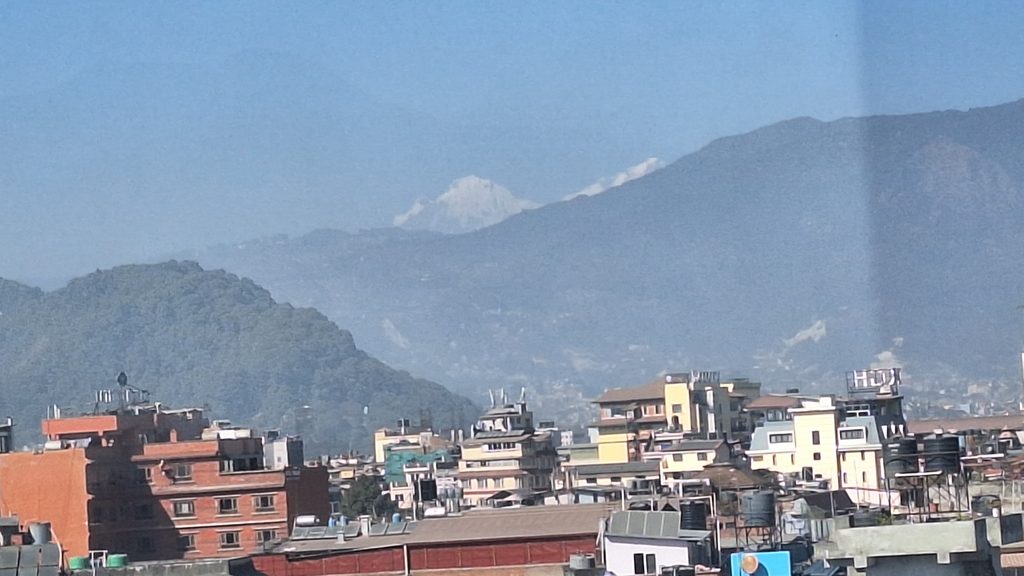
From the restaurant, I had the clearest view of the Himalayas I’d seen since arriving in Nepal.
In the distance, several magnificent snow-covered peaks rose above the surrounding landscape.
The sunshine and clearer conditions made the mountains look spectacular.
I stood there admiring the view, wondering which peaks I was looking at.
Could one of them have been Mount Everest?
I asked the restaurant staff, and they nodded in agreement.
Whether they genuinely recognised the mountain or were simply agreeing with me, I couldn’t say!
Everest is a considerable distance from Kathmandu and isn’t generally visible from most viewpoints within the city, so I wouldn’t want to claim I’d definitely seen it.
But whatever those peaks were, the view was magnificent.
Sometimes it doesn’t matter whether you can identify every mountain.
It’s enough simply to stand there and appreciate the scenery.

Photographing Everyday Kathmandu
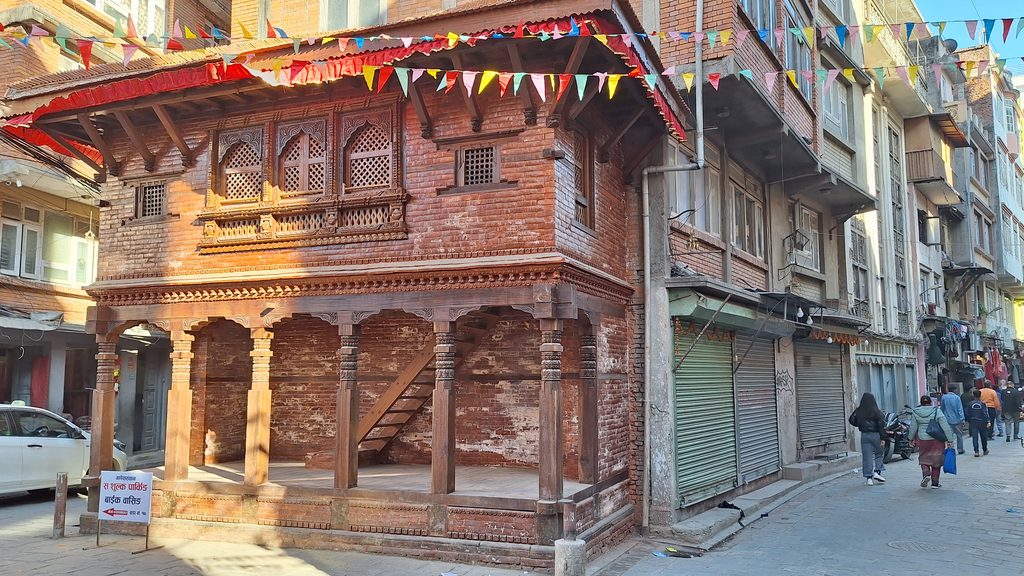
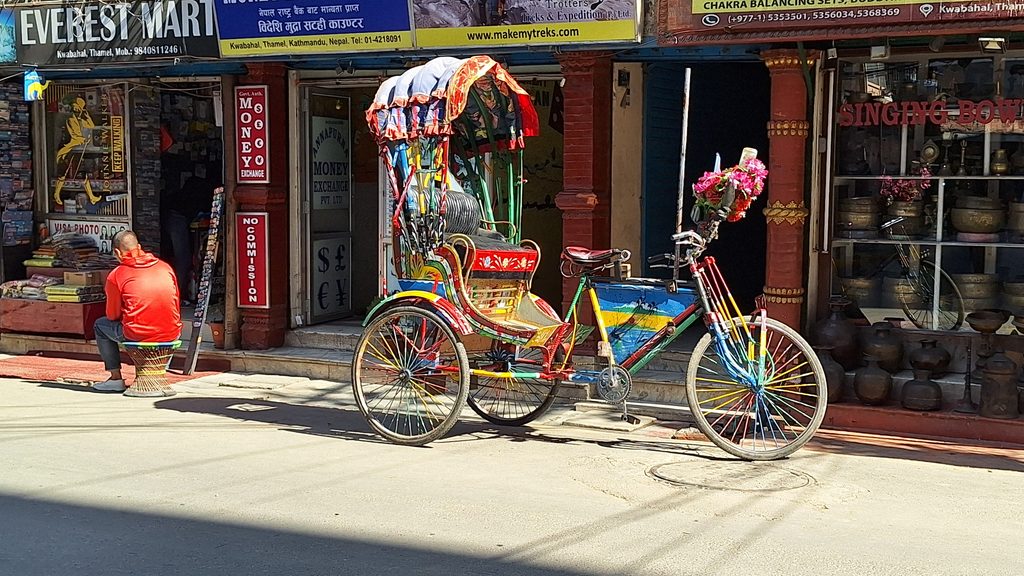
I spent the remainder of the day wandering around the local area, taking photographs of the markets, buildings and street scenes.
I enjoy capturing these ordinary moments because they tell a story about the places I visit.
Not every photograph needs to be of a famous monument.
Sometimes a busy street, a market stall or a group of people going about their daily lives can be just as interesting.
These are the scenes that help me remember what a place actually felt like.
Tomorrow — Boudhanath Stupa
Tomorrow, I’m planning another substantial walk.
My destination is Boudhanath Stupa, one of Kathmandu’s most important Buddhist religious sites.
It’s approximately 6.5 kilometres from where I’m staying.
Depending on how I’m feeling, I may walk both ways or arrange a motorbike ride back.
We’ll see what tomorrow brings.
Day 8: Sunday in Kathmandu — A Change of Plans and Himalayan Views
Weather Update: Sunny. High 22°C.
Elevation Above Sea Level: Approximately 1,445 metres at my location.
A Hearty Nepalese Breakfast
My day began with another delicious breakfast.
This morning I enjoyed two fried eggs, two pieces of toast with butter and jam, and a generous serving of Nepalese-style potato hash browns.
Now, these weren’t the hash browns we’re accustomed to in New Zealand.
Instead, the potatoes were sliced and slowly fried in olive oil with onions and green peppers, all combined in a delicious spicy sauce.
Absolutely delightful!
One of the pleasures of travelling is discovering how different countries prepare even the simplest meals.
Breakfast is no exception.
A Change of Plans
I’d originally intended to visit Boudhanath Stupa today, which would have involved a return walk of approximately 13 kilometres.
But after considering my plans, I decided to give it a miss.
Sometimes you have to be flexible.
I’ve already done plenty of walking around Kathmandu, and there are other things I need to organise before leaving Nepal.
My next destination is Tbilisi, the capital of Georgia, where the weather is expected to be considerably colder.
While Kathmandu is enjoying temperatures around 22°C, Tbilisi is forecast to be somewhere between 1°C and 8°C.
That’s quite a difference!
And I certainly don’t want to arrive in Georgia without something warm to wear.
Shopping for a Winter Jacket
Over the past couple of weeks, I’ve seen countless shops selling jackets designed for trekking in the Himalayas.
Some look extremely warm, but finding one that fits properly and suits my needs hasn’t been quite so easy.
I spotted one jacket priced at 1,200 Nepalese rupees, approximately NZ$15.35, but it wasn’t quite what I wanted.
Eventually, I found a small shop selling a jacket that fitted me nicely.
The asking price was 2,400 rupees.
Naturally, a little bargaining followed.
We eventually settled on 2,200 rupees, approximately NZ$28.
I was very pleased with that.
A similar jacket back in New Zealand could easily cost two or three times as much.
Hopefully, it’ll keep me warm when I arrive in Georgia.

Laundry — Another Job Done
I also collected my laundry today.
The total cost was just 300 Nepalese rupees, approximately NZ$3.84.
It’s remarkable how affordable some everyday services can be when travelling through Asia.
Having clean clothes and a new jacket might not sound particularly exciting, but when you’re living out of a backpack, these small things make a big difference.
An Unexpected Rooftop Discovery
While wandering through the streets, I came across a hotel with a rooftop bar and restaurant on the eighth floor.
I decided to go up and have a look.
What a wonderful discovery!
From the rooftop, I could see across the Kathmandu Valley towards the distant mountains.
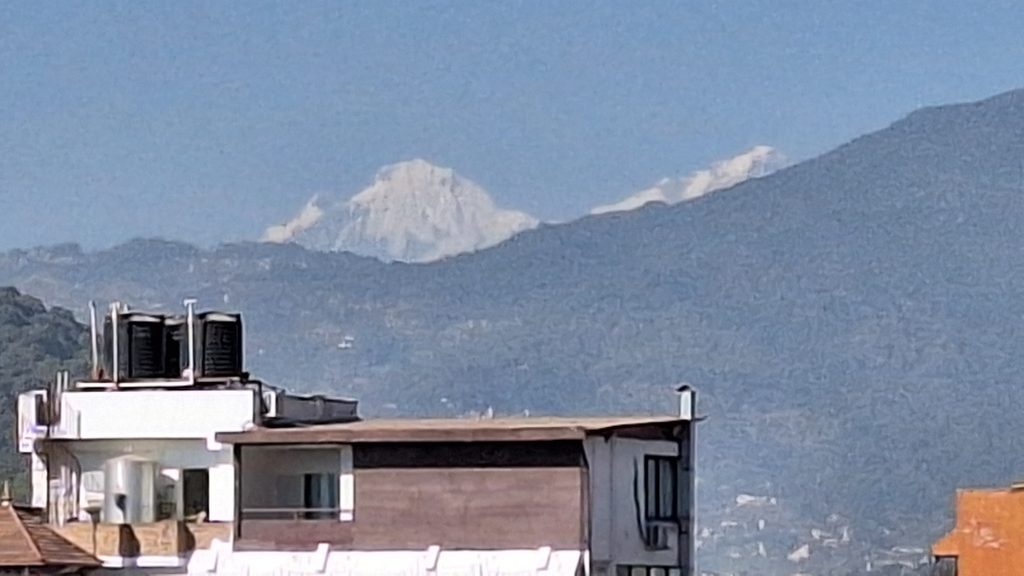
The sun was shining, and although there was some thin cloud, the views were spectacular.
I sat there enjoying the warmth and looking towards the magnificent Himalayan peaks.
It was one of those moments when you realise just how fortunate you are to be travelling.
Was That Mount Everest?
I’d been wondering for several days whether any of the distant peaks I’d seen from Kathmandu included Mount Everest.
Today, I decided to investigate a little further.
Using a compass application on my phone, I worked out the general direction of Everest, approximately 180 kilometres away.
That helped me understand where the mountain was located in relation to Kathmandu.
However, identifying an individual peak from such a distance isn’t straightforward, particularly when other mountain ranges and clouds obstruct the view.
So although I may have been looking in Everest’s direction, I can’t say for certain that I actually saw it.
Whatever mountains I was admiring, they were magnificent.
And sometimes that’s enough.
A Conversation with the Hotel Manager
While relaxing on the rooftop, I struck up a conversation with the hotel manager.
I suggested that it might be useful to have an information board showing the names and locations of the surrounding mountains.
That way, visitors could identify what they were looking at rather than simply guessing.
It seemed such a simple idea.
After all, when you’re sitting on a rooftop with the Himalayas in the distance, it’s only natural to wonder which peaks you’re seeing.
We had an enjoyable conversation, and I spent some time soaking up the sunshine.
There I was, sitting comfortably above Kathmandu, enjoying the warmth of the day with the Himalayan landscape stretching out before me.
What more could I ask for?
Kathmandu — A City Surrounded by Mountains
Kathmandu lies within a valley surrounded by hills and mountain ridges.
The elevation varies across the city, but much of central Kathmandu sits at approximately 1,300–1,450 metres above sea level.
Some of the prominent surrounding heights include Shivapuri, approximately 2,732 metres; Phulchowki, approximately 2,762 metres; Nagarjun, approximately 2,128 metres; Champadevi, approximately 2,278 metres; and Chandragiri, approximately 2,551 metres.
These hills form a natural boundary around the valley.
Beyond them, much higher Himalayan ranges rise into the sky.
Nepal’s extraordinary geography is one of the reasons the country attracts so many trekkers and mountaineers.
And although I’m not heading into the high mountains on this visit, simply being surrounded by such scenery is an experience in itself.
Meeting Local Schoolchildren
On my way back to the hostel, I encountered a group of schoolchildren.
We stopped for a conversation, and I learned a little about their school routine.
They told me that they attended school six days a week, generally from 10 am until 3 pm, with Saturday as their day off.
Their uniforms were neat and tidy, something that immediately caught my attention.
It was interesting comparing their school routine with what we’re accustomed to in New Zealand.
Of course, school hours and arrangements can vary, but I enjoyed hearing about their everyday lives directly from the children.
It’s these small encounters that make travelling so rewarding.
Reflections on Another Day
Today didn’t turn out quite as I’d planned.
I didn’t visit Boudhanath Stupa, and I didn’t complete the 13-kilometre walk I’d originally intended.
Instead, I bought a warm jacket, collected my laundry, discovered another rooftop restaurant and enjoyed some wonderful views across Kathmandu.
I also had interesting conversations with the hotel manager and a group of schoolchildren.
Not a bad day at all!
Sometimes the best travel experiences happen when you abandon your plans and simply see where the day takes you.
And sitting in the sunshine, looking towards the Himalayas, I couldn’t think of anywhere else I’d rather be.
Day 9: Winding Down — Farewell to Kathmandu
Weather Update: Sunny. High 20°C.
Elevation Above Sea Level: Approximately 1,324 metres (4,344 feet).
Kathmandu — A City Covered in Dust
As my time in Kathmandu draws to a close, I’ve been reflecting on the things I’ve noticed during my stay.
One of the most striking is the amount of dust.
Much like Dhaka, Kathmandu seems to be constantly covered in it.
The roads, buildings, shopfronts and vehicles all collect a fine layer of dust throughout the day.
I noticed this particularly when cleaning a table with a wet wipe.
Within an hour, the surface was covered in dust again!
Shopkeepers constantly brush their merchandise to keep it looking presentable, while others wash the entrances to their shops several times a day.
Even taxi drivers keep feather dusters handy, giving their vehicles a quick clean between customers.
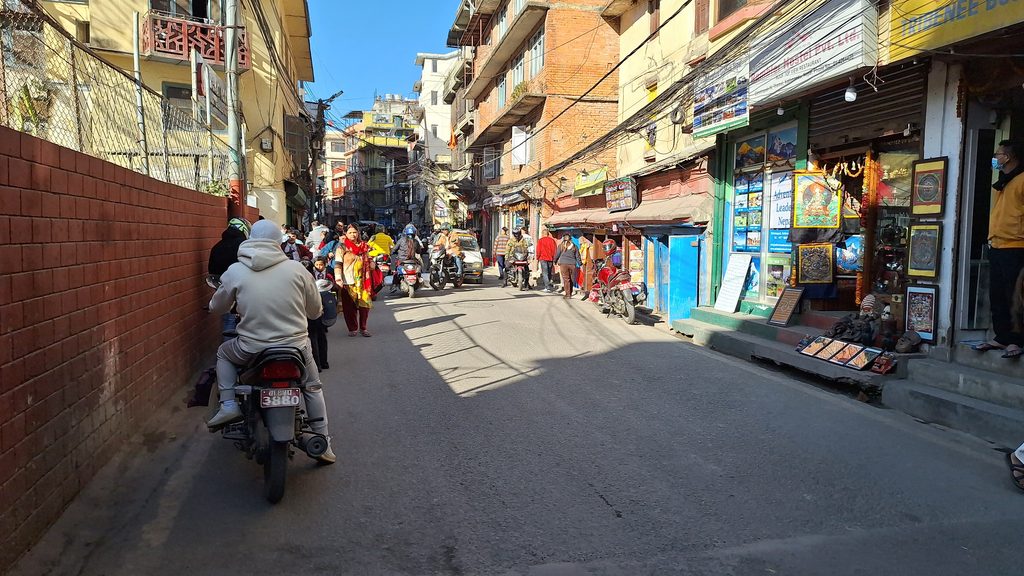
It seems to be a never-ending battle.
The Dust Gets Everywhere
Walking along Kathmandu’s busy roads, I could feel the dust drying out my mouth and irritating my throat.
It helped me understand why I frequently saw people clearing their throats and spitting in the streets.
I’d noticed similar behaviour in Dhaka, where pollution and dust were also major problems.
Here in Kathmandu, the dust seemed particularly noticeable.
I even washed a pair of my trousers and was astonished to see the water turn a dirty brown colour.
All that dust had become trapped in the fabric during my walks around the city.
It certainly makes you appreciate clean air and properly surfaced roads.
Friendly People and Persistent Shopkeepers
I’ve met some genuinely kind and helpful people during my stay in Nepal.
Krishna, who helped me find my way to the hostel on my first day, is someone I’ll remember.
But I’ve also discovered that walking through the shopping areas can become rather tiring.
People frequently approach you, hoping to sell something or persuade you to enter their shops.
Sometimes a friendly conversation turns out to be the beginning of a sales pitch.
I understand that everyone needs to earn a living, particularly in a city where tourism provides an important source of income.
Nevertheless, there are times when all I want is to wander along the streets without being approached.
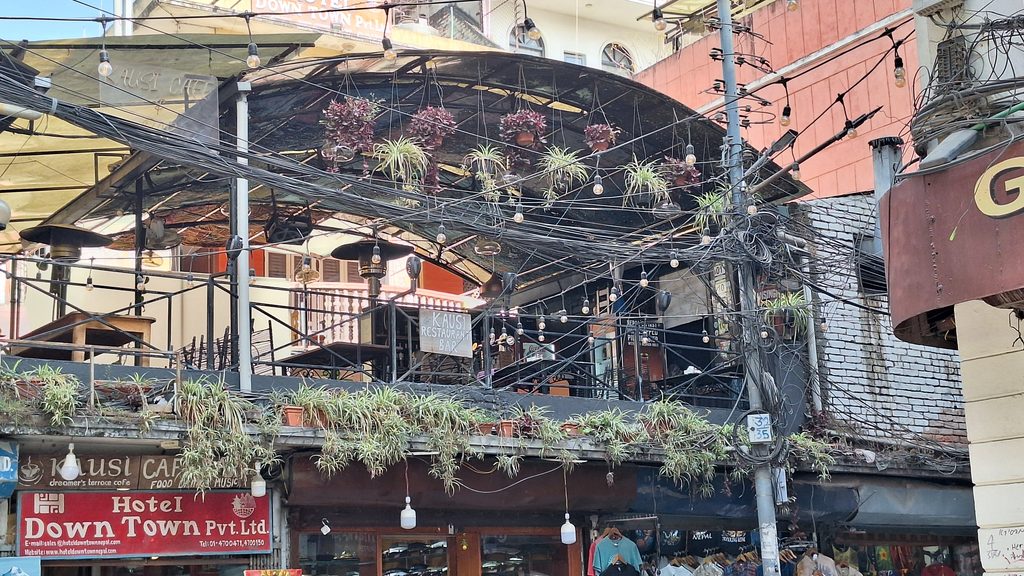
It’s another part of travelling that you learn to accept.
Leaving Kathmandu — Mixed Feelings
Now that my visit is coming to an end, I find myself feeling rather torn.
Part of me is ready to move on.
Another part wishes I could stay much longer.
Nepal has so much more to offer than Kathmandu.
There are mountain villages, rivers, valleys, trekking routes and magnificent peaks that I haven’t had the opportunity to explore.
You could spend months travelling through this country and still only see a fraction of it.
In fact, you could probably spend a lifetime exploring Nepal and never discover every corner.
But that’s the reality of my journey.
I have a goal to visit the world’s capital cities, and although I’d love to spend more time in each country, I have to keep moving.
For now, I’m content to appreciate the experiences I’ve had.
Could I Have Walked to Everest Base Camp?
One adventure that has been on my mind is the trek to Everest Base Camp.
If I’d allowed myself another two to four weeks in Nepal, I might have seriously considered attempting it.
Everest Base Camp, on the southern side of Mount Everest in the Khumbu region, stands at approximately 5,364 metres (17,598 feet) above sea level.
That’s an extraordinary height.
Most trekkers begin their journey by flying to Lukla, where the airport sits at approximately 2,846 metres above sea level.
From there, the trail passes through mountain villages, suspension bridges and some of the most spectacular scenery imaginable.
The route is well established, with teahouses offering accommodation and meals along the way.
But that doesn’t mean the trek is easy.
The Challenge of Altitude
One of the greatest difficulties is the altitude.
As you climb higher, the amount of oxygen available with each breath decreases.
Your body needs time to adjust, and rushing the ascent can lead to altitude sickness.
A commonly recommended precaution above 3,000 metres is to increase your sleeping altitude by no more than approximately 300–500 metres per day, with additional acclimatisation days along the way.
Even fit and experienced walkers can develop altitude sickness.
For someone of my age, particularly after having both hips replaced, it would be essential to approach the journey carefully and obtain appropriate medical advice.
But the idea still appeals to me.
I know it would be difficult, and I’d need to allow plenty of time.
Perhaps it would take me considerably longer than the average trekker.
But if the circumstances were right, I’d certainly be tempted to give it a try.
After all, some of the greatest adventures begin when you decide to step outside your comfort zone.
Eighty-Two Days of Sunshine
Another thing I’ve been thinking about is the weather.
For the past 82 days, I’ve enjoyed predominantly warm, sunny conditions during my travels.
Now I’m heading towards Europe, where winter is still lingering.
That’s going to be quite a change!
I’ve become accustomed to walking around in light clothing and enjoying temperatures of around 20°C or more.
In Georgia, I’ll be arriving to much colder conditions.
Am I ready for that?
I’m not entirely sure!
At least I’ve purchased a warm jacket here in Kathmandu.
And with European spring approaching, hopefully the colder weather won’t last too long.
Tomorrow — Delhi and Tbilisi
Tomorrow, I’ll be leaving Nepal.
My first flight takes me to Delhi in India, followed by an onward journey to Tbilisi, the capital of Georgia.
Another country, another capital city and another adventure.
Kathmandu has been an interesting experience.
I’ve encountered kindness, fascinating religious traditions, wonderful mountain views, dusty streets, persistent traders and some unforgettable walks.
There have been disappointments, but also many moments of enjoyment.
That’s the nature of travelling.
You never quite know what the next day will bring.
As one chapter closes, another begins.
Tomorrow, Georgia awaits!
Day 10: Leaving Kathmandu — The Journey to Georgia Begins
Weather Update: Sunny. High 22°C.
Elevation Above Sea Level: Approximately 1,324 metres (4,344 feet).
An Early Start
I set my alarm for 7:30 am this morning.
Today was departure day, and I wanted to make sure I had plenty of time to get organised before leaving for the airport.
Outside, the sun was shining brightly, but a thin layer of cloud once again hung over the surrounding mountains.
It seemed that the Himalayas were determined to keep their snow-covered peaks hidden from me right up until the end of my visit.
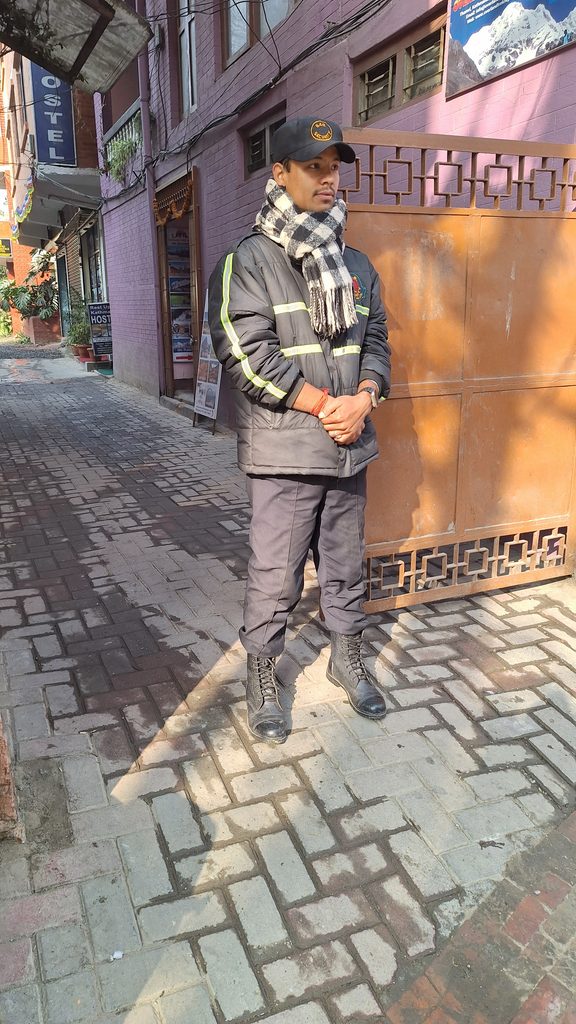
Quite a contrast to the warm afternoons I’d been enjoying in Kathmandu.
Waiting for a Motorbike That Never Arrived
A few days earlier, I’d arranged for a local motorbike rider to collect me from the hostel at 10 am and take me to the airport.
We’d agreed on a fare of 300 Nepalese rupees, which seemed a reasonable price.
Not wanting to keep him waiting, I was outside by 9:30 am, fully packed and ready to go.
Ten o’clock arrived.
No motorbike.
I waited another five minutes.
Still nothing.
By 10:05 am, I began wondering whether he’d forgotten our arrangement or was simply running late.
Travelling independently teaches you to expect the unexpected, particularly when transport arrangements are made informally.
Eventually, I decided I couldn’t wait any longer.
I found a taxi and negotiated a fare of 700 rupees, approximately US$5.
It was more than twice what I’d agreed to pay the motorbike rider, but at least I knew I was heading towards the airport.
Sometimes paying a little extra is better than risking a missed flight.
Kathmandu Airport — More Waiting Around
On arrival at the airport, I made my way through the initial security checks.
Everything went smoothly, and I passed through the scanners without any problems.
Unfortunately, the same couldn’t be said for check-in.
The information screens indicated that check-in was open, but when I arrived at the counter, there was nobody ready to process passengers.
I ended up waiting approximately half an hour before things finally got moving.
It’s one of those little frustrations that seem to follow travellers around the world.
You arrive early, do everything correctly and still spend most of your time standing around waiting.
Goodbye to Another Pair of Scissors!
After check-in and the departure formalities, I encountered another problem at security.
My scissors were confiscated.
Again!
These were part of the small emergency medical kit I carry while travelling.
Despite believing they were acceptable as carry-on items, airport security decided otherwise.
That makes three pairs of scissors I’ve lost during my travels.
At this rate, I’ll have spent more money replacing scissors than buying souvenirs!
I understand the need for airport security, but the rules seem to vary from one airport to another.
Something that passes through security without question in one country can be confiscated in the next.
Perhaps I should simply give up carrying them.
A Chicken Burger to Forget
With some time to spare before boarding, I decided to buy something to eat.
I settled on a chicken burger.
What a disappointment!
The chicken patty was so thin it was almost transparent.
I’ve eaten some interesting meals during my travels, but this certainly wasn’t one of the memorable ones for the right reasons.
It was the sort of burger that leaves you wondering where the chicken had gone.
One thing’s certain.
I wouldn’t buy another!
One Final Security Check
Eventually, boarding began.
I thought I’d completed all the necessary security procedures, having already passed through two sets of scanners.
But as we approached the aircraft, there was yet another search of our hand luggage.
This was something I hadn’t experienced before.
Another inspection, another delay.
I couldn’t help wondering why it was necessary after all the previous checks.
Nevertheless, we eventually boarded, and the captain assured everyone that despite the delay, we were still expected to arrive in Delhi on schedule.
Leaving Nepal Behind
Our flight finally took off at approximately 2 pm, half an hour later than scheduled.
As Kathmandu disappeared behind us, I reflected on my ten days in Nepal.
I’d arrived knowing relatively little about the city beyond its famous temples and its position beneath the Himalayas.
I’d discovered a place filled with history, religious traditions, bustling streets and some wonderfully helpful people.
I’d also experienced the frustrations of dust, traffic, pollution and persistent street vendors.
But that’s travelling.
You can’t expect every day to be perfect.
The important thing is to experience a country for yourself rather than relying entirely on what you’ve read or seen in photographs.
I hadn’t reached Everest Base Camp or explored the remote mountain villages, but I’d enjoyed my time in Kathmandu.
Perhaps one day I’ll return and venture further into the mountains.
Arriving in Delhi
We arrived in Delhi, India, where the temperature was a pleasant 23°C.
Unfortunately, the city was once again covered in a blanket of pollution.
Looking into the distance, the haze reminded me of a thick cotton sheet hanging over the landscape.
It created the appearance of a misty winter morning, although the temperature was anything but cold.
I’d encountered similar conditions in several Asian cities, and it was another reminder of the environmental challenges facing rapidly growing urban areas.
For now, Delhi was simply a stopover.
My onward flight to Tbilisi, Georgia, was scheduled to depart at 7:30 pm.
Another Country, Another Adventure
Although I prefer travelling overland whenever possible, sometimes flying is unavoidable.
My long-term aim remains to travel through countries rather than simply fly over them.
There’s something special about watching the landscape change gradually as you cross borders by train, bus, boat or on foot.
You experience the towns, villages and countryside that would otherwise pass unseen beneath an aircraft.
But on this occasion, flying was the most practical option.
Georgia would be another new country, another capital city and another opportunity to discover somewhere unfamiliar.
And after weeks of warm weather, I was about to experience a much colder climate.
Good thing I bought that jacket!
Final Thoughts on Nepal
Ten days in Kathmandu have given me plenty to remember.
From the kindness of Krishna on my arrival to the magnificent views of the Himalayas, the sacred temples and the everyday life of the city, Nepal has been an interesting chapter in my journey.
There were moments of frustration, certainly.
But there were also moments when I could sit quietly in the sunshine, look towards the mountains and appreciate just how fortunate I am to be doing this.
At my age, every new destination feels like another opportunity.
I don’t know exactly what lies ahead, and that’s part of the excitement.
If you’ve enjoyed following my travels, please feel free to contact me through the Contact page on my website.
I’m always happy to answer questions and share my experiences.
I hope that by reading these stories, you feel as though you’re travelling alongside me, discovering not only the famous attractions but also the everyday realities of life in the countries I visit.
Nepal is now behind me, and Georgia is waiting.
Another step into the unknown.