

Friendship, Frustration and Unexpected Adventures
From Bratislava to Kraków — A Scenic Journey Across Central Europe
Another Country, Another Adventure
After my time exploring Bratislava, the capital of Slovakia, it was time to continue my journey towards Poland.
My next destination was Kraków, a city with a remarkable history and another exciting stop on my travels around the world.
One of the things I have come to appreciate about travelling overland is that the journey itself can be just as rewarding as the destination.
When you travel by bus rather than flying, you see the countryside, small villages, farms, historic buildings and ordinary everyday life that would otherwise pass unnoticed thousands of metres below an aircraft.
And, of course, there is always the possibility that something unexpected will happen along the way!
A Slightly Uncomfortable Start
The morning began with the usual routine of packing my backpack and making sure I hadn’t forgotten anything.
I woke with a little sciatic discomfort, but after taking some ibuprofen, I was ready to get moving.
The bus station was approximately 1.7 kilometres away, which gave me a pleasant morning walk through Bratislava.
Having spent time exploring the city, I was beginning to feel familiar with my surroundings.
There is something rather satisfying about reaching that stage in a new place, just when it is time to leave!
A Surprise at the VIP Lounge
Arriving at the bus station, I noticed a VIP lounge for international passengers.

Naturally, curiosity got the better of me.
I presented my ticket for Poland and asked whether I could use the lounge.
To my delight, I was allowed inside.
There was complimentary tea and coffee, along with a comfortable and relatively peaceful place to sit while waiting for my departure.
After spending so much time travelling on a budget, these little comforts are always appreciated.
Sometimes, simply having somewhere quiet to sit and relax makes all the difference before a long journey.
Across the Beautiful Countryside
The bus departed on time, and we were soon leaving Bratislava behind.
The journey was expected to take approximately six and a half hours.
As the city disappeared, the landscape opened into rolling hills, forests, farmland and attractive villages.
Much of the countryside was beautifully maintained.
I was particularly impressed by how clean everything appeared, with very little rubbish beside the roads.
The hills were covered with trees and shrubs, and the occasional village appeared among the greenery.
It was the sort of scenery that makes travelling by road so enjoyable.
I have always believed that if you want to understand a country, you need to travel through it rather than simply fly over it.
This journey was another reminder of why.
A Ruined Castle on the Hill
Approximately two hours into the journey, I spotted something that immediately caught my attention.
High on a hillside stood the remains of an ancient castle.
Its ruined walls rose above the surrounding countryside, looking down over the landscape as they must have done for hundreds of years.
Europe is full of these reminders of its turbulent history.
I managed to take a photograph as we passed, although from a moving bus there is never much time to frame the perfect picture.
I couldn’t help wondering about the people who had lived there, the battles fought nearby and the changes those old stones had witnessed.
Sometimes a glimpse of a building lasting only a few seconds can leave a lasting impression.
Sunshine, Storms and a Sudden Drop in Temperature
As we continued north, the weather began changing.
The sunshine disappeared behind dark clouds, and before long, a storm was approaching.
The wind strengthened, the rain began falling and visibility deteriorated.
The temperature, which had been around 16°C, suddenly dropped to approximately 8°C.
What a difference in such a short time!
Fortunately, I had a jacket available.
The storm was dramatic but relatively brief, eventually easing into lighter rain.
As the weather improved, the temperature climbed back towards 11°C.
It was during this part of the journey that I began noticing vehicles displaying the letters PL on their registration plates.
We had entered Poland.
Another country on my journey!
Nearly Left Behind at a Service Station
At one point, the bus stopped at a service station so passengers could stretch their legs and purchase refreshments.
I went inside briefly.
When I came back out, I was alarmed to see the bus doors closing and the vehicle beginning to move.
For one horrible moment, I thought I was about to be stranded in the middle of nowhere without my backpack.
Thankfully, the bus stopped, and the driver appeared.
Disaster avoided!
It was one of those situations that seems amusing afterwards but certainly doesn’t feel funny while it is happening.
A useful reminder to keep an eye on the bus whenever there is a short stop.
A Strange Sight Beside the Motorway
As we approached Kraków, an extraordinary collection of white domes appeared beside the motorway.
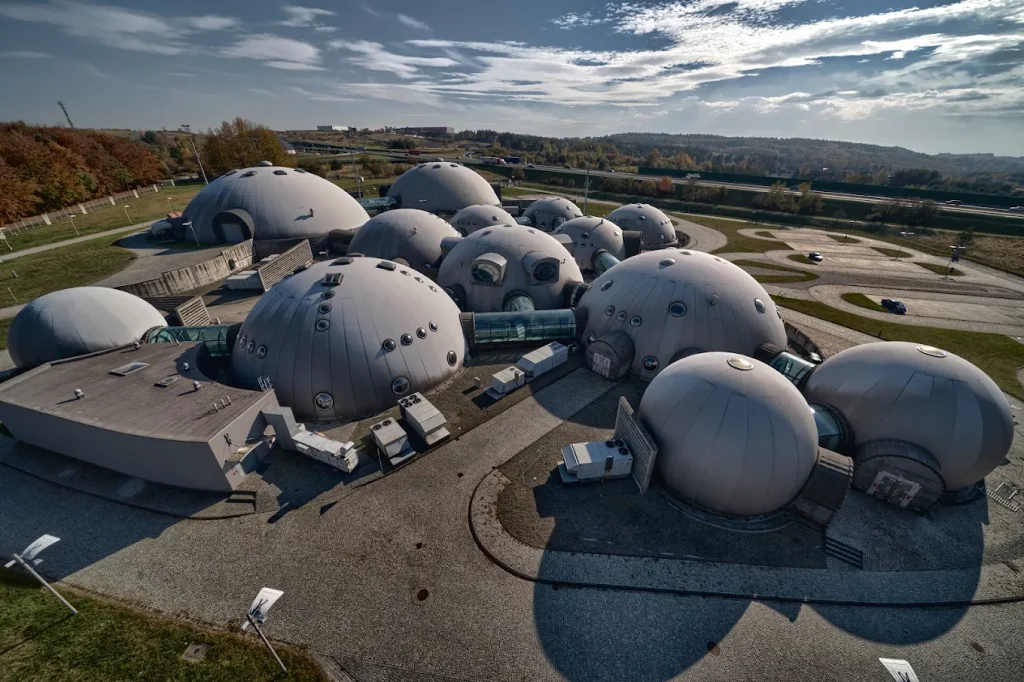
This was Alvernia Planet, a distinctive complex used for exhibitions, events and entertainment.
At the time, it was associated with a Harry Potter exhibition.
Seeing it immediately made me think of my granddaughters, Eden and Emmeline, who love Harry Potter.
Perhaps one day we might have an opportunity to experience something like this together.
Travel has a wonderful way of reminding you of family, even when you’re thousands of kilometres from home.
Arriving in Kraków
Eventually, after a journey of changing weather, lovely scenery and a few unexpected moments, we arrived in Kraków.
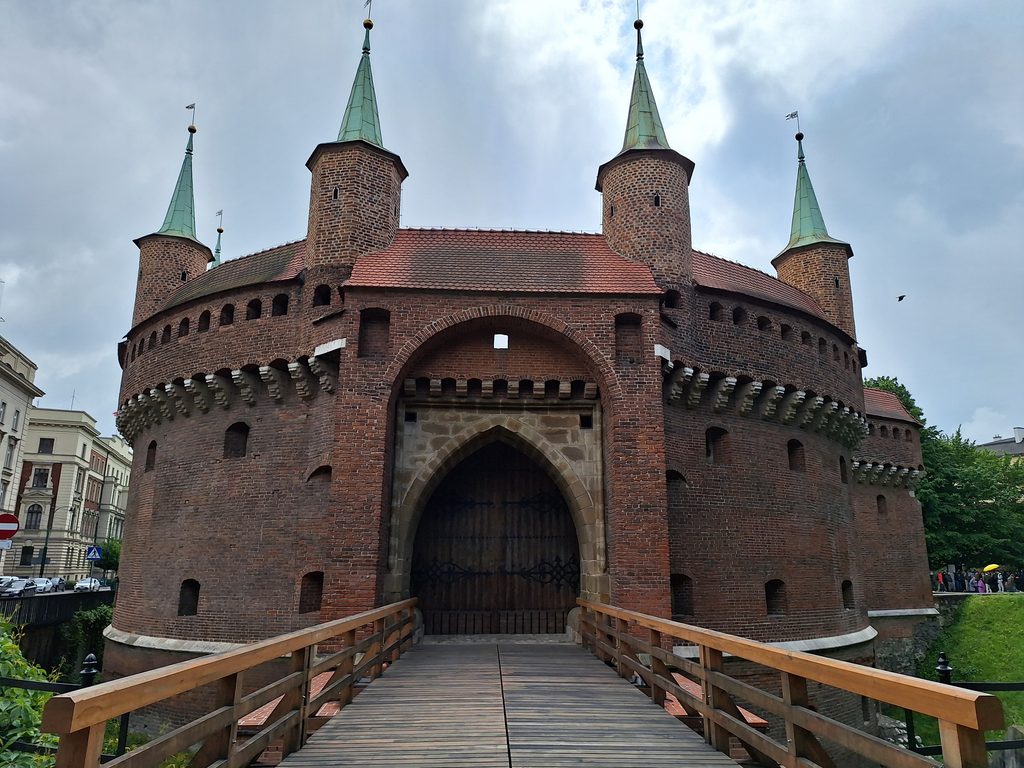
Finding my hostel from the bus station was relatively straightforward.
However, checking in felt rather impersonal.
I had been provided with access codes, which worked perfectly well, but there was nobody there to welcome me, explain the facilities or show me around.
For me, a friendly reception makes an enormous difference.
After a long day travelling, it is reassuring to have someone greet you, answer questions and help you settle in.
Fortunately, the hostel soon provided something I value even more: interesting people.
Meeting Phillip and Milosh
I met Phillip, originally from Hong Kong and now living in Canada, and Milosh from Serbia.
We spent time talking about our travels and exchanging experiences.
Milosh told me that the weather had been disappointing during his three days in Kraków.
He also mentioned that I was the first person he’d really had a conversation with during his stay.
I found that rather sad.
One of the reasons I enjoy hostels is the opportunity to meet strangers and discover their stories.
You never know who you might encounter or what you might learn.
A Glimpse of Kraków After Dark
Later that evening, I ventured out to experience a little of Kraków’s nightlife.
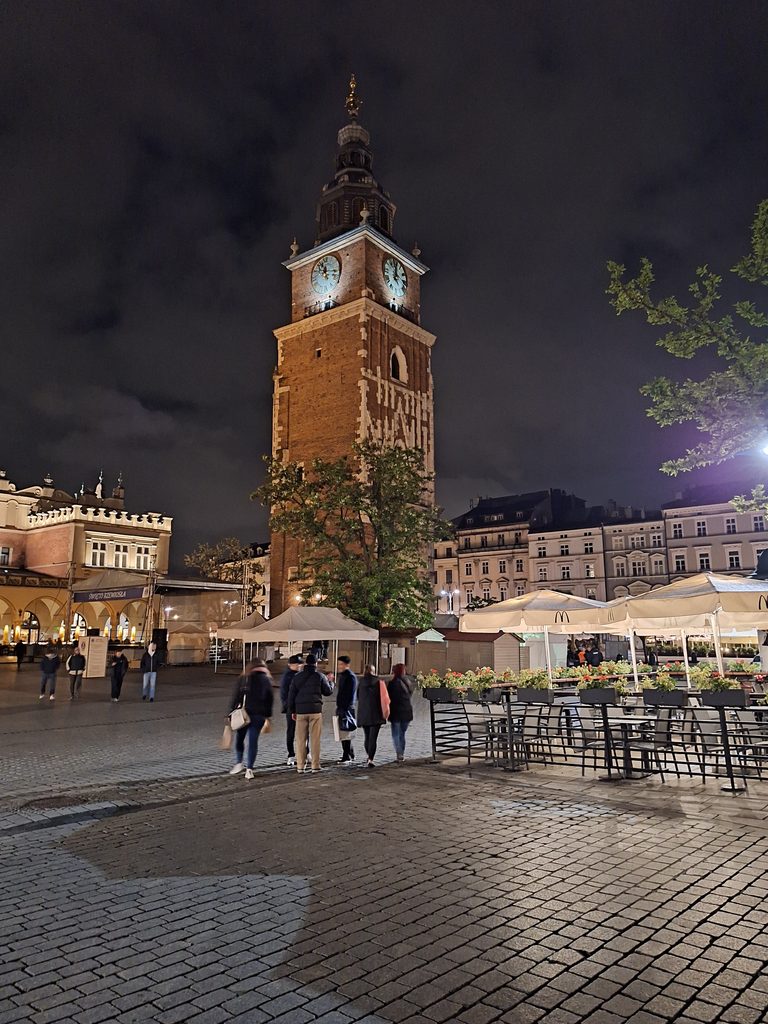
Watching the younger generation enjoying themselves brought back memories of my own younger days.
The music, atmosphere and excitement were familiar, even if I now observe things from a rather different perspective.
I also reflected on how alcohol can sometimes turn an enjoyable evening into something less pleasant.
After returning to the hostel, my sleep was interrupted in the early hours by another guest preparing to leave.
Anyone who has spent time in shared dormitories knows how inconsiderate people can occasionally be.
Nevertheless, these are some of the compromises we make when choosing affordable accommodation.
Reflections on the Journey
The journey from Bratislava to Kraków was another memorable day.
Beautiful countryside, an ancient castle, sudden storms, a near miss at a service station and conversations with people from opposite sides of the world.
No photographs of the arrival day were included in my original blog entry, but the memories remain.
Sometimes the story of travelling is just as important as the photographs.
And Kraków had much more waiting for me.
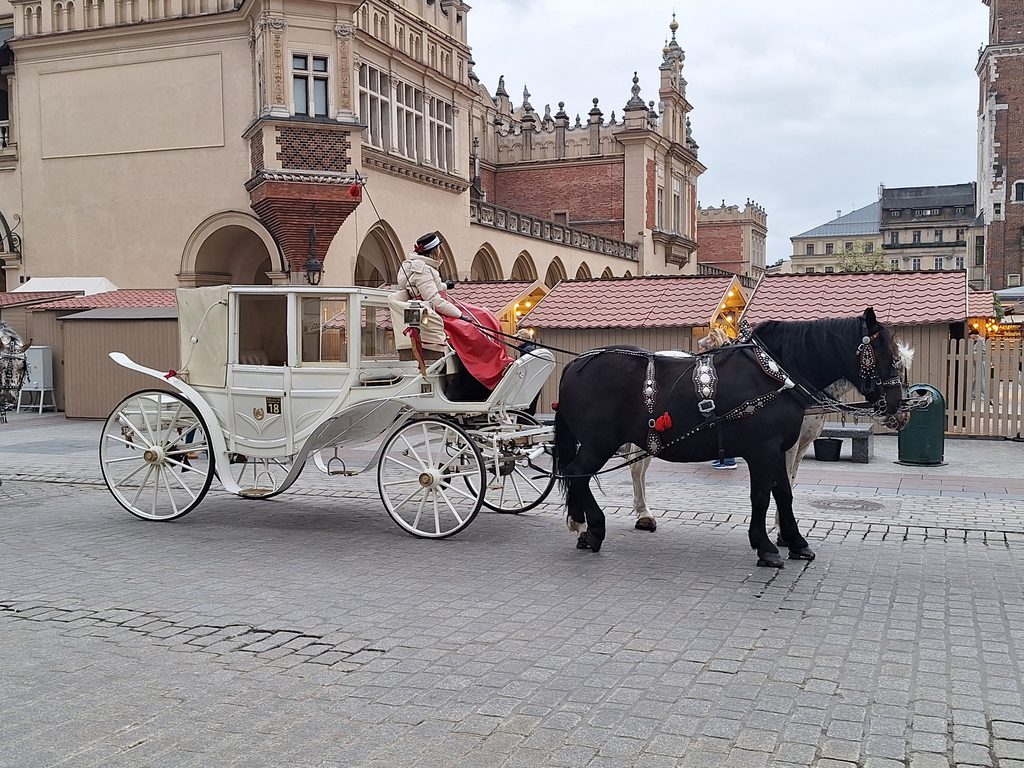
Kraków — Descending into the Extraordinary Wieliczka Salt Mine
A Journey Beneath the Earth
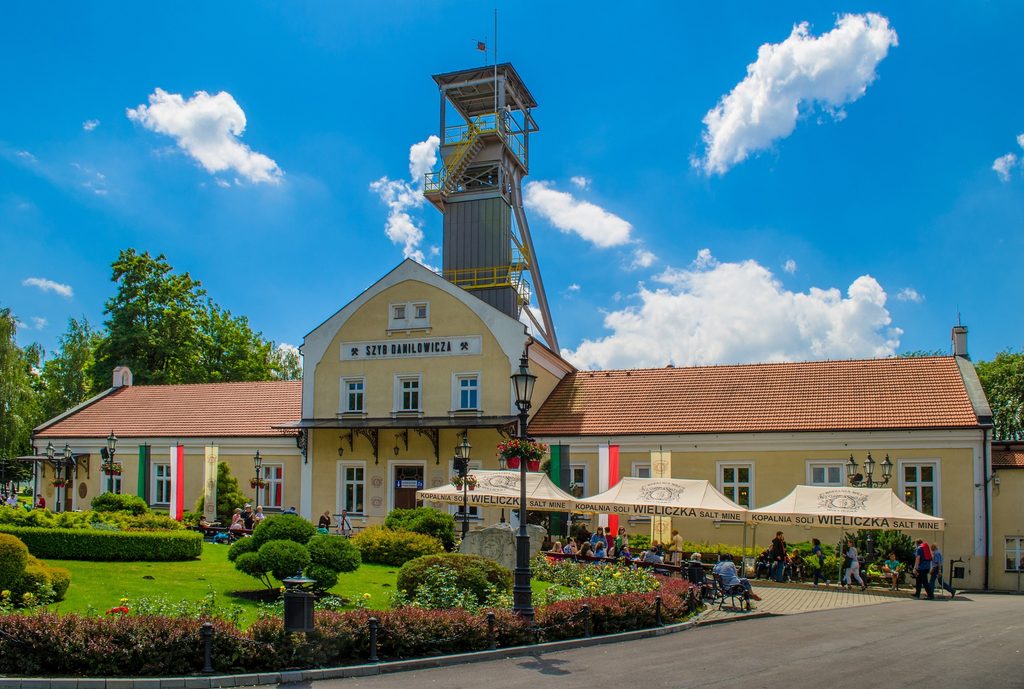
One of my most memorable experiences in Poland was visiting the Wieliczka Salt Mine, just outside Kraków.
I had heard about this remarkable place and was eager to discover what lay beneath the ground.
At 71, I’m still fascinated by places that combine history, human ingenuity and extraordinary craftsmanship.
And this visit certainly delivered all three.
Catching the Train to Wieliczka
The morning began with a short walk to Kraków’s railway station.
I purchased my ticket from one of the machines, which fortunately offered an English-language option.
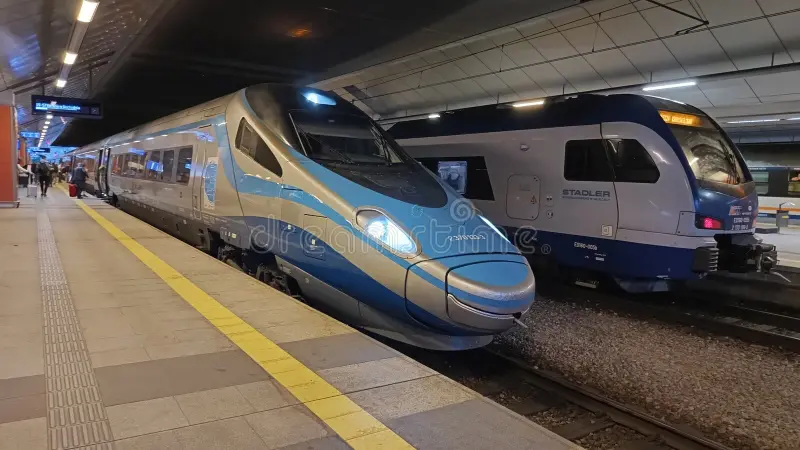
The process was fairly straightforward.
One advantage of travelling as a senior is that discounts are sometimes available, and Polish rail services offered useful concessions.
The train was modern, clean and comfortable.
After approximately 25 minutes, I arrived in Wieliczka.
From the railway station, it was a relatively short walk to the Salt Mine ticket office.
A Few Hours to Explore
I purchased my admission ticket and discovered that my English-speaking tour was scheduled for 2:30 pm.
That left me with several hours to fill.
Rather than sit around waiting, I decided to explore the surrounding area.
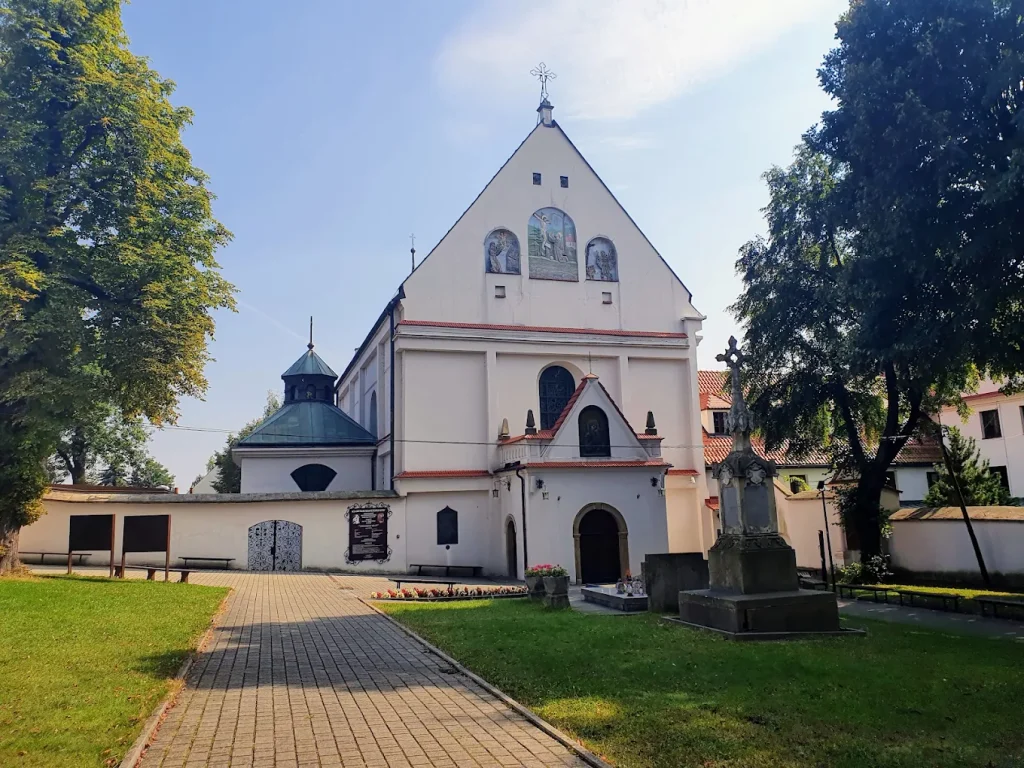
Although the monastery itself was closed, I was able to visit the chapel and enjoy the peaceful surroundings.
It was a pleasant way to spend the morning.
In hindsight, booking the mine tour online beforehand would have allowed me to organise the day more efficiently.
Descending into the Mine
At 2:30 pm, our English-speaking tour began.
We entered the mine and began descending a seemingly endless series of wooden staircases.
The deeper we went, the more I wondered what extraordinary sights might be waiting below.
The temperature underground remained around 17–18°C, which was surprisingly comfortable.
Huge wooden doors helped control the movement of air through the passages.
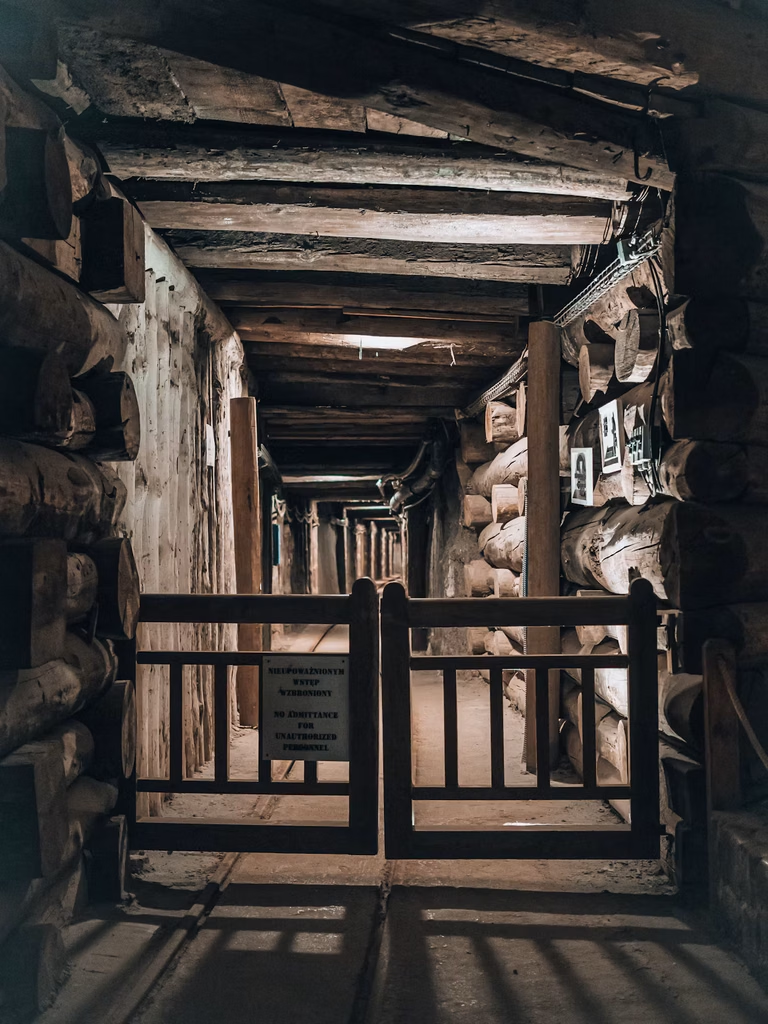
By the end of the tour, we would reach approximately 135 metres below the surface.
Seven Hundred Years of Mining History
Our guide led us through tunnels and chambers that revealed centuries of extraordinary human effort.

The Wieliczka Salt Mine had been worked commercially for hundreds of years.
In medieval Europe, salt was enormously valuable.
Today, we think little of buying a packet of salt at the supermarket.
But centuries ago, it was essential for preserving food and could be worth a considerable amount of money.
Our guide explained how miners sometimes received an allocation of salt as part of their payment, allowing them to sell it themselves.
This also helped discourage theft.
The conditions experienced by miners centuries ago must have been incredibly difficult.
Working deep underground, without modern lighting, ventilation or machinery, required enormous physical effort.
The more I learned, the more impressed I became.
An Underground World of Tunnels and Chambers
The scale of the mine is astonishing.
Its underground workings extend over nine levels, with hundreds of kilometres of passages.
The deepest parts reach more than 300 metres below the surface.
Our guided route covered approximately 3.5 kilometres, descending to the third level.
It was a substantial walk, especially after all the stairs at the beginning.
But the extraordinary sights made every step worthwhile.
The rock salt itself is naturally grey in many areas, giving the walls the appearance of polished or rough granite.
It was unlike anything I had experienced before.
St. Kinga’s Chapel — A Church Carved from Salt
The most extraordinary part of the visit was seeing the magnificent underground chapel.
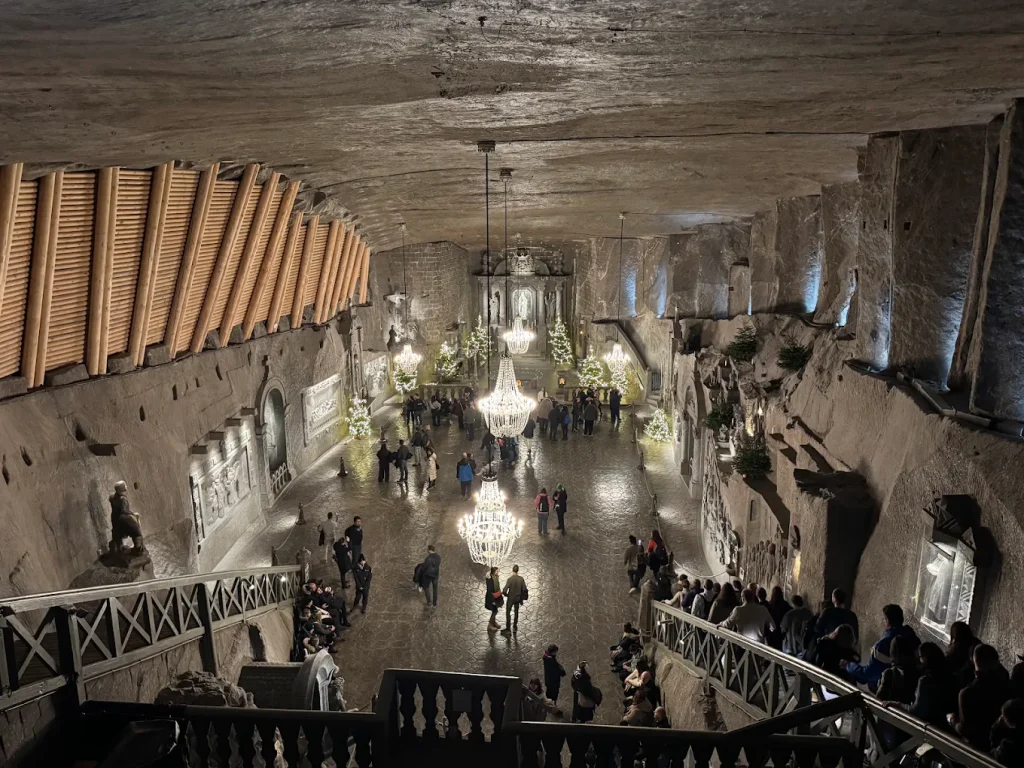
Carved directly into the salt, St. Kinga’s Chapel is an astonishing achievement.
The walls contain detailed religious sculptures and carvings depicting scenes from the life and crucifixion of Jesus.
Even the decorative features and chandeliers have connections to the salt workings.
Standing inside, it was difficult to believe that human hands had created such beauty deep beneath the earth.
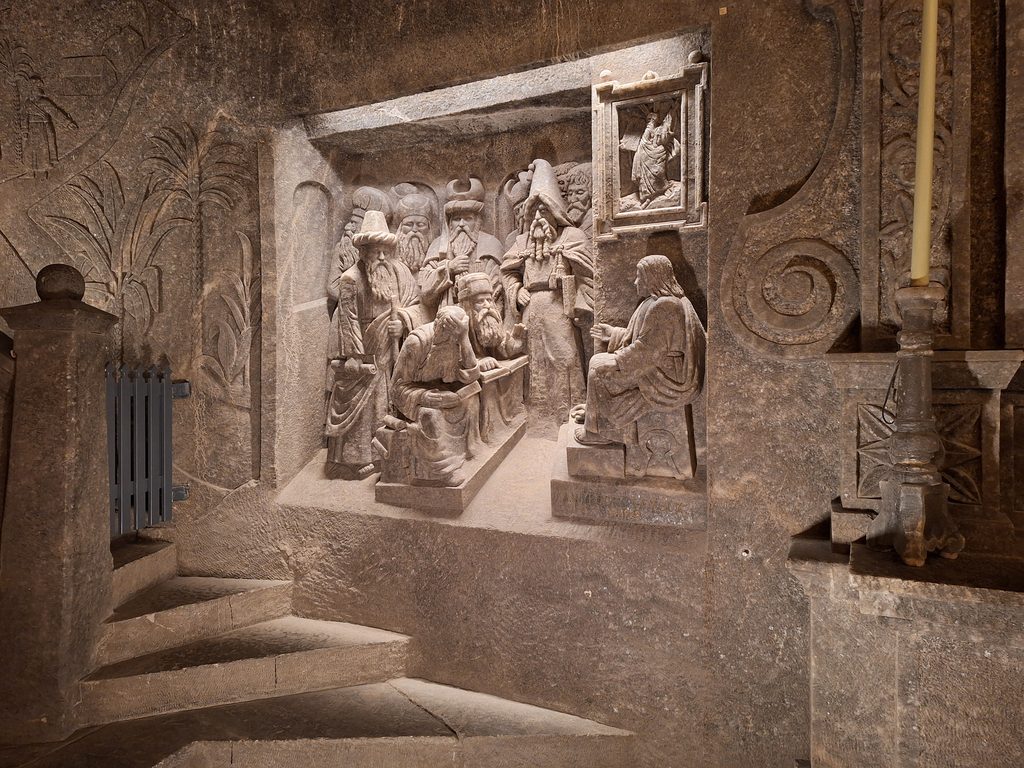
The chapel continues to be used for religious services and weddings.
Imagine being married in a church carved from salt more than 100 metres underground!
I have visited many beautiful churches during my travels, but this one was something completely different.
The craftsmanship was extraordinary.
I took photographs, although I doubt they fully capture the scale and detail of what I saw.
This is one place where you really need to stand inside to appreciate it.
Dining and Celebrating Underground
As we continued, we passed areas where visitors could purchase refreshments and souvenirs.
There was even a fully equipped restaurant deep underground.
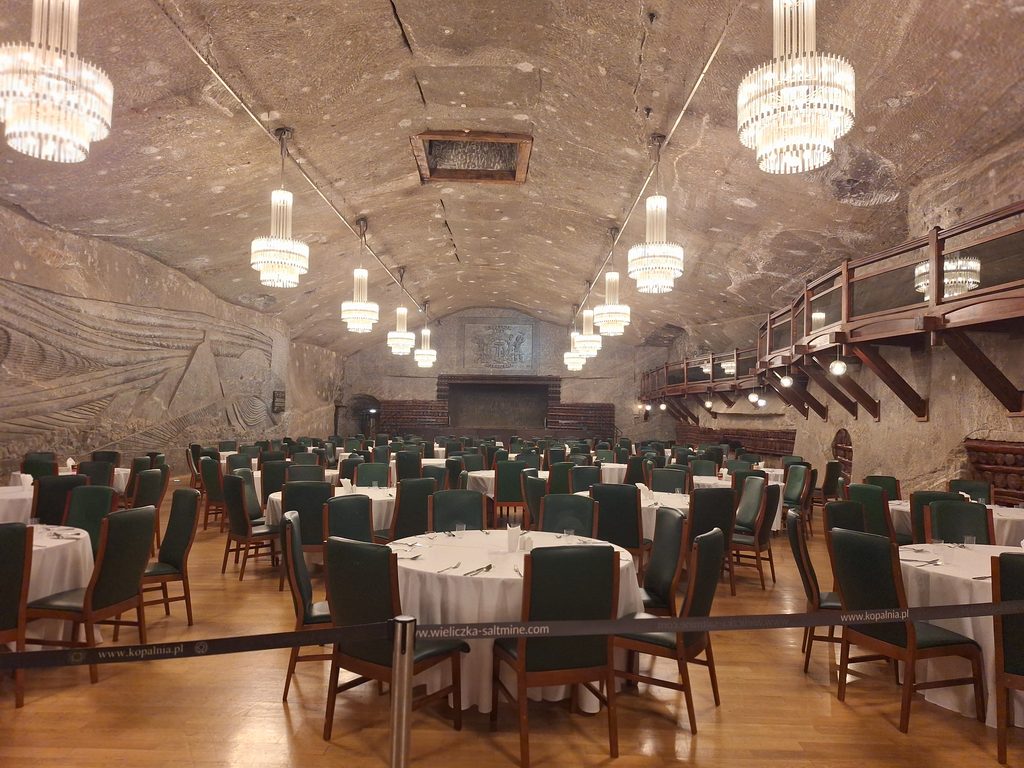
It is remarkable to think that people can enjoy a meal or attend a celebration so far below the surface.
The mine is much more than a former workplace.
It has become an extraordinary underground world celebrating history, engineering, art and religious devotion.
Returning to the Surface
After approximately two to three hours underground, it was time to return to daylight.
Thankfully, we didn’t have to climb all those stairs again.
Instead, we travelled upwards in a miners’ lift.
The lift consisted of four stacked compartments, each carrying approximately ten passengers.
It was certainly an interesting experience.
And far preferable to climbing hundreds of steps back to the surface!
Our guide had worked at the mine for 33 years.
Although I cannot remember his name, I certainly remember his enthusiasm, jokes and fascinating stories.
A good guide can transform a historic attraction into a truly memorable experience.
A Remarkable UNESCO World Heritage Site
Salt production in this area dates back to ancient times, with the development of underground mining beginning in the medieval period.
Commercial salt production eventually ended in 1996, but the mine’s enormous historical significance has been preserved.
Today, Wieliczka is recognised as a UNESCO World Heritage Site.
It is a remarkable testament to the ingenuity, determination and craftsmanship of generations of miners.
An Unforgettable Day
By the time I returned to Kraków, it was approaching seven in the evening.
I was tired but thoroughly satisfied.
I had spent the day exploring an extraordinary underground world, learning about centuries of mining history and admiring works of art unlike anything I had previously encountered.
If you’re visiting Kraków, I thoroughly recommend considering a trip to the Wieliczka Salt Mine.
For senior travellers, bear in mind that the standard tour involves a considerable number of stairs and several kilometres of walking.
It is worth checking the available tour options against your own mobility needs.
For me, it was one of the highlights of Poland.
An Unexpected Interruption — My Laptop Problems Begin
When Travel Plans Come to a Halt
Shortly after arriving in Poland, I encountered a problem that would affect my journey far more seriously than I initially expected.
My laptop developed a hardware fault.
At first, I hoped it would be repaired within a few days.
I let my readers know that I might be unable to publish my regular travel updates over the coming weekend and perhaps into the following week.
Unfortunately, the problem turned into something much bigger.
The repair process dragged on, and my computer remained unavailable for an extraordinary length of time.
What I expected to be a short interruption eventually contributed to my spending approximately three months in Poland.
It was frustrating beyond words.
I had been travelling from country to country, documenting my experiences, organising thousands of photographs and sharing the journey through my blog.
Suddenly, that routine came to a halt.
Some of my travel records became fragmented, and I was unable to keep up with the regular diary entries.
But the journey itself didn’t stop.
I continued exploring, meeting people, visiting historic places and discovering more of Poland than I had originally planned.
In the end, the delay gave me an unexpected opportunity to experience the country in far greater depth.
The following chapters bring together the experiences I managed to preserve from those months.
They don’t represent every day I spent in Poland, but they tell the story of a country that became a much bigger part of my journey than I ever anticipated.
Poland — The Journey Continues
Day 195 — From Kraków to Warsaw: A First-Class Ticket Without a Seat
Weather: Showers, high 18°C
Elevation: 100 metres (330 feet)
Leaving Kraków Behind
After enjoying my time in Kraków, it was time to travel north to Warsaw, the capital of Poland.
I had grown rather fond of Kraków, but there were more places to discover.
For this journey, I decided to treat myself to a first-class train ticket.
The upgrade cost approximately €4 more than second class, which seemed like excellent value.
I imagined a comfortable seat, a relaxing journey and perhaps a little extra space to stretch my legs.
Unfortunately, things didn’t quite work out that way.
First Class — But No Seat!
When I boarded the train, I discovered that there was no seat available for me.

Not exactly the experience I had paid extra for!
Eventually, I found myself leaning against the counter in the buffet carriage.
I decided that if I couldn’t sit comfortably, I might as well enjoy a couple of beers while watching the countryside pass by.
A Polish woman struck up a conversation.
She travelled this route regularly and told me that overcrowding was not unusual.
According to her, passengers were sometimes forced to stand in corridors even when holding first-class tickets.
She was just as unimpressed as I was.
After approximately an hour, the conductor appeared.
I showed him my ticket and asked for an email address so I could make a formal complaint.
Fortunately, at the next station, a woman left the first-class carriage, freeing up a seat.
At last, I could sit down and enjoy the remainder of the journey.
First Impressions of Warsaw
We arrived in Warsaw around lunchtime.
My first destination was the Hard Rock Café, where I stopped for something to eat and to get my bearings.
After spending time on the train, it was good to relax before finding my accommodation.
My hostel was approximately two kilometres away, a manageable walk.
So far, so good.
But the hostel had a few surprises waiting for me.
A Four-Bed Dormitory with Three Beds
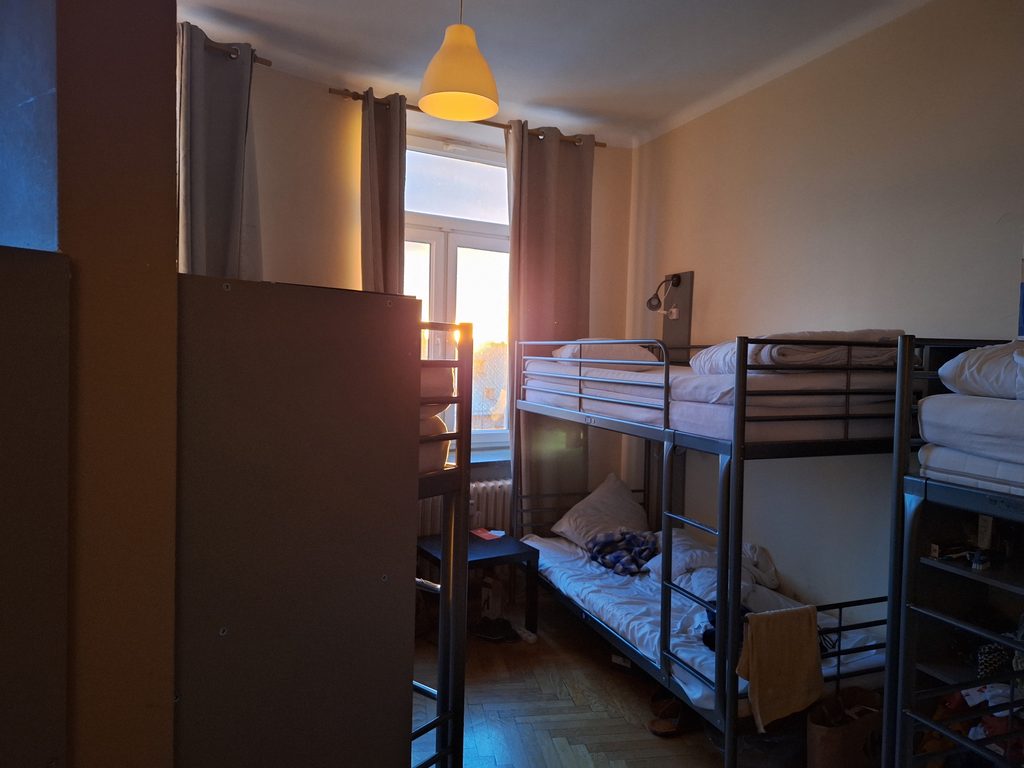
I had booked a bed in a four-person dormitory.
When I entered the room, however, I found only three beds.
Even more strangely, my allocated bed was a double.
I wondered what would happen if the hostel decided to put another guest into the same bed!
Sharing a dormitory with strangers is one thing.
Sharing a double bed with someone I have never met is quite another!
Thankfully, I had the bed to myself for the two nights I stayed.
The Mystery of the Night-Time Visitors
The first evening brought another odd experience.
At approximately 10:30 pm, a young man entered the dormitory.
I greeted him cheerfully.
“We’re roomies,” I said.
He didn’t stay long.
He left shortly afterwards without appearing to settle in or unpack anything.
The following morning, I noticed that someone had used the shower during the night.
The floor was still wet.
Whether it was the same young man, I couldn’t say.
The second evening was equally strange.
At around two in the morning, another traveller arrived.
Then, at approximately five o’clock, I woke to discover him sitting on the floor, rummaging through his bags.
“What are you doing at five o’clock in the morning?” I asked.
“Oh,” was his brief response.
He promptly returned to bed.
By the time I was properly awake later, he had disappeared.
Hostel life certainly provides its share of unusual encounters!
Warsaw’s Streets Filled with Political Rallies
During my visit, Warsaw was unusually busy.
There were crowds everywhere, with people carrying national flags, banners and political signs.
Initially, I wondered whether Poland was hosting an international football match.
The atmosphere certainly had the energy of a major sporting occasion.
However, it turned out that large political rallies were taking place ahead of Poland’s presidential election.
Supporters of rival political camps were gathering in the capital, and the police presence was considerable.
Streets were crowded, and the whole city seemed to be caught up in the excitement and tension.
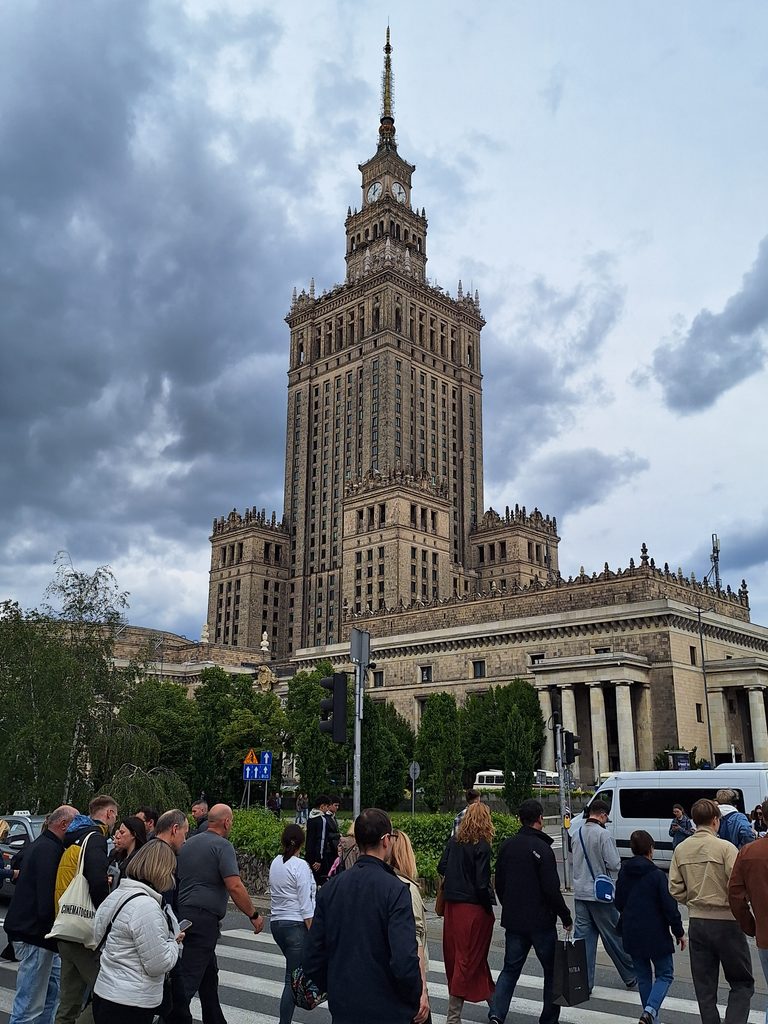
It was fascinating to witness, although the crowds made sightseeing and finding accommodation more challenging.
An Unexpected Visit to a Hookah Lounge
On my first evening, I decided to go for a short walk and find somewhere to enjoy a quiet beer.
A few streets from the hostel, I spotted a bar.
It sold beer, so that was good enough for me.
I went inside, ordered a drink and settled down.
Only then did I realise that I was sitting in a hookah lounge.
Around me, customers were smoking flavoured tobacco through elaborate water pipes, with coals glowing and sweet-smelling smoke filling the air.
It wasn’t quite the traditional pub atmosphere I had expected!
Nevertheless, it was another unexpected experience to add to the collection.
Sometimes you find exactly what you’re looking for.
Other times, travelling takes you somewhere completely different.
Moving On from Warsaw
Although Warsaw was certainly interesting, I never quite developed the same affection for it that I had for Kraków.
The crowds, political rallies and rather unusual hostel experiences made the visit less relaxing than I had hoped.
After two nights, I decided it was time to move on.
My next destination was Gdańsk, on Poland’s Baltic coast.
I booked a FlixBus for Monday and prepared for another journey north.
Not every city becomes a favourite.
But every destination adds something to the experience.
Days 197–258 — Gdańsk: History, Friendships and an Unexpectedly Long Stay
Weather: Generally sunny, 17–26°C
Elevation: Approximately 11 metres above sea level
North to the Baltic Coast
Leaving Warsaw behind, I boarded a FlixBus heading towards Gdańsk.
The journey took approximately five hours, passing through peaceful Polish countryside under beautiful blue skies.
After the crowds and bustle of Warsaw, I was looking forward to discovering a different part of the country.
Gdańsk, historically known as Danzig, is one of Poland’s most fascinating cities.
Its location on the Baltic Sea has shaped its history for centuries.
I was about to discover just how much this city had endured.
Arriving in the Old Town
One particularly convenient feature of Gdańsk is that its main bus and railway stations are situated close together near the historic centre.
After stepping off the bus, I began my usual arrival routine.
First, find somewhere to enjoy a cold beer.
Second, study the map.
Third, work out how to get to the hostel without getting hopelessly lost!
Over time, this little ritual has become part of my travelling life.
As I walked towards my accommodation, I was immediately impressed by the beautiful buildings and cobbled streets.
The colourful façades looked as though they had been standing for centuries.
What made them even more extraordinary was knowing how much of the city had been destroyed during the Second World War.
Gdańsk had been painstakingly reconstructed.
Walking through its streets today, it is difficult to imagine the devastation that once surrounded this historic port.

The Laptop That Changed My Travel Plans
Unfortunately, my continuing laptop problems made Gdańsk a far longer stop than I had originally anticipated.
What should have been a relatively brief visit became a prolonged period of waiting, frustration and uncertainty.
I was constantly hoping to hear that my computer had been repaired.
Days turned into weeks.
Weeks turned into months.
I began to feel that Poland had somehow become my temporary home.
The delay was particularly frustrating because I was trying to keep my travel blog up to date.
With thousands of photographs and diary entries to organise, not having reliable access to my computer made everything much harder.
But there was little I could do except make the best of the situation.
And fortunately, Gdańsk had plenty to offer.
Friendships from Around the World
One of the most rewarding aspects of my extended stay was the people I met.
During my time in Poland, I encountered travellers from New Zealand, Australia, Poland, Norway, Denmark, Germany, America and other countries.
We shared stories about our lives, our travels and the different circumstances that had brought us to the same place.
Some conversations lasted only a few minutes.
Others continued over several days.
These connections reminded me once again why I enjoy staying in hostels.
They offer an opportunity to meet people you might never encounter in ordinary everyday life.
My delayed journey had become an unexpected opportunity for friendship.
A Broken Tooth and an Insurance Battle
Unfortunately, my laptop wasn’t the only thing causing problems.
While eating pizza at a restaurant called 01 Pizzeria, I damaged a tooth.
What should have been an ordinary meal turned into another major inconvenience.
The injury eventually resulted in an insurance dispute and further complications with my travel plans.
I even had to make arrangements to return to Warsaw as part of dealing with the situation.
At times, I wondered what else could possibly go wrong.
First my computer, then my tooth!
Still, these problems were part of the reality of long-term independent travel.
You can plan your route, budget and accommodation, but you cannot anticipate everything.
Gdańsk — A City That Rose from the Ruins
The history of Gdańsk is extraordinary.
For centuries, it was an important Baltic trading centre, influenced by Polish, German and other European cultures.
Following the First World War, the city became the Free City of Danzig under the protection of the League of Nations.
Its position between Germany and Poland made it a centre of political tension.
Then, on 1 September 1939, German forces attacked the Polish military position at Westerplatte, near Gdańsk.
The attack became one of the opening events of the Second World War in Europe.
The city’s Jewish community was devastated by Nazi persecution and the Holocaust, while Polish and Kashubian residents also suffered terribly.
By the end of the war, much of the historic city lay in ruins.
The reconstruction of Gdańsk is one of the remarkable achievements of post-war Poland.
Today, its colourful streets and magnificent buildings are a testament to the determination of the people who rebuilt their city.
Reflecting on the Beginnings of Two World Wars
Standing in Gdańsk brought back memories of my earlier visit to Sarajevo.
There, I had stood near the bridge associated with the assassination of Archduke Franz Ferdinand in 1914, the event that helped trigger the First World War.
Now I was visiting the area where the opening attacks of the Second World War had taken place in 1939.
Two places connected with some of the darkest chapters of modern history.
I found myself wondering whether humanity had truly learned from the terrible destruction of those conflicts.
And I hoped I would never find myself visiting a place associated with the beginning of a third world war.
Walking the Historic Gates of Gdańsk
One of my favourite ways to explore Gdańsk was simply to walk through its historic streets.
The city contains a remarkable collection of gates, many of which date from its centuries as a prosperous trading port.

Each tells a different part of Gdańsk’s story.
The Highland Gate, constructed in 1588, traditionally marked the ceremonial entrance to the Royal Route.
The Golden Gate, dating from the early seventeenth century, is decorated with figures representing important civic virtues.
The Green Gate stands near the waterfront and was originally intended to provide suitable accommodation for visiting Polish royalty.
The medieval Cow Gate recalls a time when cattle passed through the city towards grazing land.
St. Mary’s Gate opens towards one of Gdańsk’s most picturesque historic streets.
The Chlebnicka Gate is another fine example of medieval mercantile architecture.
Then there is the magnificent Crane, which combined a fortified water gate with a huge lifting mechanism used in the port.
The Stągiewna Gate, with its distinctive round towers, once helped guard access to Granary Island.
Walking between these landmarks provided a fascinating journey through the city’s history.
The Museum of the Second World War
One of the most moving places I visited was Gdańsk’s Museum of the Second World War.
Much of the exhibition space is underground.
The museum takes visitors through the events leading up to the conflict, the war itself and the devastating consequences for millions of ordinary people.
I spent approximately three hours exploring the exhibitions.
At the time of my visit, my senior admission ticket cost just 22 złoty.
It was excellent value for such an extraordinary museum.
The displays were powerful, informative and frequently disturbing.
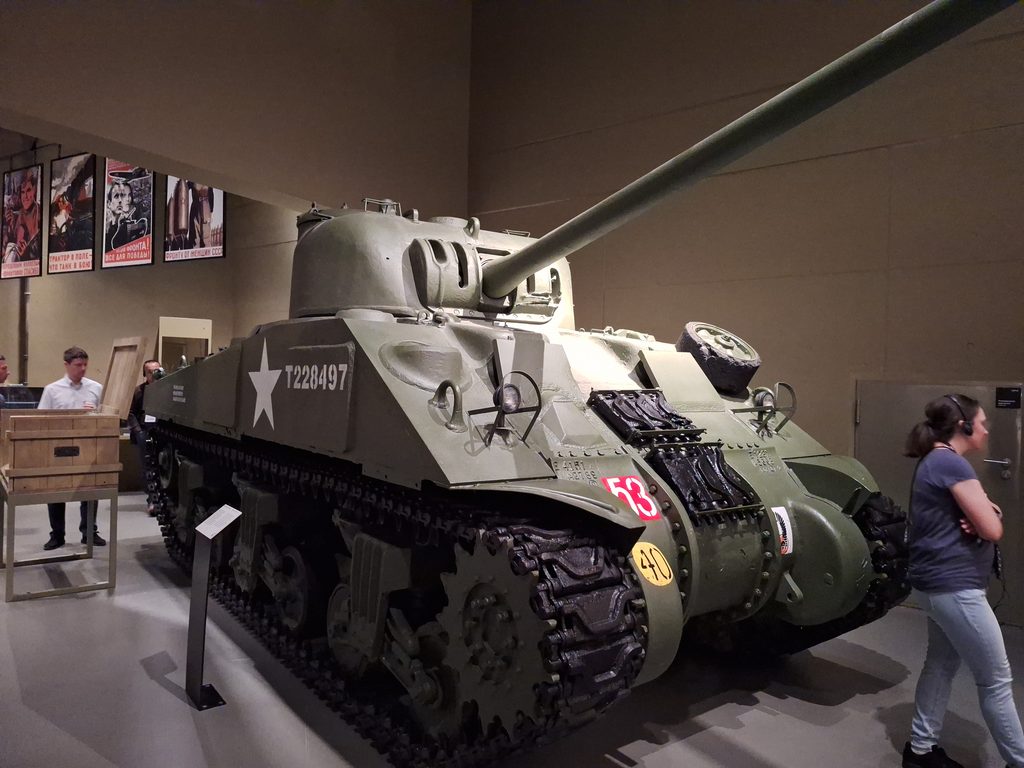
They revealed not only the military history of the war but also the suffering experienced by civilians.
I noticed school groups visiting the museum, learning about events that shaped their country and the wider world.
Seeing younger generations engaging with this history gave me hope that the lessons of the past would not be forgotten.
Solidarity — The Movement That Helped Change Europe
Gdańsk’s importance didn’t end with the Second World War.
Decades later, the city’s shipyards became the birthplace of another movement that helped change the course of European history.
In 1980, workers at the Lenin Shipyard began organising strikes and demanding greater rights.
One of their most prominent leaders was an electrician named Lech Wałęsa.
The Solidarity movement grew from a labour struggle into a powerful challenge to Poland’s communist government.
Despite repression and enormous political pressure, the movement survived.
By 1989, negotiations and elections were helping bring an end to communist rule in Poland.
Wałęsa later became President of Poland.
Walking through a city associated with such momentous events made me appreciate how much influence ordinary workers can have when they organise and refuse to give up.
The Gdańsk Crane — A Medieval Engineering Wonder
One of the city’s most distinctive waterfront landmarks is the enormous historic Crane.
Dating from the fifteenth century, it combined the functions of a water gate and a powerful hoisting machine.
In its day, it was among Europe’s most impressive port cranes.
Its huge wooden mechanisms were used to lift cargo and assist with ships’ masts.
The structure was badly damaged during the Second World War but was reconstructed afterwards.
Today, it remains a symbol of Gdańsk’s maritime history.
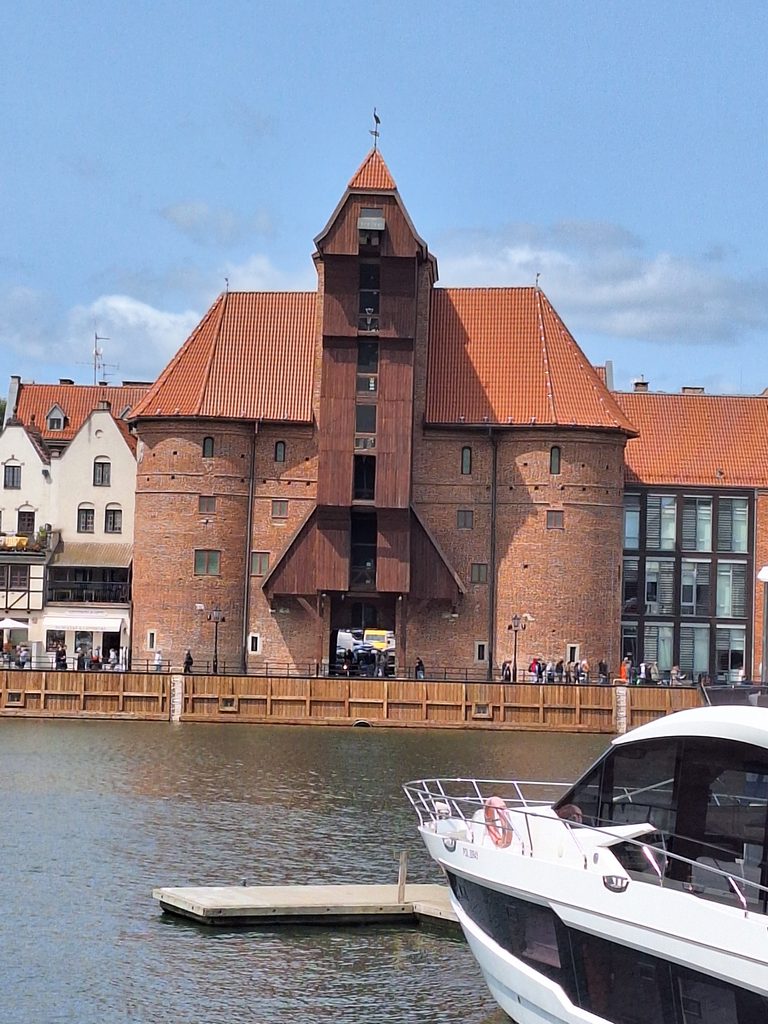
Standing beside it, I could imagine the bustling medieval harbour, with merchants, sailors and dockworkers loading ships bound for ports across Europe.
Malbork Castle — A Monument to the Teutonic Knights
Another remarkable historic attraction in northern Poland is Malbork Castle.
Built by the Teutonic Knights, this enormous brick fortress is among the largest castle complexes in the world.
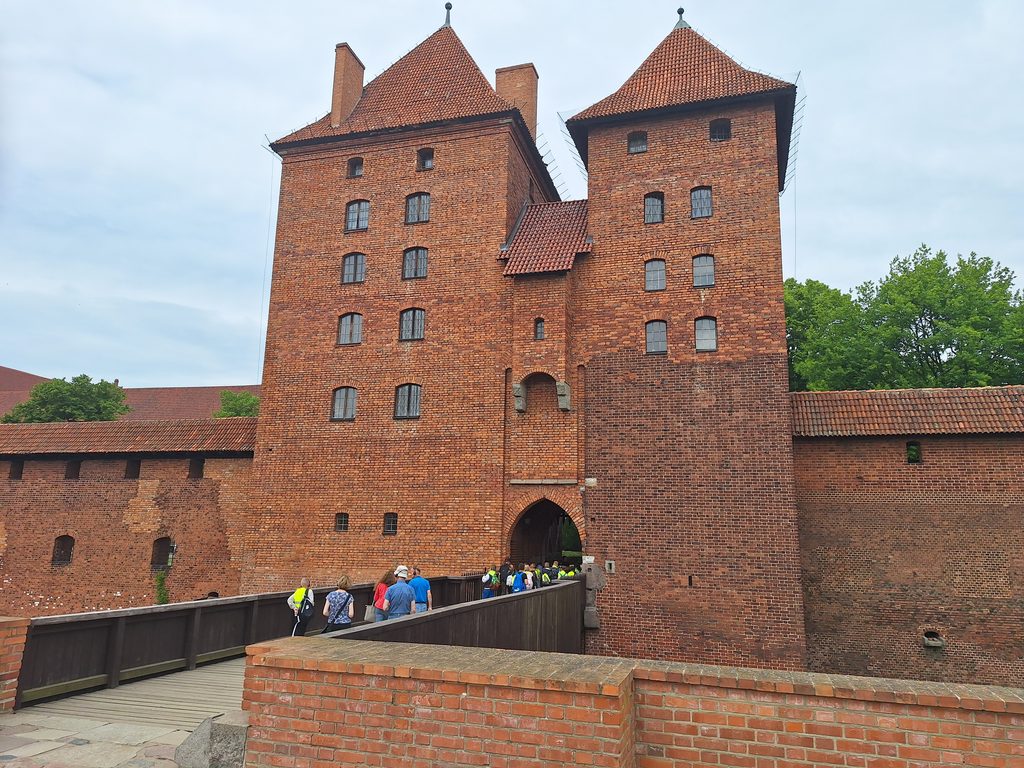
Its vast walls, courtyards, towers and defensive structures reflect the enormous power once exercised by the Teutonic Order.
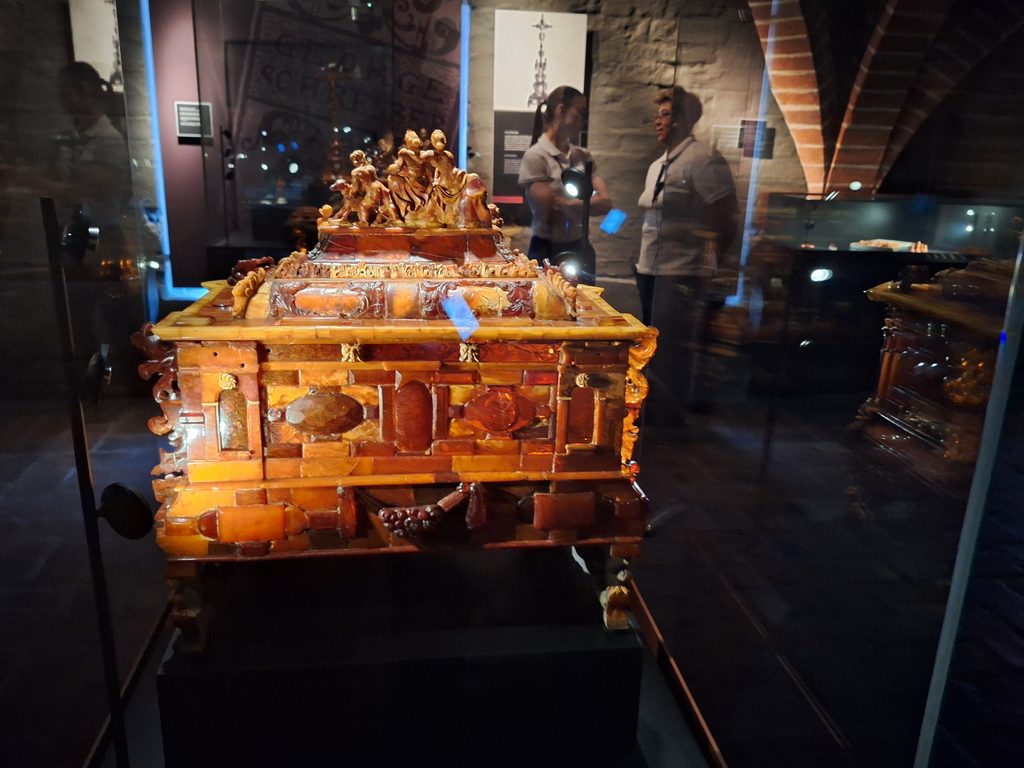
The castle has endured centuries of conflict and suffered severe damage during the Second World War.
Extensive restoration has helped preserve this extraordinary UNESCO World Heritage Site.
It is a place that deserves time, because its scale is difficult to appreciate from photographs alone.
St. Mary’s Basilica — The Crown of Gdańsk
Another great landmark is St. Mary’s Basilica.
This vast Gothic brick church dominates the historic city.
Its construction took place over many generations, and it became one of Europe’s most impressive religious buildings.
Like so much of Gdańsk, the church suffered severe damage during the Second World War.
Its restoration has been a painstaking undertaking.
Standing inside, I was struck by the scale of the building and the extraordinary amount of work that had gone into its construction.
The Astronomical Clock
Inside St. Mary’s Basilica is an extraordinary fifteenth-century astronomical clock created by Hans Düringer.
This magnificent mechanism combines timekeeping with religious imagery and astronomical information.
Its intricate decorative features and moving figures make it an extraordinary work of medieval craftsmanship.
I was fortunate enough to have a good view of the clock and its display.
It is remarkable to consider the mathematical and mechanical knowledge required to construct something so sophisticated hundreds of years ago.

Daniel Fahrenheit and Granary Island
Gdańsk is also connected with Daniel Gabriel Fahrenheit, the scientist associated with the Fahrenheit temperature scale.
A monument in the city commemorates his contribution to science.
Then there is Granary Island, once one of the great centres of Gdańsk’s commercial prosperity.
Hundreds of granaries stored vast quantities of grain destined for European markets.
The area suffered enormous destruction during the war.
Today, it has been transformed into a lively district with reconstructed and contemporary buildings, restaurants and places for visitors to explore.
The contrast between old and new is fascinating.
St. Dominic’s Fair — A City Full of Life
During my extended stay, I had an opportunity to experience Gdańsk during St. Dominic’s Fair.
This enormous annual event has roots stretching back to the thirteenth century.
The streets were packed with market stalls selling everything from crafts, jewellery and antiques to books, clothing and food.
I remember walking along one street where the stall numbers had reached the 900s.
And still they continued!
There seemed to be something happening everywhere.
Music, food, crowds and colourful displays filled the historic streets.
It was wonderful to see Gdańsk so full of life.
Of course, the festival also meant that accommodation became more expensive and harder to find.
For a traveller on a budget, that is something worth remembering.
A City That Became More Than a Stopover
I had never intended to spend so long in Gdańsk.
The laptop repairs, dental problems and other delays were frustrating, and at times I felt that my journey had been put on hold.
But I had also discovered a remarkable city.
I had learned about its history, enjoyed its beautiful architecture, visited important museums and met wonderful people.
I had been given something I rarely allowed myself during my travels: time.
Time to explore slowly, return to places I enjoyed and develop a deeper understanding of a city.
Gdańsk had become far more than another destination on my map.
It had become an important chapter in my journey.
Days 259–280 — Wrocław: A Change of Scenery
Weather: Warm summer days, approximately 26–28°C
Finally Leaving Gdańsk — For a While
After spending so many weeks in Gdańsk, I was ready for a change of scenery.
Several people had told me that Wrocław was one of Poland’s most beautiful cities.
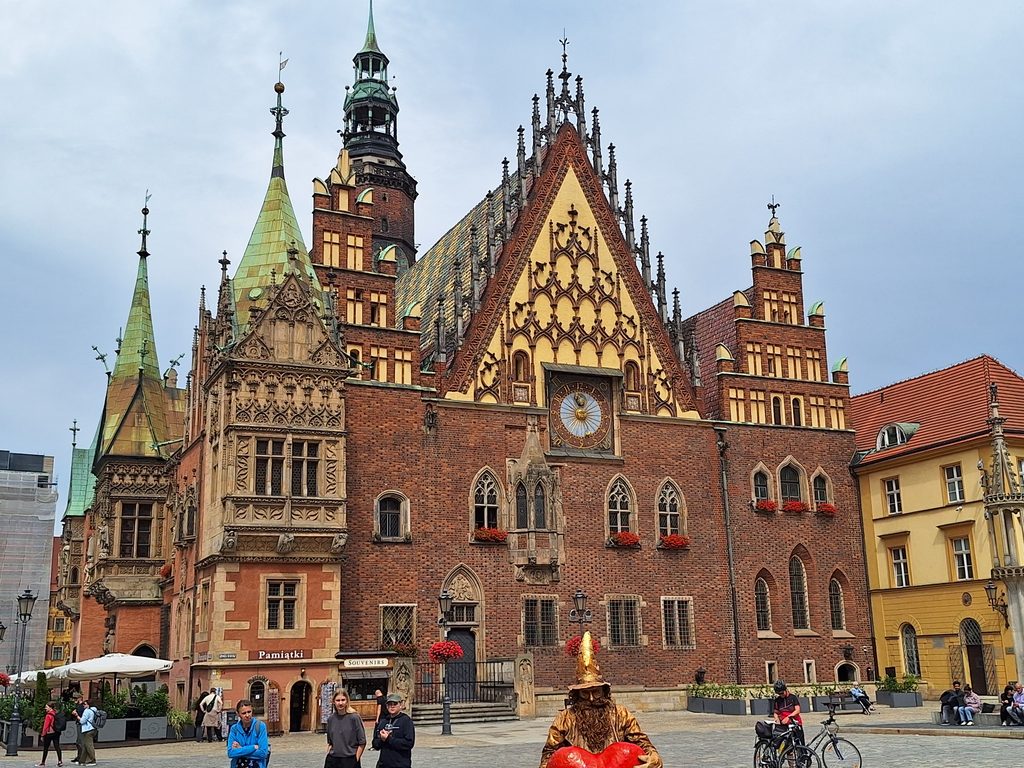
That was enough to convince me it deserved a visit.
I booked an early train departing at approximately 6:10 am.
The journey south took a little over five hours, passing through attractive Polish countryside.
At approximately 11:15 am, I arrived in Wrocław.
Another new city to explore!
A Hostel Near the Railway Station
Finding the hostel was surprisingly easy.
With Google Maps already set up, I left the railway station, turned left, crossed at the traffic lights and discovered my accommodation less than 200 metres away.
That was a pleasant change from some of my previous hostel-hunting adventures.
Unfortunately, it was too early to check in.
I found a nearby place to eat and waited until my room was available.
Later, carrying my backpack up several flights of stairs reminded me that not all hostels are particularly friendly towards senior travellers.
The first dormitory was a quiet six-bed room at the rear of the building.
That was lovely.
However, during a later stay, I found myself in a ten-bed dormitory facing the main road.
With summer temperatures reaching 26–28°C and no air conditioning or fans, the windows had to remain open.
Unfortunately, the traffic noise made sleeping difficult.
Another reminder that a cheap bed is not always good value if you cannot get a decent night’s sleep.
Centennial Hall — Impressive but Closed
One of my first intended destinations was Centennial Hall.
Built between 1911 and 1913, this extraordinary reinforced-concrete structure is recognised as a UNESCO World Heritage Site.
Its enormous dome was an extraordinary engineering achievement for its time.

Unfortunately, when I arrived, the building was closed.
That was disappointing.
However, the surrounding exhibition grounds were worth exploring.
The area included gardens, fountains and attractive open spaces.
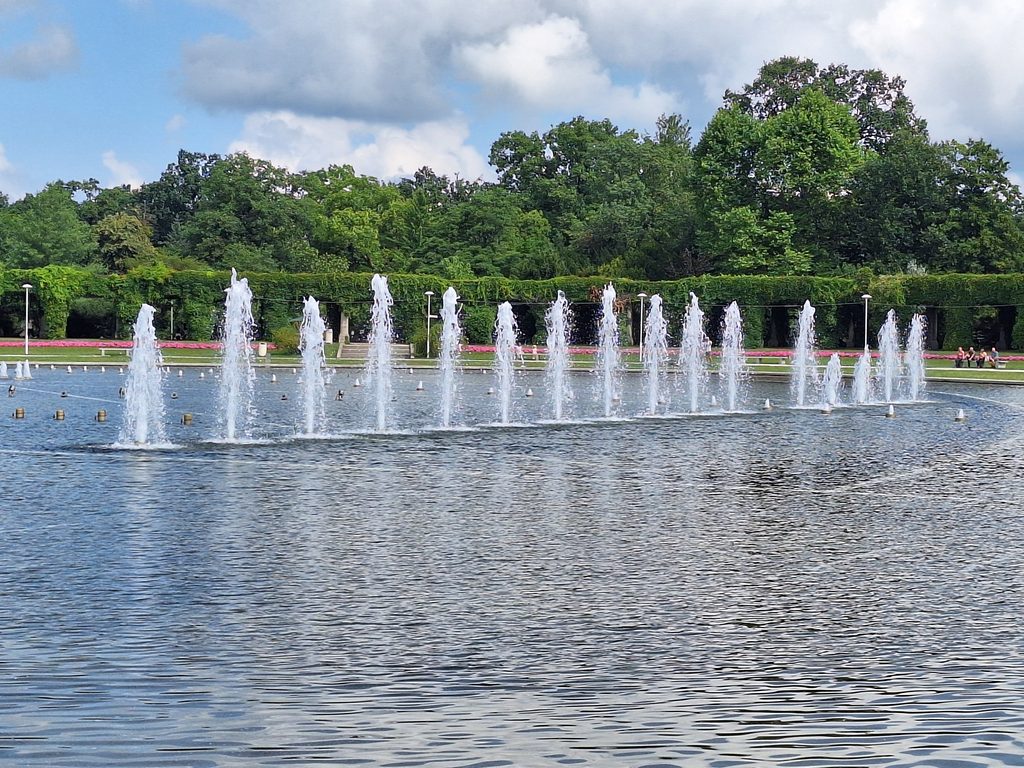
I considered returning another day, but as often happens during long journeys, other experiences took priority.
Catching the Wrong Tram
Later, I decided to use the city’s tram network.
I boarded what I believed was the correct tram.
Unfortunately, it wasn’t!
Before long, I realised I was travelling in the wrong direction.
My tourist map wasn’t much help because it lacked the street names I needed.
For a while, I felt that familiar unease of being lost in an unfamiliar city.
Thankfully, a helpful woman at a Żabka convenience store pointed me in the right direction.
I soon found my way back towards the historic centre.
Getting lost is sometimes frustrating, but it can also introduce you to people and places you would otherwise never encounter.
Ostrów Tumski — Cathedral Island
One of the most beautiful parts of Wrocław is Ostrów Tumski, commonly known as Cathedral Island.
This historic area is among the oldest parts of the city.
Crossing Tumski Bridge, I entered a district of cobbled streets, magnificent churches and historic buildings.
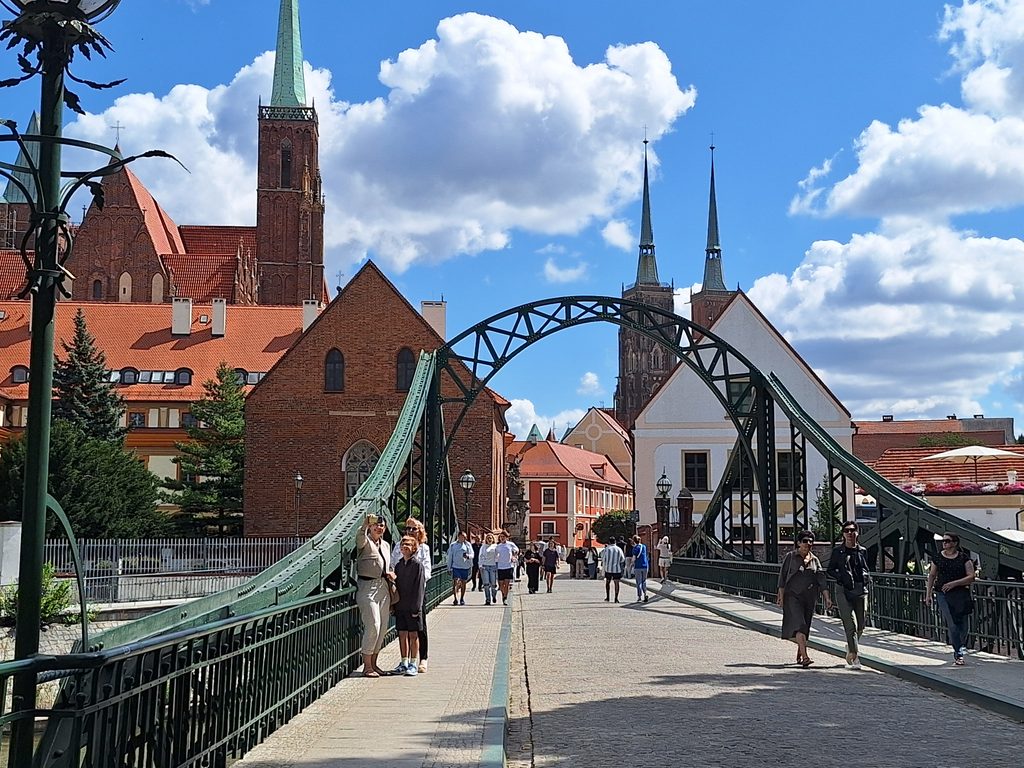
The atmosphere is especially attractive in the evening.
Traditional gas lamps are still used in the area, and a lamplighter lights them by hand.
It is a wonderful reminder of an earlier age.
The Cathedral of St. John the Baptist dominates the skyline with its twin towers.
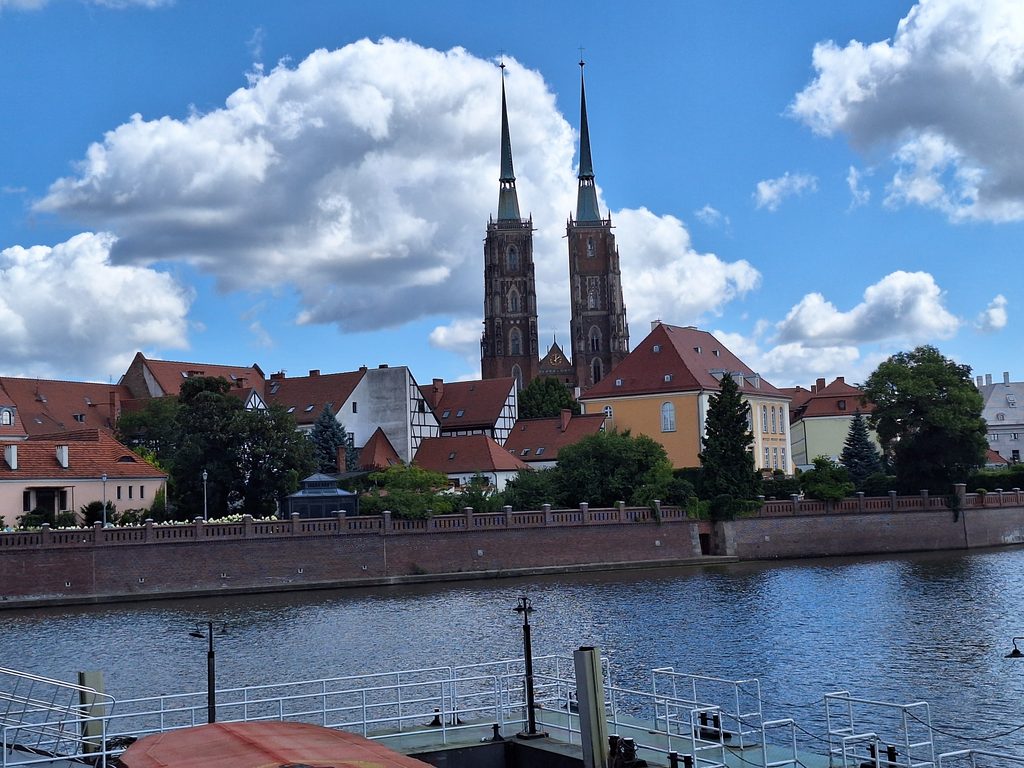
Nearby are other impressive religious buildings, including the Church of the Holy Cross and the Archbishop’s Palace.
Walking through this beautiful historic district was one of the highlights of Wrocław.
Wrocław Cathedral — A Survivor of Fire and War
The Cathedral of St. John the Baptist has an extraordinary history.
Several churches have occupied the site over the centuries.
Earlier buildings were damaged or destroyed by fires, and the cathedral suffered enormous destruction during the Second World War.
Approximately 70 per cent of the building was damaged during the conflict.
Its subsequent reconstruction restored much of the magnificent Gothic appearance visitors admire today.
Standing inside, I was struck by the resilience represented by such buildings.
They are monuments not only to religion but also to the determination of communities to rebuild after disaster.
A Moment of Prayer with a Stranger
Leaving the cathedral, I was approached by a man with a physical disability who asked me for money.
I had no cash.
These days, I use my Wise card for many purchases to avoid unnecessary bank and ATM fees.
I explained that I couldn’t give him money, but I offered to pray with him.
He accepted.
I placed my arm gently around his shoulders, and we shared a moment of prayer.
It was a brief encounter, but one that stayed with me.
Sometimes the most meaningful moments in travel don’t happen inside famous buildings.
They happen when two strangers connect, even if only for a few minutes.
The Wonderful Dwarves of Wrocław
One of Wrocław’s most unusual attractions is its collection of little bronze dwarves.
These small figures are scattered throughout the city.
Some sit on benches.
Others carry luggage, work with tools or appear in amusing situations beside shops and public buildings.
The tradition is connected to the Orange Alternative, an anti-communist protest movement that used humour and dwarf imagery as symbols of resistance.
Over time, the dwarves became a much-loved part of the city’s identity.
There are now hundreds of them.
I enjoyed spotting them as I wandered through the streets.
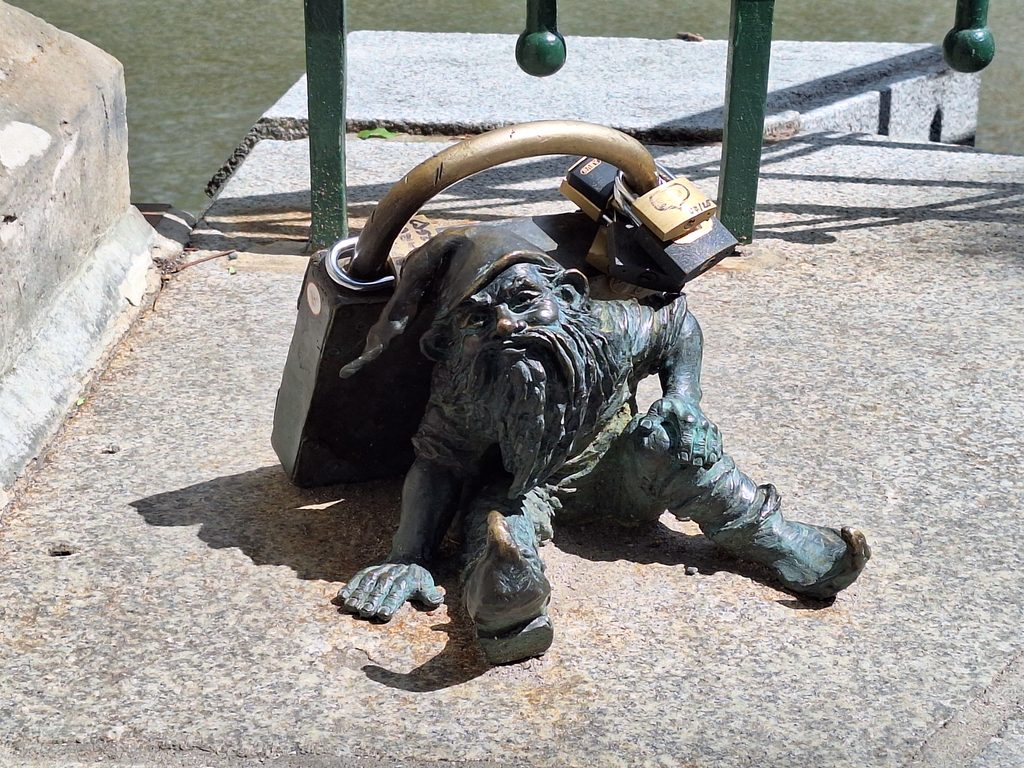
Families often turn the search into a treasure hunt, following maps to discover as many as possible.
It is a charming way to explore a city.
Three Weeks in Wrocław
What I had expected to be a relatively short stay became approximately three weeks.
Once again, my laptop problems influenced my plans.
I was still trying to arrange its return and bring my travelling life back to something resembling normality.
Eventually, collecting the repaired computer required an extraordinary journey.
I had to travel back to Gdańsk and return to Wrocław, a round trip of approximately 1,000 kilometres in a single day.
It was exhausting.
But at least I was getting closer to resolving the problem that had disrupted so much of my journey.
Reflections on Wrocław
Wrocław wasn’t always easy.
There were uncomfortable hostel rooms, wrong trams, closed attractions and continuing frustrations with my computer.
But there was also extraordinary architecture, a beautiful historic cathedral district, helpful strangers and those delightful little dwarves.
I was beginning to realise that my extended stay in Poland was providing a very different experience from the rapid movement between countries that had characterised much of my journey.
For once, I was getting to know places in greater depth.
And that wasn’t necessarily a bad thing.
Poland — The Final Days
Wrocław — Battles, Beer and Booking Ahead
Planning My Departure for Lithuania
With the laptop situation finally moving towards a resolution, I began preparing for the next country.
Lithuania was my next destination.
I made my way to Wrocław’s railway station to investigate onward travel arrangements.
The night-train itinerary I was considering involved departing at 11:56 pm on Monday and reaching Vilnius at approximately 5:26 pm the following day.
That left me with more time to explore Wrocław.
One attraction I particularly wanted to visit was the Racławice Panorama, a remarkable historical painting depicting an important battle in Polish history.
I had heard about the painting and was determined not to leave the city without seeing it.
A Busy Day at the Panorama
I arrived at the Panorama building at approximately 12:15 pm.
Unfortunately, the next available admission wasn’t until two o’clock.
The building was extremely busy, with crowds of people waiting for their allocated entry times.
Rather than spend hours in a queue, I decided to organise a ticket for another day.
With that sorted, I turned my attention to something equally important.
Lunch!
A Wonderful Meal at Targowa Bar
Down near the river, I discovered Targowa Bar.
It became one of my favourite places to eat and enjoy a beer during my stay in Wrocław.

On this occasion, I ordered beef cheeks braised in beer, accompanied by new potatoes and red cabbage slaw.
The meat was beautifully tender and full of flavour.
At 66 złoty, approximately NZ$31 at the exchange rate I recorded, it was an excellent meal.
I really should have taken a photograph before starting.
Unfortunately, I was far too hungry!
Sometimes the best meals disappear before the camera has a chance.
Day 283 — The Racławice Panorama: Standing Inside History
One of the World’s Great Panoramic Paintings
One of the highlights of my visit to Wrocław was the extraordinary Racławice Panorama.
At the time of my visit, senior admission cost 37 złoty, approximately NZ$17.34 or €8.68.
The painting is housed inside a purpose-built circular building.
Measuring approximately 15 metres high and 114 metres around, it is an enormous work of art.
The painting depicts the Battle of Racławice, fought on 4 April 1794 during the Kościuszko Uprising against Russian forces.
Its creators wanted visitors to experience the battle almost as though they were standing in the middle of it.
And that is exactly what happens.
Stepping into the Battle
Entering the exhibition is an extraordinary experience.
Rather than looking at a conventional painting hanging on a wall, you stand in the centre of an enormous circular scene.
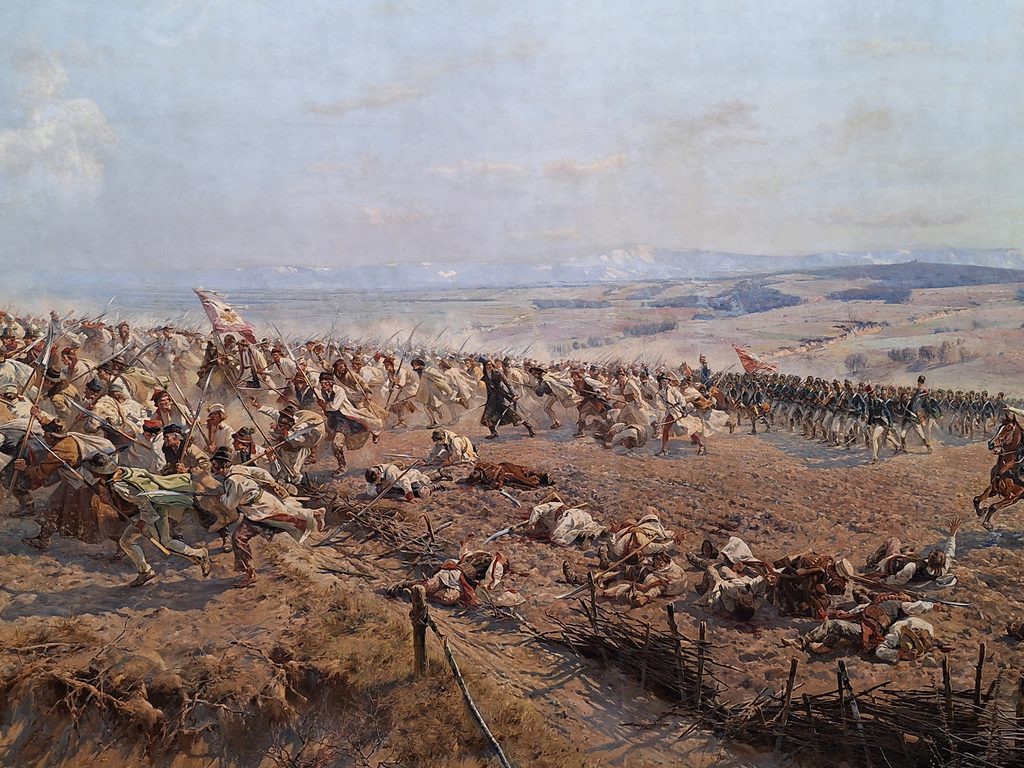
The landscape seems to stretch away in every direction.
Soldiers advance across the countryside.
Cannons appear through clouds of smoke.
Peasant fighters armed with scythes confront Russian troops.

The use of perspective, lighting and real objects in front of the canvas creates an astonishing illusion of depth.

For a moment, it feels as though you have stepped back into 1794.
Tadeusz Kościuszko and the Polish Struggle
The battle was led by Tadeusz Kościuszko, one of Poland’s great national heroes.
He had previously fought in the American War of Independence before returning to lead an uprising against foreign domination of Poland.
At Racławice, Polish forces achieved an important victory against Russian troops.
Although the uprising ultimately failed, the battle became a powerful symbol of Polish resistance and national pride.
The painting captures that spirit.
I found myself studying the faces, uniforms, weapons and extraordinary detail of the scene.
It was impossible not to admire the skill of the artists.
The Polish Fighters and the Battle of Britain
An interesting connection with more recent history is the continuing importance of Kościuszko’s name.
During the Second World War, the famous Polish 303 Squadron of the Royal Air Force carried his name.
Its pilots played an important role in the Battle of Britain.
Their courage became another chapter in Poland’s long struggle for freedom.
It was fascinating to think about how one historical figure could inspire generations separated by more than a century.
Trying to Capture the Experience
The exhibition was crowded, making filming difficult.
However, I managed to take more than 40 photographs.
I hoped that together they would convey some impression of standing inside the immense painting.
But photographs can never completely reproduce the experience.
The scale, atmosphere and sense of being surrounded by the battle are extraordinary.
I had almost skipped this attraction.
I’m very glad I didn’t.
Reflections on the Panorama
The Racławice Panorama is one of the most unusual historical attractions I have encountered.
It combines art, history and storytelling in a way that few museums can match.
Standing there, surrounded by the events of 1794, I felt a deeper appreciation of Poland’s turbulent history.
For anyone visiting Wrocław, I would strongly recommend considering a visit.
It was worth every złoty.
Days 283–285 — Farewell to Poland After Three Months
Looking Back on an Unexpected Journey
When I first arrived in Poland, I certainly didn’t expect to spend approximately three months here.
My original intention had been to explore a few cities before continuing north towards the Baltic countries.
Instead, laptop repairs, a damaged tooth and insurance difficulties repeatedly delayed my departure.
At times, I was extremely frustrated.
There were days when I wondered whether I would ever get moving again.
Yet looking back, Poland had given me a remarkable collection of experiences.
The extraordinary Wieliczka Salt Mine near Kraków.
The busy streets and unusual hostel experiences in Warsaw.
The historic gates, museums, shipyards and friendships of Gdańsk.
And the beautiful buildings, cathedral district and unforgettable Panorama in Wrocław.
It wasn’t the journey I had planned.
But it was still an adventure.
Cold Winds and Another Difficult Hostel Night
My final weekend in Wrocław brought another change in the weather.
After weeks of warm summer conditions, a cold wind swept through the city.
The temperature dropped to approximately 16°C.
For the first time in quite a while, I reached for my jacket.
The previous night hadn’t been particularly restful.
Several guests in the dormitory were noisy, making it difficult to sleep.
By approximately 6:30 am, I gave up trying and got out of bed.
I had managed only around five hours of sleep.
One of the downsides of staying in shared accommodation is that not everyone appreciates the importance of allowing others to rest.
Still, I wasn’t going to spend my final days in Poland sitting indoors.
A Walk Along the Oder River
I headed out into the cool morning air.
After spending some time at a museum, I continued towards the River Oder.
The riverside was alive with activity.
Food stalls filled the air with wonderful aromas.
There were dishes from different parts of the world, reflecting the increasingly international food culture of Polish cities.
I stopped for a generous meal of curry, rice, vegetables and different meat dishes.
At less than €10, it was excellent value.
Afterwards, I made my way back towards Targowa Bar, which had become a familiar and enjoyable place to spend some time.
Wrocław’s Historic Market Hall
The restaurant was connected with the area around Wrocław’s historic Market Hall.
The hall, built in the early twentieth century, is an impressive example of the city’s commercial architecture.
It recalls the period when Wrocław was known as Breslau and formed part of Germany.
Inside, the market atmosphere reflects the city’s continuing importance as a place of trade and everyday community life.
After a couple of beers, I returned to the hostel.
Thankfully, the noisy guests had moved on.
A peaceful night’s sleep was finally looking possible.
The Four Domes Pavilion and the Fountains
Another outing took me towards the Four Domes Pavilion and the exhibition grounds near Centennial Hall.
The pavilion was designed by architect Hans Poelzig and completed in the early twentieth century.
Today, it forms part of Wrocław’s important cultural attractions.
Nearby, I spent time watching the musical fountains.
The water rose and fell in carefully choreographed patterns, creating an entertaining display.
It was a pleasant way to spend part of the day, particularly after the frustrations and uncertainty of the previous weeks.
Gastro Miasto — A Wonderful Celebration of Food
One of the most enjoyable experiences of my final days was visiting Gastro Miasto, Wrocław’s popular food festival.
The riverside area was filled with food stalls, restaurants, craft drinks and live entertainment.
There seemed to be something for everyone.
Traditional Polish food sat alongside dishes from Asia and other parts of the world.
Children played while adults enjoyed meals and listened to music.
The atmosphere was relaxed and welcoming.
I eventually settled on a delicious chicken tikka masala.
But everywhere I looked, there was another tempting dish.
I wished I could have tried more!
Food, Community and Memories of Home
The festival reminded me of food events back home in Tauranga.
There is something wonderful about a community gathering where people can relax, enjoy different foods and spend time together.
These events bring people from different backgrounds into the same space.
For a traveller, they are also an opportunity to experience a city’s culture beyond its museums and famous landmarks.
I wandered among the stalls, enjoying the atmosphere and listening to the music.
It was one of those simple experiences that make travelling worthwhile.
My Final Day in Wrocław
Eventually, my last day in Poland arrived.
It was time to organise my belongings, make final arrangements and prepare for the journey north.
I returned once more to Targowa for a craft beer.
It had become a familiar part of my time in Wrocław.
I considered getting a takeaway pizza later in the day, but several places were closed because it was Monday.
So I settled for a kebab instead.
Not quite what I had planned, but perfectly satisfactory.
As I walked through the streets, I reflected on how much Poland had become part of my travelling life.
Places that had once been completely unfamiliar now felt recognisable.
I knew where to find a meal, how to use the transport system and which streets led back to my accommodation.
It felt strange to be leaving.
Three Months That Changed My Journey
There is no doubt that the delays in Poland cost me time.
I had hoped to visit more countries during these months.
Instead, I found myself dealing with repairs, insurance problems and a growing backlog of photographs and diary entries.
My laptop problems also disrupted my ability to share the journey with everyone following Inspire Seniors Travel.
Some diary entries were condensed, and other days were never properly documented.
That is why my written account of Poland doesn’t contain an entry for every day I spent here.
But I continued travelling and discovering.
And along the way, I met people who reminded me why I had started this adventure in the first place.
Poland had given me history, friendship, frustration, good food and plenty of opportunities to reflect.
In some ways, being forced to slow down helped me appreciate the country more deeply.
Looking Towards Lithuania
Now, at last, it was time to move on.
My next destination was Vilnius, the capital of Lithuania.
I felt the familiar combination of excitement and uncertainty that always accompanies departure.
Would the next journey go smoothly?
Would I find my hostel easily?
What wonderful people might I meet?
And, perhaps most importantly, would my laptop continue working?
After three months in Poland, I felt almost as though my journey was beginning again.
There were still many countries ahead of me and countless experiences waiting to be discovered.
Thank You for Following My Journey
Before leaving Poland, I want to thank everyone who has continued following my travels despite the long interruptions in my blog.
Your interest and encouragement mean a great deal to me.
This journey has never been simply about visiting countries and collecting capital cities.
It is about stepping beyond fear, discovering the unknown, learning about the world and showing that life can still be an adventure as we grow older.
Poland challenged my patience, but it also rewarded me in ways I had never anticipated.
Now it was time to close this chapter and begin another.
Up, up and away — Lithuania, here I come!
Andrew
Inspire Seniors Travel